Almost everyone who starts in photography relies entirely on ambient light. It’s intuitive — the light is already there, you just work with it. But as you develop your eye and start pursuing specific looks, you run into a wall: the light you want isn’t always the light that’s available. Off-camera flash bridges that gap, but only if you understand the principles behind it.
The biggest misconception in flash photography is that flash looks artificial by default. It doesn’t. Done correctly, flash is indistinguishable from natural light — because the underlying physics are identical. Light is light. What makes it look natural or artificial is how it’s modified, positioned, and balanced with the ambient scene. This guide covers that balancing act in detail, with three specific applications: balancing flash with existing natural light outdoors, simulating window light with a strobe, and recreating golden hour after the sun goes down.
This article is part of our Photography Lighting guide.
→ See the complete Photography Lighting guide
Understanding light: the most important concept in this guide
Before getting into technique, one principle needs to be established clearly: natural light is not a quality of light. It’s a source. The sun produces every quality of light depending on conditions — harsh midday sun is a small, hard source. An overcast sky is a massive soft source. Golden hour is a directional, warm, low-angle source. Window light is a large, soft, directional source. None of these qualities are exclusive to sunlight.
A strobe with a large softbox placed close to a subject produces soft light — the same soft light that an overcast sky produces, for the same physical reason: the light source is large relative to the subject. A strobe placed far away with no modifier produces hard, directional light — the same quality as direct sun. The source doesn’t determine the quality. The size, distance, position, and color of the light does.
This means that if you want to imitate any natural light look, you don’t need to find that specific lighting condition. You need to analyze its qualities — direction, size relative to subject, color temperature, intensity — and replicate those qualities with whatever tools you have. Once you internalize that, the gap between “natural light” and “flash” disappears.

Watch this demonstration from our Lighting 201 course showing exactly how strobe positioning and modification creates light that reads as completely natural:
Balancing flash with natural light outdoors
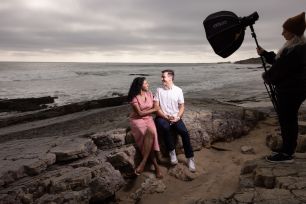
The most common first step into off-camera flash is using it as a fill or complement to existing natural light. This is also where most photographers go wrong — they add too much flash power and the result looks lit rather than natural.
The approach that works: dial in your ambient exposure first, then add flash as a secondary element rather than a primary one.
Step 1: Build your ambient exposure
Before touching the flash, set your camera settings using only the natural light. This becomes the foundation that the flash supplements. The key principle: for natural looking results, keep the ambient exposure relatively bright and the flash power relatively low. The more you reverse that ratio — dark ambient, high flash power — the more dramatic and obviously lit the result becomes.
Note that most cameras have a maximum flash sync speed of 1/250 sec. If you need a faster shutter speed to control bright ambient light, you’ll either need a flash that supports High Speed Sync, or you can use an ND filter over the lens to bring the shutter speed back into sync range without changing your aperture or ISO.
Step 2: Match the quality of the ambient light
If the natural light in your scene is soft — open shade, overcast sky, bounced light — your flash needs to produce soft light too. A bare flash in a soft-light scene produces specular highlights and hard shadow edges that immediately signal artificial light, even if the exposure is correct. Add a modifier — softbox, MagSphere, scrim, or bounce surface — to match the quality of the ambient.
The same applies in reverse. If the ambient light is hard and directional, a heavily modified flash that produces soft fill can look inconsistent. Match the character of the existing light with the character of your flash output.
Step 3: Start low and work up
Begin with your flash power lower than you think you need. The goal is for the flash to be present without being identifiable — viewers should see the subject well lit, not see the flash. Add power incrementally until the subject is cleanly exposed without the flash becoming visible as a distinct light source. Position the flash at approximately 45 degrees off-camera, slightly above eye level, which matches the most natural overhead light direction.
Here’s the full demonstration of this technique in action:
The comparison between ambient-only and ambient-plus-flash at the correct ratio shows what this looks like in practice. At the right balance, the flash-assisted image reads as better natural light, not as a lit image.
Simulating window light with off-camera flash
Window light is one of the most sought-after lighting qualities in portrait photography — large, soft, directional, and with a gradual shadow transition that’s extremely flattering. The good news is that it’s also one of the most straightforward qualities to replicate with flash, because the physics are simple: window light is a large, soft, directional source at 90 degrees to the subject.
Method 1: Diffusion cloth — recreating window light anywhere
The cheapest and most flexible way to simulate window light is with a large piece of pure white fabric stretched between stands. The fabric diffuses and spreads the flash output, creating a large effective light source that produces the soft, even quality of window light. Pure white is essential — any color mix in the fabric shifts the color temperature of the light.
Step 1: Position the light source correctly. Window light is directional — it hits the subject from one side at roughly 90 degrees. Place your flash at 90 degrees to the subject to replicate this. Adjust the subject’s position relative to the light to find the shadow balance you want, exactly as you would position a subject relative to an actual window.


Step 2: Add diffusion. A bare flash — even through a softbox — produces specular highlights on skin that don’t read as window light. The transition from lit to shadow is too sharp, the highlights too bright and defined. Running the light through a diffusion cloth softens those highlights and spreads the light in a way that closely mimics the quality of light coming through a large window.

Step 3: Adjust distance to control softness. The closer the diffusion cloth is to the subject, the larger the effective light source is relative to the subject, and the softer the light becomes. Move the cloth closer for a softer, more open look. Pull it back for slightly more defined shadows. A second layer of diffusion cloth can be added for an even softer quality — particularly useful when you want to completely open up the shadow side of the face.


Flag the light if needed to prevent spill on the background — a flag or black panel placed between the flash and the background channels the light toward the subject and cloth rather than spreading across the entire scene.
Here are the final portraits from this setup:


Method 2: Flash through an actual window
When a window is present but the natural light through it isn’t sufficient — wrong time of day, wrong direction, cloudy and too flat — you can push a flash through the window from outside to recreate the directional quality of window light with full control over intensity and color.
Step 1: Compose the shot. Position the subject relative to the window the same way you would for natural window light — far enough from the window to get directional light, at the distance and angle that produces the shadow pattern you want on the face.

Step 2: Dial in ambient exposure. Set your ambient exposure first, leaning toward the darker side of the histogram since you’ll be adding flash. At a wide aperture like f/1.2, a fast shutter speed is needed to control the ambient — which can push above flash sync speed. An ND filter over the lens brings the shutter speed back into sync range without changing aperture or ISO, eliminating the need for High Speed Sync.


Step 3: Place and modify the flash. Mount the flash on a stand and position it outside the window, pointed through the glass at the subject. A zoom dish or grid concentrates the light through the window and minimizes spill. A CTO gel warms the flash output to match the color temperature of typical interior window light — without it, the flash can read as cool and obviously artificial against warm interior ambient.

Step 4: Pose for the light pattern. Hard window light — which this technique produces — requires posing that takes advantage of the shadow pattern. Rembrandt lighting, loop lighting, and split lighting all work well here. Micro-adjustments to the subject’s head angle and shoulder position change the shadow pattern significantly with hard light, so take time to refine the pose rather than simply capturing the first position.

Recreating golden hour with flash
Golden hour has three defining qualities: warm color temperature, low directional angle, and relatively hard light (because the sun, even at the horizon, is still a distant small source). All three can be replicated with strobe.
The video above shows the full process of recreating golden hour lighting using off-camera flash — including the color gelling, positioning, and power settings that make the result convincing. The key variables to dial in:
Color: Add a CTO gel to the flash. A full CTO shifts the flash output to approximately 3200K — a strong warm tone that reads as late-afternoon sun. Half or quarter CTO gels give you a subtler warmth if the full shift is too heavy for the scene.
Direction: Position the flash low and to the side — mimicking the sun’s angle near the horizon. If the flash is at standing height or above, the angle immediately reads as artificial because golden hour sun comes in from below most subjects’ eye level.
Power and ambient balance: As with any natural light simulation, the ambient exposure should be bright enough to feel like a golden hour scene — warm sky tones, rich background exposure. The flash adds the directional rim or key light from the “sun” position without overpowering the ambient. Keep the flash-to-ambient ratio close; dramatic underexposure with a high-powered flash produces a studio look, not a golden hour look.

For more on lighting patterns and how to position light for different portrait effects, see our complete Photography Lighting hub. Our Photography 101 Workshop covers the full progression from camera fundamentals through flash, and the dedicated lighting courses — Lighting 101 and Lighting 201 — go deep on everything covered in this article with full shoot-to-edit walkthroughs.
Frequently asked questions about flash and natural light
Can flash ever truly look like natural light?
Yes — consistently, when the flash is matched to the qualities of the ambient light in the scene. Color temperature, direction, size relative to the subject, and intensity relative to the ambient all need to align. When they do, viewers have no way to identify the flash because the light follows the same physical rules as the natural light already present. The flash doesn’t look natural because it’s hidden — it looks natural because it’s physically producing the same qualities as the light it’s supplementing or replacing.
What modifier should I use to simulate window light?
A large softbox, octa, or diffusion cloth produces the soft, even quality that window light is known for. The larger the modifier relative to the subject, the softer the result. For the most convincing window light simulation, a diffusion cloth stretched across a large frame — effectively a giant scrim — produces the most even and natural-looking output because it spreads the light across a larger physical area than most commercial softboxes. The Magbox with a focus diffuser is a practical portable option that produces quality close to this.
Do I need High Speed Sync for outdoor flash work?
Only if your shutter speed needs to exceed your camera’s sync speed — typically 1/200 or 1/250 sec. In many outdoor situations at moderate apertures, you can stay within sync speed without issue. When shooting wide open (f/1.2, f/1.4, f/1.8) in bright outdoor conditions, your shutter speed will naturally push above sync speed to control exposure. In that case, either use HSS-capable flash and trigger, or place an ND filter over the lens to reduce the amount of light entering the camera, bringing your shutter speed back into sync range without changing aperture or ISO.
What gel should I use to match golden hour color?
A CTO (Color Temperature Orange) gel is the standard choice for warming flash output to match warm ambient light. A full CTO shifts the flash from roughly 5500K to approximately 3200K — a dramatic warm shift that reads as direct late-afternoon sun. For a subtler warm quality, use a half or quarter CTO. If your ambient is significantly cooler (overcast, blue-hour light), warming the flash with CTO while keeping the ambient cool creates a natural-looking contrast between the lit subject and the cool background — a look that reads as warm light against a cool sky, which is one of the most appealing combinations in portrait photography.
How do I know if my flash is too powerful or too subtle?
Too powerful: the subject looks brighter than the environment in a way that feels inconsistent with the ambient light, shadows have a hardness or direction that doesn’t match the ambient, or the image looks like a lit studio shot rather than an environmental portrait. Too subtle: the flash isn’t doing meaningful work — the image looks the same with or without it. The right balance is when the subject is cleanly exposed and slightly brighter than a pure ambient exposure would produce, but the flash isn’t identifiable as a separate light source. If you can see where the flash is coming from by looking at the catchlights or shadow direction, the flash is probably too powerful or positioned inconsistently with the ambient.