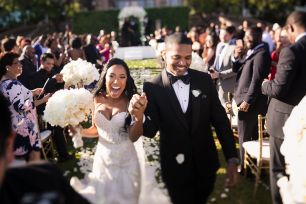
Flash is a powerful tool. But before you reach for it, you should be squeezing every last drop of quality out of the light that’s already there. We’ve shot hundreds of portrait and engagement sessions using nothing but the sun, a reflector, and an understanding of how light behaves — and the results consistently rival setups with full off-camera flash rigs.
This guide covers the core techniques for natural light portrait photography: how to find and shape flattering light, how to work across different times of day, how to use a 5-in-1 reflector to solve real problems in the field, and how to compose your subjects within the light for maximum impact. Whether you’re shooting a couples session at golden hour or a quick portrait under midday sun, these techniques apply.
This article is part of our complete guide to lighting for photographers. For the full framework, visit our Lighting & Flash Photography Guide.
Finding the right light for natural light portraits
Work with open shade first
The fastest way to improve a natural light portrait is to move your subject out of direct midday sun and into open shade. Direct overhead sun creates hard, unpleasant shadows in the eye sockets and under the nose — not flattering on anyone. Open shade, by contrast, wraps light around the face far more evenly.
The best shady spots sit right at the edge of the shade line, close to the boundary between sun and shadow. That proximity means your subject still benefits from reflected and ambient light bouncing in from the sunlit area nearby. In our experience, you’ll often find yourself standing in full sun while your subject is comfortably shaded — that’s the sweet spot.
Once you’ve placed your subject in shade, identify the dominant light direction. Stand in their spot, hold your hand out flat, and rotate until it’s most evenly lit. That’s where the primary light is coming from. Shoot from that direction with the light at your back so it falls cleanly onto your subject’s face.


Refine your shade: find a natural hair light
Not all shade is created equal. Once your subject is in a good spot, look for a secondary light source entering from behind the scene. A gap in the tree canopy, a break in a wall, or even open sky behind your subject can create a natural hair light that separates them from the background.
Frame your subject against a darker background so that hair light pops. Done right, you’ve created what is effectively a three-light portrait setup — key light from the open shade in front, fill from ambient bounce, and a separation light from behind — using zero gear.


Shoot during golden hour
If you have any control over scheduling, book sessions in the two hours after sunrise or the two hours before sunset. The sun sits low enough that it’s no longer directly overhead, and the atmosphere diffuses it just enough to soften the harshness. That combination gives you options: use it as a key light from behind you for even butterfly lighting, or angle your subject to one side to build loop or Rembrandt patterns across their face.
Honestly, this is where direct sunlight actually works in your favor. The warm color, the directional quality, and the natural contrast are genuinely hard to replicate with flash. The one caveat: direct sun exposes every skin texture, so if your subject has flawless skin, this is a great time to use it. If not, diffuse it — more on that below.

Keep shooting after sunset
Golden hour gets most of the attention, but the 20 minutes after the sun drops below the horizon are underrated. The sky is still colorful, the light is gentler and more diffused, and the harsh contrast is gone entirely. That said, it’s dim — you’ll need a camera with solid high-ISO performance and fast glass to pull it off cleanly. Older or smaller-sensor bodies can struggle here, especially if you need to recover shadows in post. Pair a fast prime with a body that handles ISO 3200 or higher without excessive noise, and this window becomes one of the most beautiful in natural light portrait photography.

How to shape and control natural light
Use a scrim to tame hard light
You’re on location, the sun is harsh, and you can’t move your subject into shade. Grab the scrim from your 5-in-1 reflector and position it between the sun and your subject. What was a hard, unflattering light source becomes a large, soft key light. Think of it as a portable cloud.
The key thing to watch: make sure the scrim’s shadow edge doesn’t fall across your subject mid-frame. If you’re shooting full-length and your diffuser only covers the upper body, you’ll see a visible line across the legs that kills the shot. Either go large enough to cover the full subject or commit to a tighter crop.


Find natural reflectors and neutralize color casts
Before you set up any gear, scout your location for existing reflective surfaces. White walls, light-colored pavement, bright building facades — these all act as oversized natural reflectors and can provide enough fill light that you don’t need anything else. This is one of those things that experienced location shooters develop an eye for fast. We’ve shot entire sessions in urban environments using nothing but a white wall as our key light.
One thing to watch: warm-colored walls and surfaces cast a warm color onto your subject’s skin. If the bounce looks too orange or yellow, place the white side of your reflector flat against the wall to neutralize the color before it reaches your subject. That simple fix cleans up the light considerably without any post-processing correction needed.


Use a 5-in-1 reflector as your key light
The 5-in-1 reflector is the single most useful piece of gear for natural light portrait photography. It’s cheap, portable, and gives you a surprising amount of control. Here’s the setup we use constantly at golden hour sessions:
Turn your subject so the sun is behind them, acting as an edge or rim light. Then position the reflector in front of and slightly above them, angling it to bounce that backlight back into their face. The reflector becomes your key light. Hold it above eye level so the light falls downward and creates natural-looking shadows — never below the face, which produces that unflattering “flashlight under the chin” look.
White side gives you softer, more subtle fill. Silver bounces more light and creates more contrast — useful if you want drama or if you’re working far from the subject. The diffusion disk (when you remove the cover entirely) turns the sun into a large soft source directly overhead. That’s the version we reach for most often on outdoor bridal sessions.

Composing and exposing for natural light portraits
Place your subjects in the brightest part of the frame
This is one of those compositional principles that sounds simple but makes a real difference in the final image. Our eyes go to the brightest area of a frame first — so if your subjects are sitting in a mid-toned or shadowed area while a bright patch of sky or open ground draws attention elsewhere, the composition is working against you.
The fix: position your subjects over the brightest available area. Open sky behind them, a patch of light ground, a sun-lit surface. This does two things. First, it naturally draws the viewer’s eye to the subjects. Second, it gives you more editing latitude because the exposure will be working with your composition rather than against it.

Use hard light to shape and define the body
Most photographers default to avoiding harsh directional sun for portraits. That’s understandable — it’s unforgiving. But used deliberately, hard light is a powerful tool for defining form and creating drama. The key is posing.
Position your subjects so the hard directional light creates a recognizable pattern on their faces — Rembrandt, loop, or split. For couples, a stacked or combination open pose works well here. Ask the subject closest to the camera to angle their face slightly toward the light to catch those highlights cleanly. Hand placement, body angle, and the relationship between the two subjects all contribute to how the light reads in the final frame. This is where your posing knowledge and your lighting knowledge work together.

Expose for the highlights, not always the skin
There’s a tendency in portrait photography to treat proper skin exposure as the only correct exposure. It isn’t. Sometimes the most interesting image comes from exposing for the highlights and letting the shadows go dark — using contrast to draw attention to form, silhouette, and shape rather than facial detail.
Try exposing down a stop or two from your metered reading and see what happens. Highlights pop, backgrounds go moody, and the image takes on a different character entirely. This is especially effective in backlit situations where you’re fighting the sun anyway. Don’t fight it — use it.


Natural light portrait setups in action: beach session at golden hour
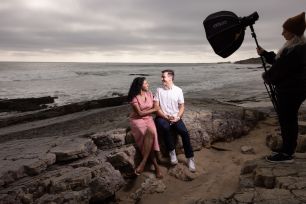
All the techniques above come together in real shoots. Here’s a practical example from a couples session shot at a beach cave opening near golden hour, using a Canon EOS R5 and a Canon RF 15-35mm f/2.8L. Two setups, one location, minimal gear.
Setup 1: Subjects at the cave opening, angled composition
The first setup captures the cave opening at an angle, which creates natural framing and places the subjects in the brighter area of the frame as one leads the other out. Exposing for the sky keeps highlights from blowing while retaining shadow detail throughout. Pro tip: shooting toward the light source, have your subjects turn their faces slightly to the side to catch the highlights on their cheekbones rather than shooting flat into the light.


Setup 2: Subjects directly in front of the sun
For the second setup, position subjects directly between the camera and the sun — but wait until the sun is low enough that it’s not blinding and the quality of light is warm. Get low to the ground to compose them against the brightest part of the sky. Position the camera in the subjects’ shadow so you’re not fighting lens flare, and expose for the sky to retain those warm highlight tones. From that base position, you can move closer or adjust the framing to pull a variety of looks from the same setup.


[Related Reading: How to Light & Shoot a Dramatic Portrait by Yourself]
[Related Reading: 6 Techniques to Create Great Images Anywhere]
[Related Reading: Step-by-Step Guide to Capturing Our Favorite Signature Portrait]
For a complete framework covering natural light portraits from first principles through advanced couple setups, check out our Engagement Photography 101 workshop, included with SLR Lounge Premium. You’ll also find our Flash Photography Training System there for when you’re ready to add artificial light to what you’ve learned here.
Frequently asked questions about natural light portrait photography
What is the best time of day for natural light portraits?
The two hours before sunset and after sunrise — commonly called golden hour — give you the most workable direct sunlight. The sun is low, slightly warm, and creates flattering directional light. That said, open shade at any time of day can produce excellent portraits. Midday sessions are entirely manageable if you know how to find and shape shade.
Do I need a reflector for natural light portrait photography?
Not always, but a 5-in-1 reflector is the highest-value piece of gear you can add to a natural light kit. For under $30 it gives you a scrim, a white fill, a silver fill, a gold fill, and a diffusion disk. In our experience, the scrim and the white reflector panels get the most use on location sessions.
How do I handle natural light portraits in harsh midday sun?
Three options: move your subject into open shade, use a scrim to diffuse the sun directly, or position your subject so the hard light creates a deliberate Rembrandt or loop pattern. Avoiding the light entirely is the easiest solution, but working with it deliberately can produce dramatic, interesting results.
What camera settings should I use for natural light portraits?
In open shade, a starting point of f/2 to f/2.8, 1/200s, ISO 200–400 gets you in the ballpark for most conditions. For backlit golden hour shots, expose for the sky and let the subjects go slightly darker, then use a reflector or adjust in post. Post-sunset shooting typically requires ISO 1600–3200 with a fast prime at f/1.8 or wider.
Can I shoot natural light portraits in full sun without any gear?
Yes, with caveats. Direct sun works best during golden hour when the quality is softer and more directional. At midday, you need either shade or a scrim. Hard direct sun mid-day without any diffusion will expose every skin texture and create deep, unflattering shadows. It’s workable in some creative scenarios — silhouettes, exposing for highlights — but for most portrait work you’ll want to modify it.
How do I fix a color cast from a natural reflector like a warm-colored wall?
Place the white panel of your 5-in-1 reflector flat against the wall surface so it intercepts the warm bounce before it reaches your subject. The white panel neutralizes the color and gives you clean, white-balanced fill instead.