Advertisement

6 Must-Have Lenses for Wedding Photography

Wedding photography is a unique combination of every type of photography. Fashion and portrait photography, architectural photography, product photography, macro photography, family and children photography, and sometimes even travel photography are all included under the required knowledge umbrella of wedding photography.

In order to deliver a complete wedding photography product, you’re going to need lenses that allow you to capture each of these aspects with artistry and creativity. In a perfect world, we’d have the finances and manpower to haul every available lens to the venue; but in reality, we’re limited to a handful of accessible, high-quality, and versatile lenses.

Here is a subjective list of 6 must have lenses for any given wedding. It should be noted that we, the authors of this article, have a bias for shooting wide open (low apertures) in most situations. Also, we list Canon lenses, as the authors of this article shoot with 5D Mark II’s, but each lens listed should have an equivalent for every other brand name DSLR producer.

6 Must-Have Lenses for Wedding Photography

1. 70-200mm f/2.8L Zoom Lens

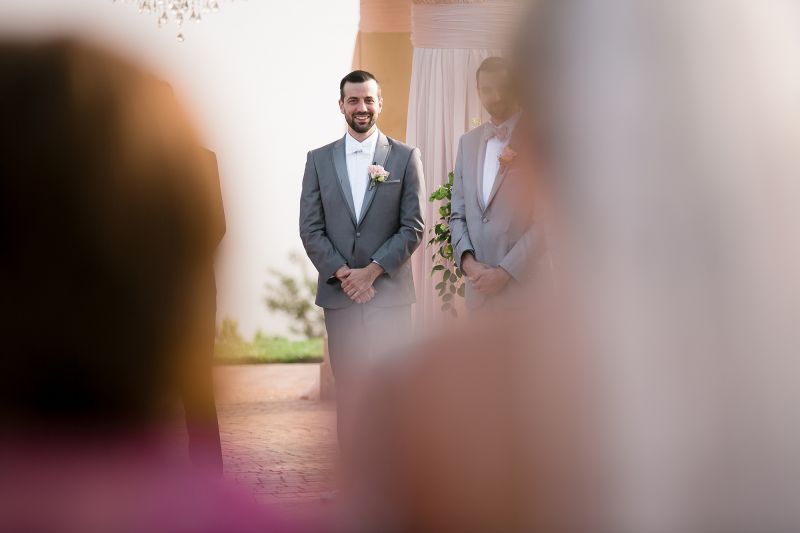
This is my favorite lenses. It creates a beautiful bokeh (blur) at f2.8, and the compression you get when you’re zoomed in from 150-200mm gives your image a look that’s hard to achieve with any other lens. It also allows you to get in close on the moment without disrupting the moment, such as the following image:
capri-laguna-inn-laguna-beach

It also allows you to capture candids, from the tears at a wedding ceremony (pictured below) to the laughs at a wedding reception.
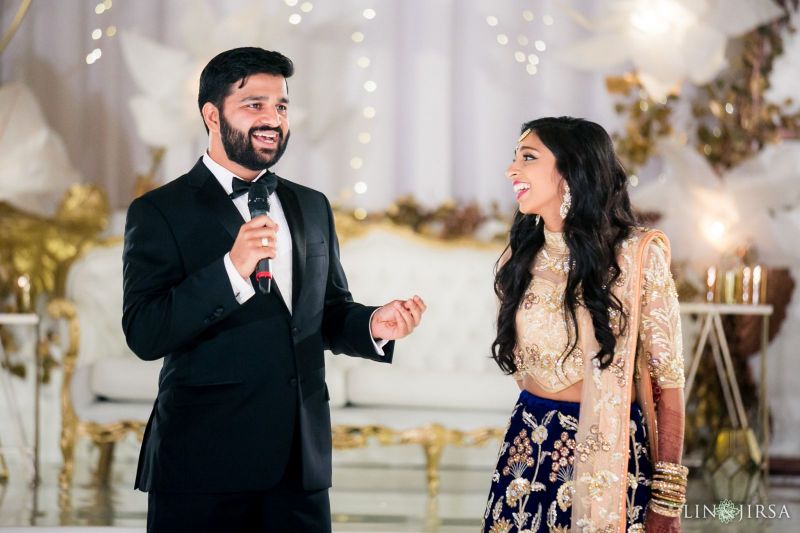
via-cabrillo-marina-doubletree-san-pedro

2. 50mm f1.4 Lens

This is another one of my favorite lenses. It can save the day when the light starts to drop and allow you to bring out the backgrounds. It also, makes you less reliant on your flash, creating a softer, more natural look for your subjects, as illustrated in the following outdoor dance floor picture.
23-party-orella-ranch-wedding-photography

The 50mm also allows you to create stunning portraits, as the low aperture creates the shallow depth of field that makes your subject pop off the page and softens your subject’s skin.
via-cabrillo-marina-doubletree-bride (1)

3. 24-70mm f/2.8L USM

This is a critical lens for smaller spaces. For example, a tea ceremony in a Chinese wedding is commonly held in a living room. The 70-200 would be too close for this situation, and the 50mm would not provide enough versatility, as you typically don’t have too much room for movement.
el-monte-wedding-photography-tea

4. 100mm f/2.8 Macro USM Lens for Canon SLR Cameras

If your bride and groom are spending thousands of dollars on the details of a wedding, they are sure to appreciate you capturing the event in detail. With the 100mm Macro, you can capture detailed shots with the same quality and detail as product advertisements in magazines. Add in your touch of lighting and creativity, and you get ring shots like the one below.
capri-laguna-inn-wedding-photography-details-2

5. 15mm f/2.8 Fisheye (Note: This is for full-frame sensors. For crop frame, research 8mm or 10mm fisheyes)

The fisheye is important for capturing the moment with a unique perspective. This perspective pulls everything from the edges into the center and creates a surreal, ultra-wide view of a venue or ceremony site, as pictured below.
bl-turnip-rose-costa-mesa-wedding-photography-0044

Using the fisheye to capture dance floor shoots at a reception or, for example, an Indian Baraat (as pictured below) creates a interesting and exciting image, as the distortion on the edges focuses your attention on the subjects in the middle, yet the composition of the frame still allows you to see the smiles and emotion of the crowd.
4-baraat-indian-wedding

6. 16-35mm f/2.8L II USM Ultra Wide Angle Zoom Lens

Sometimes the 24-70mm lens just isn’t wide enough to capture everything you want. The ultra wide angle helps you capture your surroundings, such as this shot of our wedding party in the streets of San Francisco.
marines-memorial-hotel-san-francisco1

Venue and landscape shots are also a great addition to your wedding day coverage, as it sets the scene for the day and allows you to take full advantage of amazing scenery.
santa-barbara-elings-park1

Honorable Mentions:
1. 85mm f1.2L II USM
This is a great lens, but not a necessity if you’re happy with the results from your 70-200mm.
2. 24-105mm f/4 L Lens
The major advantage of this lens is its versatility. But, as stated before, we are partial to lower apertures, and sometimes the f/4 just isn’t fast enough, nor does it create our desired bokeh.

I hope you enjoyed this article, if so, please share the love and feel free to comment and add additional insight below!

By: Lin and Jirsa Wedding Photography, Los Angeles and Orange County Wedding Photographers

_______________________________________________________________________________
If you’ve found this article informative, please consider donating below:


_______________________________________________________________________________


Advertisement
  • olivier

    85L is not great … it’s magical…
    135L should be mentionned … much sharper than the 70-200f2.8

    but for me the number one lens is the 35L….35mm is just perfect, so close to natural vision and at 1.4 beeing abble to isolate a subject with the narrow dof with a wide angle lens is amazing

  • http://theweddingprofessionals.blogspot.com/ Michael

    Great short article on wedding lens recommendation.
    I would tend to agree with most suggestions, however,
    in my opinion the Cann 85 1.2L is just too slow for
    weddings, you miss 90% of the shots. It’s great to
    impress people with, but the 85 1.8 is far more
    practical and gives you a far higher keeper rate.
    And it can double duty for the telescopic compression
    effect of the 70-200 2.8 with a far faster aperture.
    The 70-200 2.8 is a brick to carry around during an
    8 hour plus all day wedding event. Just my thoughts.

  • Dana Goodson

    I’m a Nikon shooter so I’ll have to mention the 14-24 2.8. It’s costly but I opted for this instead of a fisheye to use on my D700. It’s incredibly sharp and I don’t have to worry about any edge distortion. I love that I’m able to get some pretty dramatic images due to how wide it is.
    Thanks for the article. Very informative. :o)

  • http://www.jonphillipsphoto.com Jon Phillips

    I recently added a 200mm f/2.8 L series to my arsenal. I found that when I was using a 70-200, I was always shooting at 200.

  • http://www.xsightn.com Xsightn

    Nice article though all Nikon, we get the picture
    I have to agree with Goodson, the 14-24 2.8 is a great addition for Nikon shooters. Yet to get one though but am working towards it

  • http://www.mikemurrowphotography.com mike

    Ten? Ten lenses? Non sense. I shoot with a 17mm, 50mm and 180mm. 90% of my images are with the 50.

  • http://blue-hour.deviantart.com Scotty

    Great! Now all I need is $7,000 and I’ll be a successful wedding photog! Dx

    • http://www.facebook.com/profile.php?id=100000206642313 Dustin Gardner

      Haha I know the feeling. I’m currently shooting with a Sigma 70-300mm 
      f/4-5.6  Macro, a 50mm F/1.8, and a 28-90mm f/3.5-5.6, but, weird as it may be, I get beautiful shots, and, they love the shots as well (The families)

      • Marek Trela

         You can only get mediocre pictures with these lenses. If you are serious about wedding photography you better save up some money and buy quality glass.

        • Pablo

          I don’t know if I’d say “you can only get mediocre pictures with these lenses” is an accurate assessment.

           Of course the quality of glass is incredibly important and plays a larger factor in image quality than anything except perhaps the photographer’s skill, but that doesn’t mean the shots a photographer gets with these lenses are mediocre at best. 

          To the same extent, I don’t think it would work to say “You can’t take amazing pictures with an APS-C camera”, or “unless you’re shooting Medium Format you’ll never produce a good image”.  These are all tools, and they do as they are told (within their limits).  If you know the limitations of your equipment and understand how to make it work for you, you can go a long way with lesser quailty gear.

           I’d say that under challenging conditions it is true, lower quality, slower lenses will have a hard time producing great images, but that doesn’t mean it can’t be done, especially if you really know what you are doing.  I’d rather have a wedding photographer with lower quality glass who really knows what they are doing than a novice with tons of equipment and not enough skill.  

          That’s not to say you shouldn’t invest in good glass, no doubt you should if you are making money off of your photography and/or want to further the capabilities of your equipment.  I have some very good glass, and I am blown away by the differences between the good glass and the much lower end stuff I have shot with (and some that I own).  That being said, I have produced some great images with lower end lenses under less challenging situations.  To Dustin I’d say save your money, buy a high quality lens or two that fits your needs, you’ll be impressed with the differences, and so will your customers.  Beyond that, shoot with what you have, and make the equipment you have work for you. 

          Not everyone has the money to buy $5,000 or $10,000 plus in lenses, and not everyone is in the position to need to make that kind of investment either.  That doesn’t mean they can’t produce high quality images, or that they shouldn’t try.  Everyone starts with lower quality gear unless they are independently wealthy.

          • Lcruz0811

            Thanks for this comment! I find that way too many people look at gear and not creativity. I shoot with an entry level canon and have gotten some awesome images out of it. I know people who have the new 5d mark III and their images lack creativity. You can get amazing shots with anything you just have to try. 

          • Mike Moon

            Lcruz0811
            That’s because the camera is not as important as the glass. I’ve been doing weddings for 7 years, (I do about 30 per year) and I wouldn’t be caught dead in a church ceremony without 2.8 lenses. You’d be much better going with an off-brand 2.8 lens than spending the same amount on a Canon-brand 3.5-5.6 lens. God forbid you’re stuck with 3.5 minimum aperture in a dark church with a no-flash rule! 2.8 lenses are REQUIRED for professional wedding photography. If you can’t afford them, rent them. — The camera is not as important. You could shoot a gorgeous wedding with a Canon 20D and 70-200 2.8 IS USM II lens, but not the reverse with a MkIII and 3.5-5.6 lens. 

          • Me

            @me: I think you guys should focus more on your own photography and creativity than others.. And gotten it not even a word by the way!!

          • Mike Moon

            Pablo:
            Regarding the comment, “I’d rather have a wedding photographer with lower quality glass who really knows what they are doing than a novice with tons of equipment and not enough skill.”,

            I agree with you, but it’s unfortunate clients get fooled into paying for either one. Neither is acceptable. 2.8 glass is the cost of entry in wedding photography. Not even a great, skilled photographer can shoot a church wedding without flash with non-2.8 lenses. — Shooting “a” wedding is one thing. Marketing yourself as a professional photographer without 2.8 glass is another thing. That’s not OK.

        • AMP.ed Photo

           That’s not a very nice thing to say. People can get amazing pictures with any camera/lens setup. You may not be able to zoom in and see the open pores as much, but clients can still absolutely adore their images. They may have to rely on flash much more, but there is nothing wrong with shooting with these lenses.

          The main ways this would bother me (if I was shooting those lenses) is that I couldn’t shoot in low-light very well without a flash, and having Uncle Bob there with the top of the line camera and all the lenses mentioned in the article, and yet you’re getting paid to shoot the images with a lower quality camera/lens setup.

          That being said, people have to start somewhere.

          Last point, Dustin mentioned he was shooting families, NOT weddings. So your point is moot.

        • http://www.facebook.com/oeaspence Omar Spence

           Lens selection is most challenging when you are just starting out. Not all of us get to start with $7k, but having started from a tight budget, one thing I learned is to stay far away from zooms until you can afford the best. There are no good zooms around for less than $1500. Fast primes give you the best bang for the buck, the supposed versatility of a zoom for the same price is just an illusion which dies quickly when it comes down to the results. And anything slower than F/2.8 is mediocre.

    • Mike Moon

      Why is this too much to ask? A $7,000 investment for your own business? The problem with the industry today is that too many people can fool clients into thinking they’re professional photographers with a $2,000 investment and decent portfolio. In the real wedding photography world, you’re stuck with more lighting scenarios than you’d encounter in a year of studio shooting. Dark churches with no-flash rules, blazing sun with no shade, all in the same day! Can you shoot a wedding without the lenses that comprise a $7,000 investment? Yes, — especially if you rent them. Can you shoot 10 or more weddings a year without investing $7K in lenses? — You shouldn’t even try. Clients don’t deserve that.

      • Mike Moon

        Sorry Scotty, I missed the sarcasm till now. I think you’re point is that investing in the lenses won’t make you a professional without the talent, skill and experience to match the investment. I agree with you 100%!

  • http://www.brandonworf.com/photography/ Brandon

    In my experience, the 70-200 is great, but doesn’t work well in small chapels, as it just can’t back out far enough. The 24-70 is ideal, but the 24-105 is far more versatile in situations where a little extra zoom compression is necessary.

  • Samantha

    Scotty, I think most successful wedding photogs would say it takes so much more than just lenses, cameras, and equipment to be good at what you do.

    And Mike, I also think everyone has their own style of shooting. Some of my best weddings were shot on only 3 lenses (16-35mm, 50mm, and 70-200mm). But, I would definitely have to agree with the authors picks on these lenses.

    The lenses listed are quite standard and staple lenses. Though I would have to say I hate shooting on the 24-70mm. I would rather use a wide and a 50mm prime to cover that range. I don’t really like the look and feel of the bokeh on the 24-70mm, I feel like everything comes out looking too standard.

    I would have to say that anyone that doesn’t think a fisheye is an amazing lens, hasn’t shot enough weddings =). It creates some of the coolest effects for wide angle shots and dance floor shots.

    Here are my favorites (in order):
    1) 70-200mm F2.8 IS
    2) 50mm F1.4
    3) 16-35mm F2.8
    4) 15mm F2.8 fisheye
    5) 100mm F2.8 macro
    6) 24mm F1.4

    The 50mm F1.2 is nice, but I find that it’s impossible to shoot anything moving at F1.2, and around F1.8+ I can’t really tell the difference between the 50mm F1.4. So, might as well stick with the cheaper lens.

    Kudos to the author, loved the article.

  • http://www.linandjirsa.com Pye

    Brandon, I would have to agree that I love the additional range on the 24-105mm. But, to be honest, we bought one to try out, then ended up selling it because it simply just wasn’t fast enough in low light, and it seems like we are always shooting low light. Do you typically use your 24-105mm during the day or in well lit areas? I am curious, what would be your 5 or 6 staple lenses?

  • http://www.monjardimnoleto.com.br Lorena Monjardim

    70-200 2.8 L IS is definetly my baby!!

    I love my 50 mm L 1.2 but it is an artistic extra equipment in my pack.

    My 24-70 2.8 L is used only in small rooms or where 70-200 is impossible to use.
    (my hus uses it more than i do)

    I agree with the authors about large apertures..

    Nice article!

    2.8 is my smallest choice!

  • John Donnelly

    Been a while since I’ve used my film camera. I have a fantastic 35-200 that covers mostly everything. I have a 28mm wide angle and a 500mm fixed for anything else. Enjoyed your article, some really great pics!

  • http://martinskikulis.com Martins Kikulis Photography

    For me the best wedding lens ever is Nikon’s 14-24 f/2.8! Sometimes I shoot all wedding from start till end just with that one lens. That’s how much I love it!

  • http://www.igorklajo.de Igor Klajo

    Thanks for this small lens roundup to have at weddings. I think this is the lens collection you should have now only for weddings, but for all kinda events. I myself just started to get the real stuff together, have the 70-200mm f/4L. I had to get something better than I had before and I couldn’t wait got get enough money for the f/2.8 version. Now I see I should have waited because I often take photos in low light condition where a flash is unwanted.
    My next lens on the buy list is the 50mm f1.4 and then the 24-70mm f2.8. These three lenses are enough to do the important thing done. Like stated here, with a fisheye and a wide angle zoom lens you can have some photos with the special touch, so these two lenses will be one day mine as well ( I hope ).

  • http://www.jhgibsonphotography.com HurleyG

    Quite a good article. I believe you’ve got your choices right on. I used to use a 70-200mm f/2.8 for every wedding I shot, but for the last two I used my 85mm f/1.8 and the results were surprising. I’ve always heard that prime lenses are the best way to go, and I’ve definitely got to agree. Very nice article. Thank you.

  • http://brittonphoto.com Britton

    Good choices with the exception of the 50f/1.4 . That lens is poor at focusing in low lighting conditions. The 35f/1.4 is the one to get.

  • http://www.cdeschampsphotography.com Cathy

    Great article. I tend to rely on my 24-70 f2.8 for a lot of the work. I like the 70-200 VRII for the close ups, placing of the rings etc. I’ve been able to get some great shots with a 50mm and pro mist filter for bride portraits.

  • Pingback: 6 Must-Have Lenses for Wedding Photography - Digital Scrapbooking Community - DesignerDigitals

  • http://www.vulephotography.com Vu

    You got quite a list there. For the most part, we have similar taste. Have you tried the 35L & 135L as a combo though? Beside having most of the lens you mentioned w/ me on my last assignment, I found myself shooting w/ the 35 & 135 80% of the time.

  • http://www.nigerianweddingphotographers.com/ Dare

    35L & 135L will help you a lot in weddings

  • http://www.deirdreryan.com Deirdre Ryan

    I have a 90mm Macro 2.8 Tamron and a 11-18mm 5.6 Tamron Canon mounts and a 18-135mm Canon lenses. I learn to work with what I have. My goal is to get the 70-200 Canon and the 50 1.4 Canon. However since the earthquake who knows when the prices will go down and the availability :(

  • Anonymous

    You write amazing article ,You capture nice wedding photographs.I use 24-70mm  f2.8 lens for capture wedding photographs.Thanks for sharing information.
    wedding photographers bristol

  • Arkadi

    I don’t like 70-200.. it is bulky. I think everything is a question of equilibrium.. I don’t wanna run around loaded with equipment. I keep one body at hands, 16-35 for any case, 35 1.4 60% of time, 85 1.2 30% of time. I live macro lens and fish-eye in a trolley. You can see the results  http://www.fotoarcadia.com
    I think there could be drawn a line between those who use tele and those who use 35sh lenses. I think the last breed of fols love more people and love being inside of action.

  • 1picture=1000 words

    I just entered the Wedding photography business, last engagment i used a 18-55 EF-S lens, my pictures keep out pretty good but these six lens just makes it 100 times better. Great work and great article, Good luck in being unique in your way.

  • Hankersonphotography

    Thank you for sharing this info…love you work..and I pray that you continue to do great things. Hank.

  • Emma Margaret

    This is a great article! I’ll keep these tips in mind.

  • http://www.savuphotography.com/ Fotograf Profesionist Nunta

    You can actually cover whole weddings with just a 24-70 and a full frame camera. New cameras also have lots of megapixels that translate into room for cropping so a 24-70 2.8 can become almost a 24-105 2.8, especially on cameras like the new D800.
    A 100 2.8 can actually be all that you need as a telephoto lens and be a cheaper replacement for the 70-200
    I also don’t think a fish eye is “must have”, that look is not for everyone.

  • Josefu

    Awesome article here, I agree with Fotograf Profesionist Nunta.

  • Photographers01

    Oh this is SO perfectly written.Nice captures.

    http://www.bigindianwedding.com


  • Vj One

    Most pros don’t want to use off brand glass. But I have seen results from the off brand glass that are stunning to say the least. Photography is much like DJ-ing. To which I practice both crafts.( I am a much better at the latter).
    In DJ-ing world, to be acknowledged as a “pro- dj”, you have to have that angelic glow in the dark apple logo. Fellow DJ’s and promoters give you the benefit of a doubt once you power up the 2000+ laptop. Does that make you a pro-dj? I don’t know. Do the patrons care? Nope. They want to have a good time…they want to dance. The DJ can walk in with a DELL inspiron running windows XP and still make people dance the night away. (Nothing against DELL) Because he knows how to do his job well with his “non pro” equipment

    Same as photography. I had a Sony point and shoot (400 bucks worth) and could produce just as good if not better pics than some of the photographers I hired for my DJ-ing gigs. Does that make me a pro or make him a whack? Now I own a 7D and the 24-70L. I must say, the camera takes better pics than my point and shoot but when I hand it to someone else, they can’t get the same great pics I can ….consistently. Now, I am an advanced amateur taking impressive pictures with a pro body. I am not a pro, but my understanding of aperture, ISO and shutter and my familiarity with the 7D allow me to produce pro-like results.

    Its the marriage of good equipment and acquired skill and experience that make a good photographer. My point, a puppet is just a doll without it’s puppeteer. Its not just the equipment.

    And the canon lenses look sexxy too. Who can argue with that?

  • Derek

    Just wondering what your thoughts are on 24-70 vs 24-120 if it was a choice? 24-70 is the better lense but is having the versatility of the 120 better?
    Thanks

  • Paulashe1961

    I’am in question on the ring photo.

  • http://www.facebook.com/CatherineLaceyPhotography Catherine Lacey Dodd

    Great. I’ve opted for the 35/1.4 of late over the 50/1.4. Fab in almost no light.

  • Hector Alanis

    Very good article.  The wedding is a one time event in the life, and is very important for the photographer catch the moments.  I am not a pro, but I have been as second shooter in weddings and a good glass is very useful for dificult situation. I´ve  lost a lots of catches because a I don´t have a 2.8 prime.  But my 70-200 2.8 has been very useful.

  • @ Photographer San Antonio

    I have to agree with getting good glass. I shoot weddings professionally every weekend. I do not charge thousands. I charge 500 and still use pro glass. I have a 28-70 f2.8 It is a very nice lens. I also use a lower end lens on DX a superzoom f3.5-5.6 18-200mm for backup camera that I wear! I will be getting an 70-200 f2.8 as soon as I can afford it. I also use a 35mm f2.8 and find that with today’s digital cameras and high ISO 2.8 is as low as I need. 1.4f lenses were great with film but are not needed anymore and are far too expensive in my opinion.

    I spent 850 on the 28-70 – $500 on the 18-200 the 70-200 is over one thousand used.

  • Irina

    Very helpful! Thank you! Just one qustion: is there a big difference in quality between 50mm 1.4 and 50mm 1.8? 

    • Stefan Warmuth

      besides the obviously larger aperture, the focus of the 1.4 is much faster

  • Hector M.

    what are your feelings about the 50mm 1.2

  • Hector M.

    I noticed you posted this article in 2009. Are these still your top 6 lenes? If not what are you guys using now?

  • Jon wright

    great article as have my first wedding coming up soon, many thanks

  • Apo5

    What for 16-35 if you already have 15mm fisheye :)

  • CK

    Just one small thought on the Canon 24-70 F2.8:  It weighs a ton.  By the time you load up your 5D with a vertical grip, flash, diffuser, etc. and throw on this lens — you better be pumping iron in advance.  If you’re not part-timing as a MMA instructor, you might consider the 24-105 F4.0.
    I rented each, shot a wedding with each — and went with the 24-105.  Less sweating, more shooting.

Read previous post:
Win an iPod Touch!

We've had a great response to the last Giveaway/Competition that we announced on SLR Lounge, so today we wanted to share another awesome opportunity to win some free stuff. Slr-lens.co.uk is gathering opinions on the cameras/lenses, so they're running a competition to win an iPod Touch 8GB.

Close