Flash is not a prerequisite for great photography. Used without intention, it flattens shadows, kills mood, and leaves your subjects looking like they’re posing for a passport photo. Used at the right moment, it saves shots that would otherwise be unusable. The difficulty isn’t learning how to fire a flash, it’s knowing when the shot actually needs one. This guide covers the specific situations where we reach for a flash on real shoots, the ones where we deliberately don’t, and how to tell the difference before you commit.
Watch the video
If you’d rather watch than read, the video below is a clip from our Lighting 101 course inside SLR Lounge Premium. It walks through the core decision points covered in this article.
The real question: what does flash actually do for you?
Flash gives you control. That’s it. Every specific reason to pull out a speedlight or strobe collapses back into that single idea. You control how much light hits your subject, where that light comes from, how hard or soft it looks, and what color it is. Ambient light gives you what the sun, the ceiling, and the street lamps happen to be doing. Flash gives you what you decide.
When the ambient is already doing what you need, there’s no reason to add flash. When it isn’t, flash is often the fastest fix. The rest of this article is about recognizing which situation you’re in.
When to use flash in photography
Here are the specific situations where we reach for flash on real shoots. If any of these apply to what you’re shooting, flash is probably the right call.
1. The ambient is too dim to shoot without pushing ISO past your comfort zone
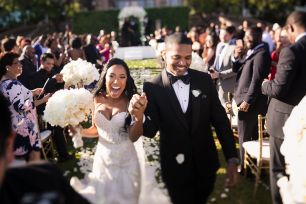
Indoor receptions, evening portraits, dimly lit venues, this is the most obvious case. If you’re fighting to hold shutter speed above 1/60 and you’re already at ISO 3200, flash gives you back four or five stops of light without the noise penalty. We routinely shoot wedding receptions at ISO 1600 with bounced flash where we’d otherwise be at ISO 12800 without it.
2. The background is properly exposed but the subject is in shadow
Backlit portraits are the classic example. The sun is behind the subject, the sky is beautifully exposed, and the subject’s face is two to three stops underexposed. You have two options: expose for the face and blow out the sky, or expose for the sky and use flash to bring the face up to match. In our experience, flash wins this trade almost every time. The family portrait below is a typical case where exposing for skin would have destroyed the background.

The trick here is matching the direction. Ambient light comes from the right, flash comes from the right. We bounced off a reflector to soften it, but the direction stays true to the scene. Cross-lighting from the opposite direction immediately reads as artificial.
3. You need to separate the subject from a busy or bright background
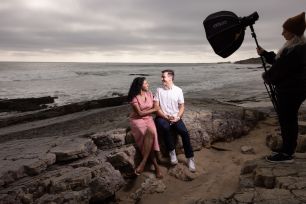
Open shade against a busy background is flat, and the subject blends into everything behind them. A subtle flash, even just a third of a stop above ambient, lifts them off the scene and gives you separation. In the shot below, the model looked dark and flat against the backdrop. Adding a warmed flash, gelled with a CTO to match the existing color temperature and bounced off a reflector, pulled her forward without making the image look lit.

This is one of the most underused applications. You don’t need a dramatic amount of light to improve a scene, you need the right amount in the right place.
4. Midday sun is creating harsh shadows on faces
Counterintuitive but true. The brightest conditions often need flash the most. When the sun is directly overhead, shadows fall under eyebrows, noses, and chins, and no amount of posing fixes it. A flash fired from slightly in front of the subject fills those shadows and evens the exposure. Most beginners think flash is for dark environments. Experienced portrait shooters know it’s just as useful at noon.
5. You want to mix color temperatures for creative effect
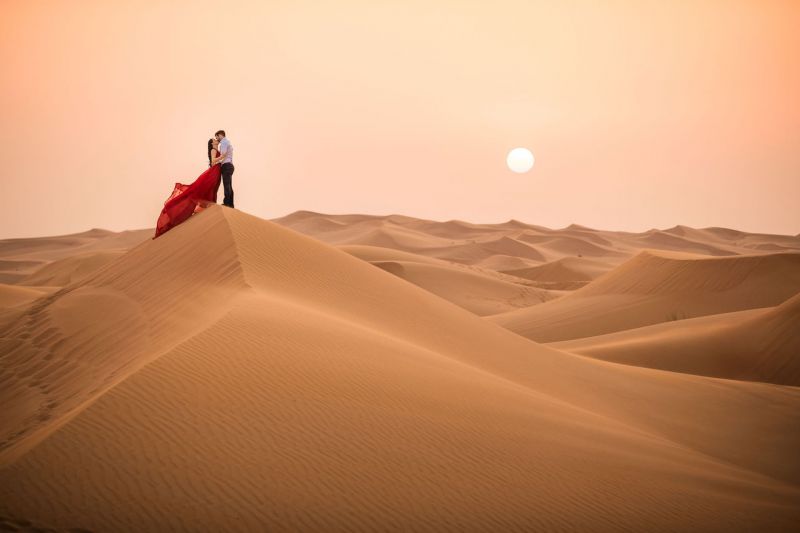
Every light source has its own color. Daylight is around 5500K, tungsten is around 3200K, fluorescent is green-tinged, sunset is warm. Flash, uncorrected, reads as daylight. Put a gel on it and you can match the ambient, oppose it, or fabricate a color that wasn’t there. In the beach shot below, there was nothing wrong with the warm sunset glow on its own, but pulling the flash color cooler let the ocean and the bikini pop against the warm ambient, turning a nice shot into a more deliberate one.

This is creative control, not correction. You’re not fixing a problem, you’re composing with color.
6. You need a specific quality of light the scene isn’t giving you
Soft, diffused flash through a large modifier gives you flattering portrait light. Hard, direct flash gives you editorial, high-fashion, or dance-style imagery with sharp shadows. Specular flash defines the muscle and bone structure of athletes. There’s no single correct quality, there’s the quality the shot calls for, and flash lets you choose.


If the ambient is soft and you want hard, flash is the answer. If the ambient is hard and you want soft, flash through a big modifier is the answer. The scene you’re given isn’t the scene you’re stuck with.
Flash vs no flash: when each one wins
The most honest way to learn when flash matters is to look at the same scene with and without it. Here are the trade-offs we actually weigh on shoots.
Go without flash when:
- The ambient light is already flattering and directional (golden hour, window light, open shade with a bright bounce source nearby)
- You want a documentary or photojournalistic feel where artificial light would disrupt the mood
- You’re shooting fast-moving candid moments and setup time would cost you the shot
- The color and quality of the existing light is part of the image’s emotional content, think candlelit receptions or warm sunset
Go with flash when:
- The ambient is too dim to hold your shutter speed without unacceptable noise
- The subject and background can’t both be exposed properly without added light
- Harsh directional shadows are falling where they hurt the image (under eyes, across half the face)
- You need predictable, repeatable light across a session where ambient is changing (sunset portraits, overcast breaking)
- You want a specific look that the scene’s natural light can’t produce
The mistake beginners make is treating this as a binary. It isn’t. Flash used at a third of a stop below ambient is completely invisible in the final image but still adds catchlights, separation, and fill. You don’t have to choose between “flash look” and “natural look,” you choose how much flash, and the answer is often much less than people expect.
When NOT to use flash
Just as important as knowing when to use flash is knowing when to leave it in the bag. We’ll be direct: most beginner flash work looks bad because the flash is overpowering ambient light that didn’t need help in the first place.
Skip the flash when:
- The ambient is the photograph. A candlelit reception toast, window-lit portrait, or street lamp-illuminated couple shot has mood that flash will destroy. The shadow and color information in the ambient is the image.
- You’re too close to a reflective surface. Direct on-camera flash against a mirror, glass, or glossy wall creates hot spots and reflections that are nearly impossible to fix in post. Either reposition or bounce off a ceiling.
- Flash is banned or disruptive. Ceremonies, museums, performances, speeches. Even if it’s technically allowed, it often isn’t welcome.
- You haven’t taken an ambient reading first. Firing a flash before you know what the ambient is doing means you don’t know whether your flash is 1/3 stop under or 3 stops over. Meter the scene, then decide.
How to decide on the fly
Here’s the thought process we run through in the first few seconds of a shot:
- What’s the ambient doing? Take a meter reading or a test frame. What’s the shutter, aperture, ISO that gives you a usable exposure? Is the light on the subject flattering as is, or is it falling in the wrong place?
- What’s missing? If the ambient works, shoot it. If the subject is in shadow, the background is blowing out, the color is wrong, or the shutter is dropping below safe handheld, flash has a job to do.
- What’s the smallest amount of flash that fixes it? Start a stop under ambient and dial up. The goal is almost never “flash-lit image,” the goal is “better image, where you can’t tell a flash fired.”
Over time this becomes instinct. You’ll walk into a reception and know within thirty seconds whether you’re shooting it bounced, direct, off-camera, or ambient only. Until it’s instinct, slowing down and checking ambient first prevents the most common flash mistakes.
Frequently asked questions about flash photography
Do I need flash for portrait photography?
No, but you’ll limit your options without one. Plenty of gorgeous portrait work happens in ambient light only, especially during golden hour and in open shade. Flash becomes essential when you’re shooting in dim environments, fighting harsh midday sun, or balancing a bright background against a shadowed subject. Most professional portrait photographers carry flash even when they don’t plan to use it, because conditions change.
What’s the difference between flash and continuous light?
Flash fires a brief, bright burst synchronized with your shutter. Continuous light stays on the whole time. Flash is more power-efficient, easier to carry, and can overpower sunlight with reasonable output. Continuous light is easier to visualize and better for video. For still photography, especially portraits and weddings, flash is the standard.
When should I use on-camera flash vs off-camera flash?
On-camera flash, bounced off a ceiling or wall, is fast and situational. It’s what we use for most reception candids and any fast-moving scenario. Off-camera flash gives you directional control, which matters for intentional portraits, group shots, and any image where you want the light to come from a specific angle. If you’re new to flash, master on-camera bounce first. Off-camera is the next step.
Will flash make my photos look unnatural?
Only if it’s overpowering the ambient or coming from the wrong direction. A flash fired subtly from the direction the ambient is already coming from, at an output below the ambient exposure, is invisible to most viewers. The “flash look” that beginners worry about comes from on-camera direct flash at full power, which almost never produces flattering results. Bounce it, soften it, or move it off camera and the problem disappears.
What’s the best flash for beginners?
A basic TTL-capable speedlight from Godox, Canon, Nikon, or Sony covers 90% of beginner scenarios for under $200. Look for something with manual mode, TTL, a tilting head for bouncing, and wireless receiver capability so you can take it off-camera later. You don’t need a studio strobe to learn flash, you need repetition with a tool you actually carry.
Final thoughts
Flash isn’t about making images look lit. It’s about having options when the ambient light isn’t giving you what the shot needs. Learn to read a scene first, decide what’s missing, and use the smallest amount of flash that fixes the gap. The photographers whose flash work reads as natural aren’t using less gear, they’re using it more thoughtfully.
If you want a complete education on flash technique, from gear selection and on-camera bounce to off-camera setups and creative gel work, our Flash Photography Training System covers the full progression, and it’s included with SLR Lounge Premium.