Some of the most powerful wedding photographs have nothing to do with the couple exchanging vows. They happen when a father sees his daughter in her wedding dress for the first time, when he holds her a little longer than expected at the end of the aisle, or when a familiar song brings back memories neither of them anticipated.
These moments are meaningful because of the history behind them. A father-daughter relationship can span decades of family traditions, inside jokes, shared experiences, and quiet sacrifices. On the wedding day, all of that history can surface in a single expression.
For wedding photographers, the challenge is that these interactions are often brief and unpredictable. You cannot manufacture genuine emotion, but you can anticipate the situations where it is most likely to happen. You can also make deliberate choices about composition, lighting, timing, and perspective that turn an ordinary documentary frame into a photograph the family will treasure for generations.
The photographs in this collection were submitted to a recent Wedding Maps contest, A Father’s Love. Beyond showcasing touching father-daughter moments, they offer valuable lessons in wedding photography. Let’s explore eight types of moments worth looking for, why these images work, and how you can apply the same techniques to your own wedding photography.
1. Helping her get ready
Getting-ready coverage typically revolves around hair, makeup, dresses, and bridesmaids. However, inviting a father into the preparations can create an intimate interaction that feels different from the usual bridal preparation photographs.
Simple gestures often work best. A father fastening a necklace, helping with a bracelet, or straightening a veil has a natural reason to be close to his daughter. Rather than asking them to stand together and smile, the photographer can document a meaningful activity that gives their interaction a sense of purpose.
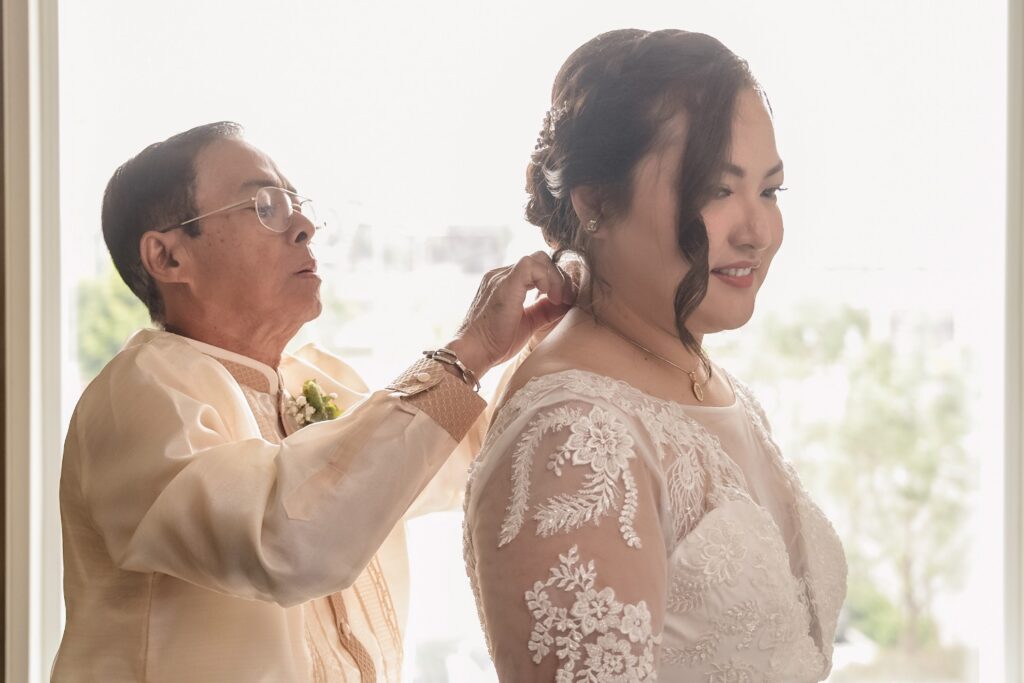
In this photograph by Let’s Make a Memory, the father carefully fastens his daughter’s necklace while she stands near a bright window. The gesture is small, but the concentration and physical closeness make the scene feel personal.
Notice how the window provides soft, directional light that defines the contours of their faces without introducing a distracting background. The side angle also allows us to understand the action rather than simply seeing two people standing close together.
Photography takeaway: Look for genuine tasks that bring family members together naturally. If the bride wants her father involved in getting ready, suggest a meaningful activity rather than a generic pose. Position yourself where you can capture the interaction, both faces when possible, and the details of their hands. Then resist the temptation to direct every movement. The unscripted expressions that follow are often more valuable than the original activity.
2. The quiet moment before
Not every emotional wedding photograph requires tears. Sometimes the most moving images are quiet moments when nothing particularly dramatic is happening.
The minutes before a ceremony are especially valuable. The bride and her father may be waiting for their cue to walk down the aisle, exchanging a few private words, or simply standing together. These transitions are easy to overlook because photographers are often preoccupied with ceremony logistics. Yet they can reveal a more vulnerable side of the relationship than a formal portrait ever could.
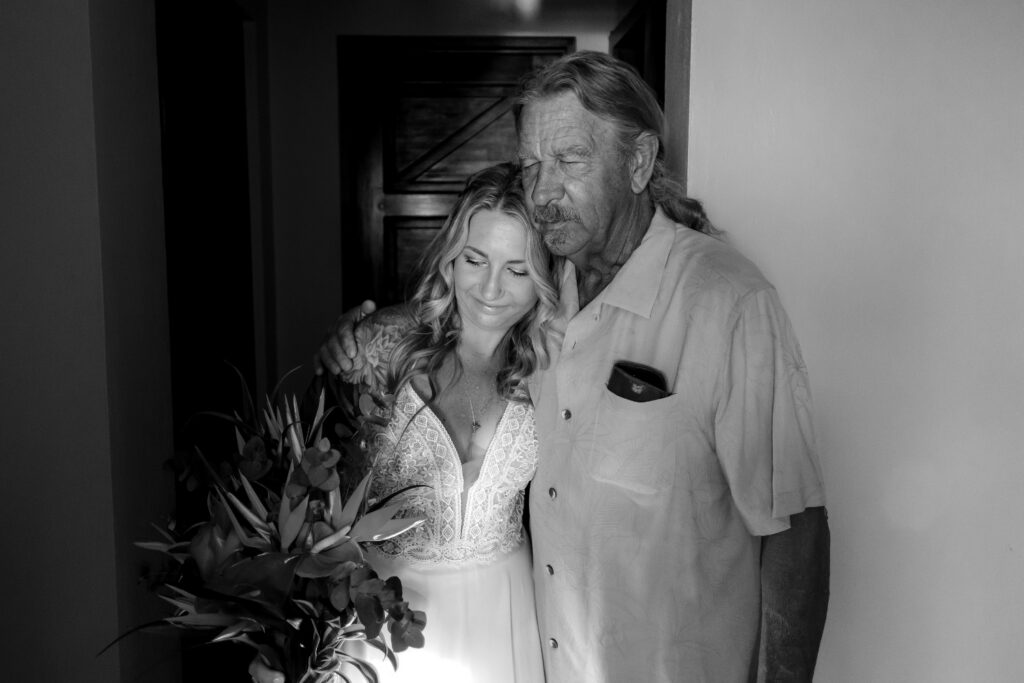
Kevin Heslin captures a beautifully understated moment as the bride rests against her father’s shoulder, both with their eyes closed. There is no exaggerated gesture or obvious performance for the camera. The emotional impact comes from their shared stillness.
The doorway acts as a natural frame, while the darker hallway reduces visual competition. Black-and-white processing further emphasizes the relationship between their expressions, body language, and the surrounding light.
This is also a good example of why photographers should occasionally stop directing and simply observe. A few seconds of silence can lead to more authentic photographs than another round of posing instructions.
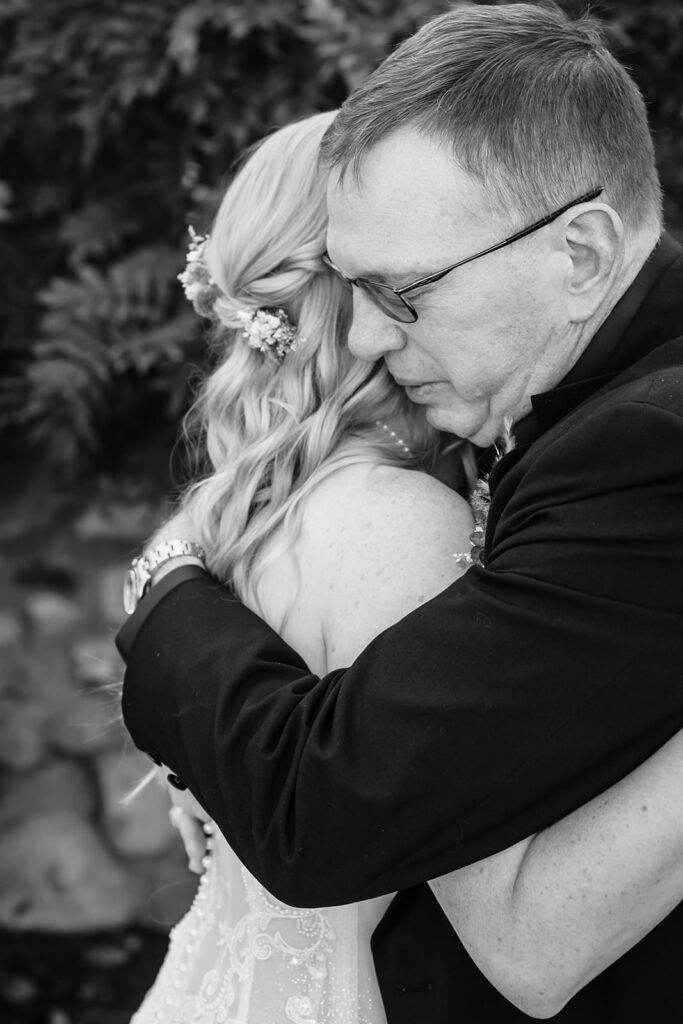
Stratus Adventure Photography takes a different approach, using a tight vertical composition to isolate an embrace. By excluding most of the surrounding environment, the photographer removes nearly everything that could compete with the emotional connection.
Close framing is especially effective when the subjects’ hands, faces, or posture communicate the story. You don’t always need to establish where the moment occurred. Sometimes the relationship itself is the entire photograph.
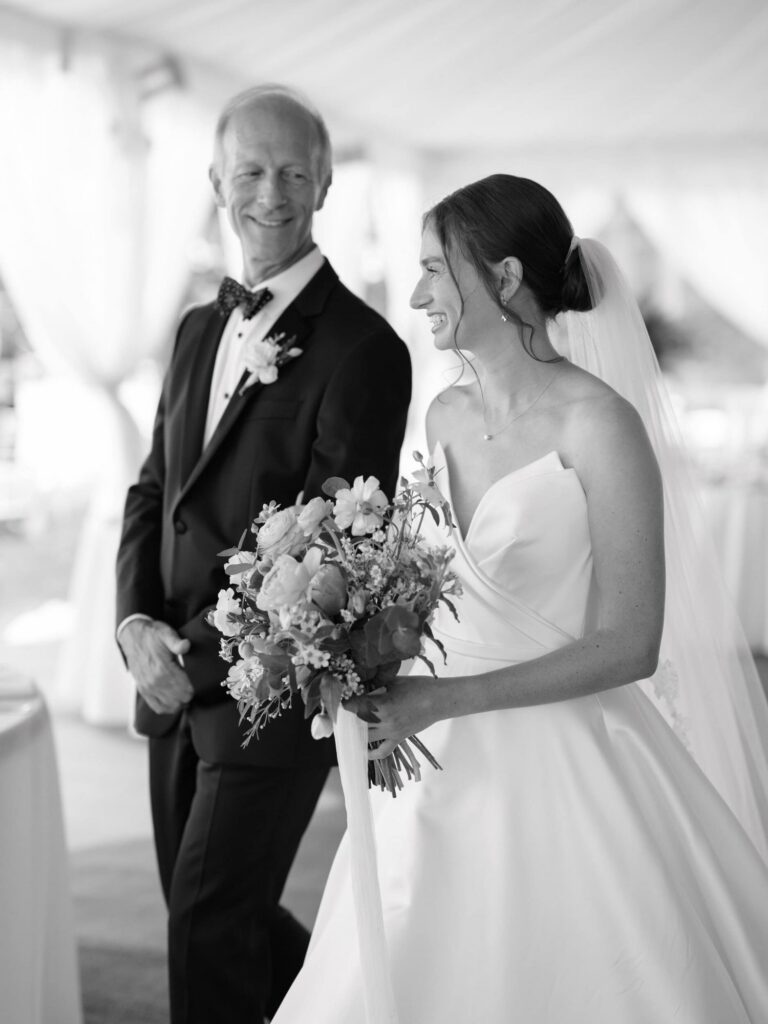
Zac Green Photo demonstrates that emotional storytelling does not always require physical contact. Here, the father and bride walk together, sharing an easy smile. His attention is on her, while she looks ahead, creating a natural sense of anticipation and movement.
The image feels observational rather than arranged. Giving subjects room to walk, talk, and interact can produce body language that is difficult to recreate through traditional posing.
Photography takeaway: Build a little breathing room into the timeline, particularly before the ceremony. Keep your camera ready during transitions and avoid filling every quiet moment with instructions. Work with the available light, simplify distracting backgrounds, and pay attention to subtle gestures. A relaxed smile, a hand on a shoulder, or a brief pause can be just as meaningful as an emotional breakdown.
3. The first-look reaction
A father-daughter first look can be one of the most rewarding moments of the wedding day. Unlike the traditional couple’s first look, this interaction carries the perspective of a parent who has watched his daughter grow up. The reaction might be laughter, disbelief, tears, or a completely speechless expression.
For photographers, the priority is usually the father’s face. The most common mistake is concentrating so heavily on the bride that the actual reaction becomes obscured or happens outside the frame.
Whenever possible, choose the location and camera position before bringing the father into the scene. Consider the direction of the light, background distractions, and how he will turn toward the bride. Shooting over the bride’s shoulder is often effective because it establishes exactly what the father is reacting to, without requiring a second photograph for context.
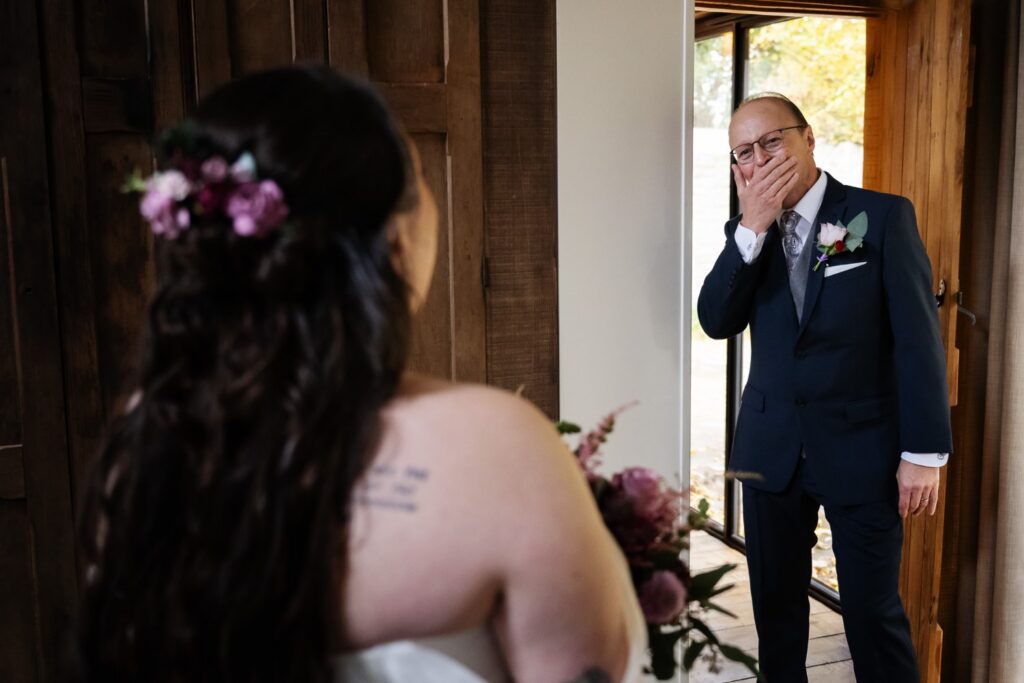
Andy Sidders Photography captures a father’s unmistakable reaction as he covers his mouth in surprise. The bride’s hair and floral details occupy the foreground, remaining intentionally out of focus.
That foreground is important. Without it, this would simply be a photograph of a man reacting to something outside the frame. Including part of the bride connects the expression to its cause, making the story understandable immediately.
The doorway also creates a clean visual boundary around the father, guiding attention toward his face. It’s a reminder that strong composition can be achieved through careful positioning rather than elaborate lighting equipment.
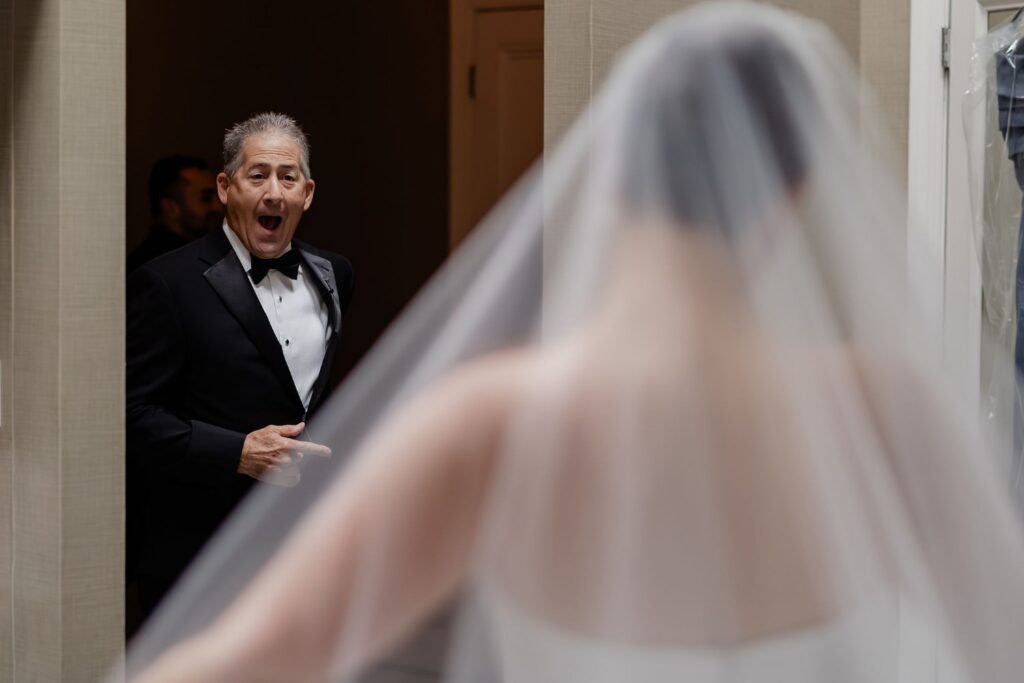
WS Photography uses the bride’s veil as a substantial foreground element, allowing the father’s surprised expression to emerge from the softness surrounding him.
This type of composition creates depth and a strong sense of perspective. The viewer effectively experiences the moment from the bride’s side of the interaction. It also demonstrates how elements that might normally be considered obstructions can become powerful storytelling tools when used intentionally.
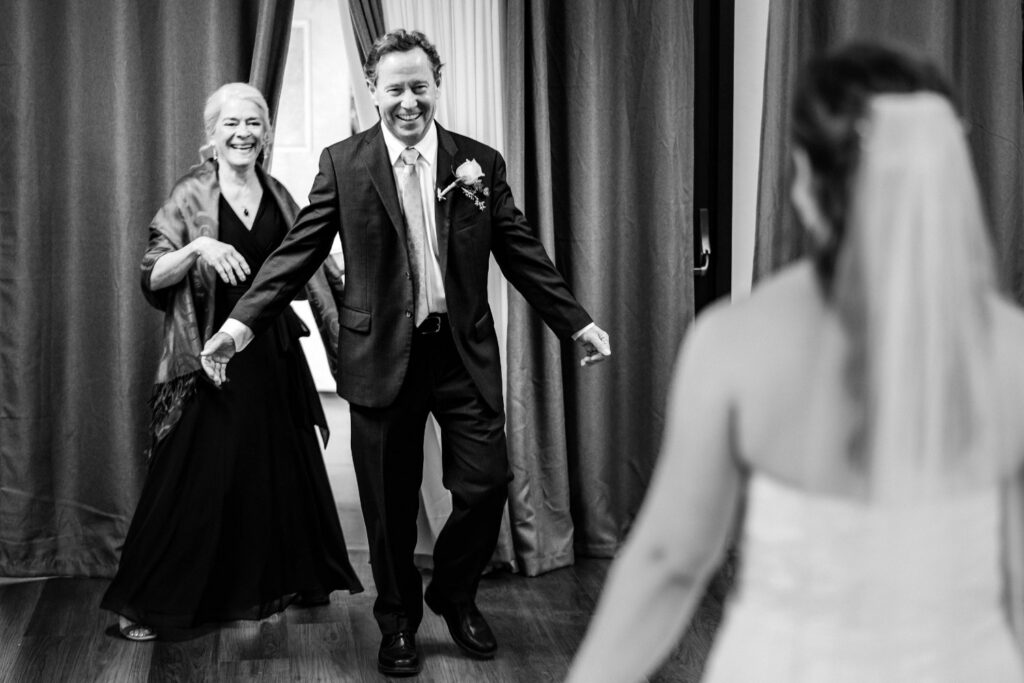
In this image by Tekoa Rose Photography, the father’s reaction has already become an action. His arms extend toward the bride as he moves forward to embrace her.
The image benefits from multiple layers of storytelling. The bride’s blurred shoulder establishes the perspective, while another person’s laughter in the background reinforces the joy of the moment. The result feels spontaneous and energetic rather than static.
This illustrates an important principle: don’t stop shooting after the initial reaction. The father’s expression may be the first meaningful frame, but his movement toward the bride and the embrace that follows may produce an even stronger sequence.
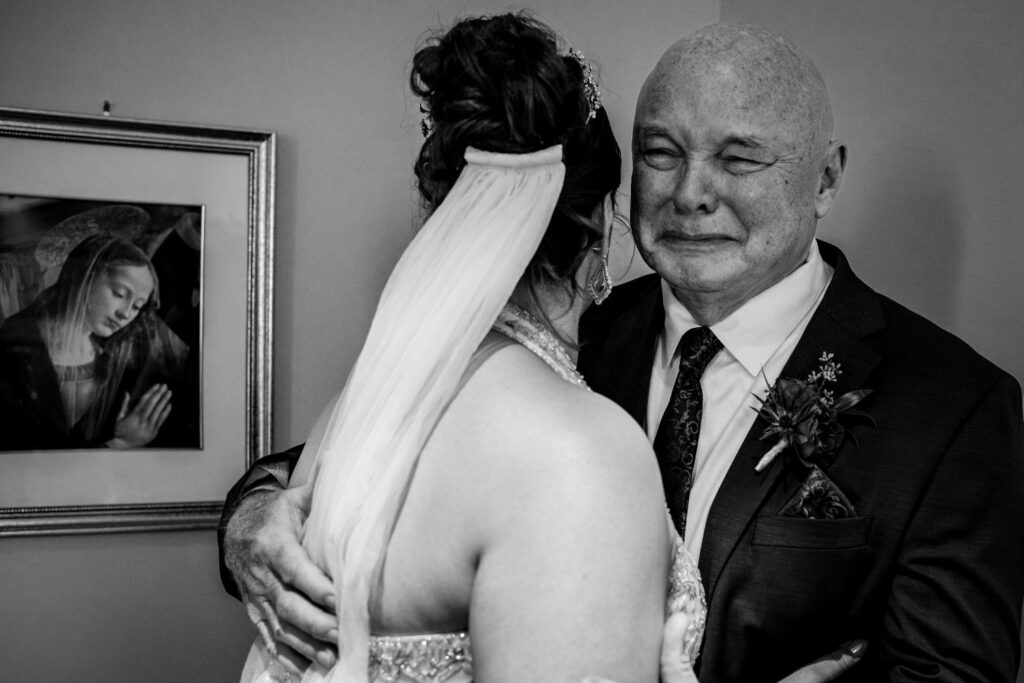
Potok’s World Photography captures a deeply emotional reaction, with the father visibly overcome as he sees his daughter. The bride’s veil creates an intimate foreground while the background painting contributes a subtle environmental detail.
When photographing tears, timing matters more than technical perfection. Expressions change rapidly, and the photographer needs to maintain focus on the eyes while remaining ready for movement. Continuous autofocus and a short burst of frames can improve the chances of capturing the decisive expression without interrupting the experience.
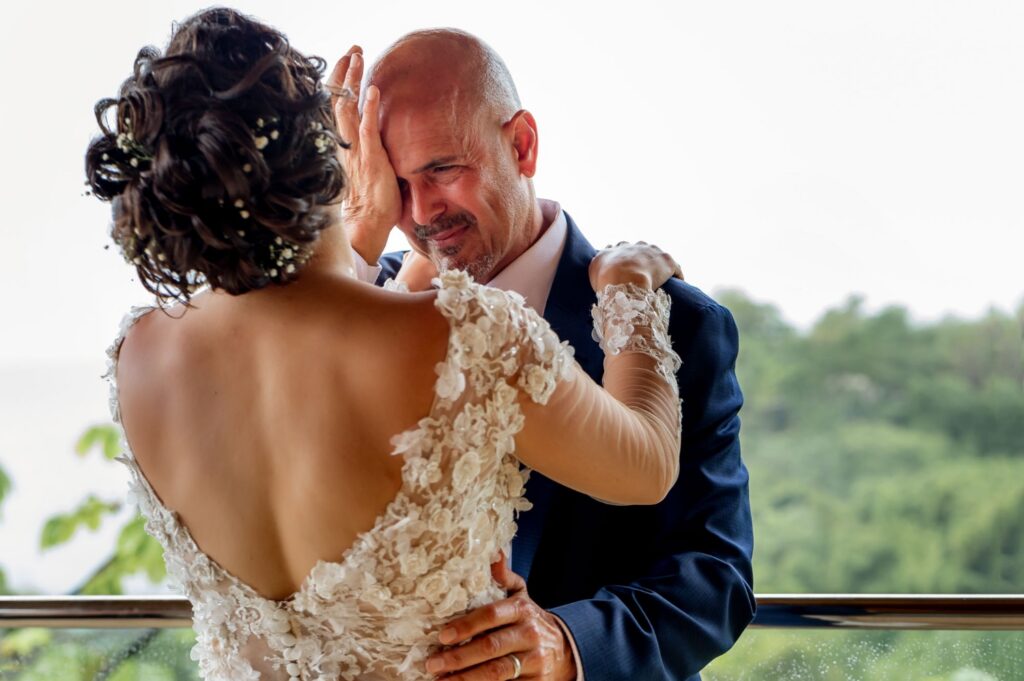
Kevin Heslin’s photograph shows the father wiping away a tear while the bride rests her hand on his shoulder. The gesture of reassurance adds another emotional dimension. Instead of simply documenting his reaction, the image reveals how she responds to it.
The bright landscape and sky create separation around the subjects, while the texture of the bride’s lace dress adds detail to the foreground. Her hand is particularly important because it connects the two figures visually and emotionally.
Small gestures like this are easy to miss when concentrating exclusively on faces. Watch how people touch, comfort, and respond to one another. Those details often explain the emotional significance of the moment.
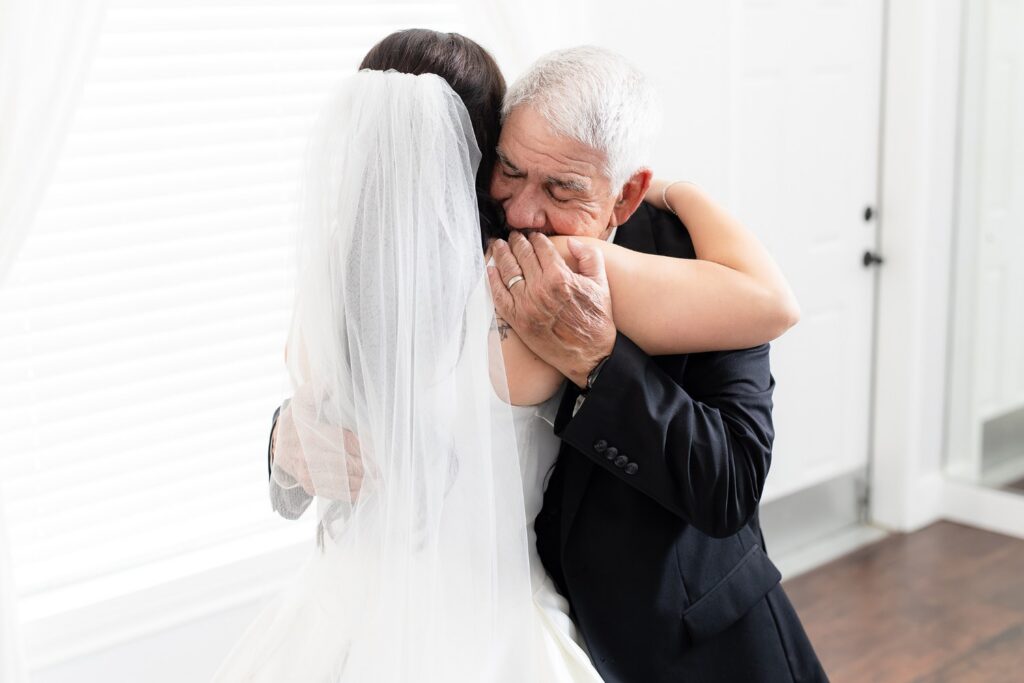
Stefani Ciotti Photography captures the emotional release that follows the first look. The father’s face is pressed against his daughter as they embrace, with her veil adding softness and depth to the composition.
This photograph reinforces why the first look should be approached as a sequence rather than a single planned shot. The initial surprise, the approach, the embrace, and the conversation afterward may all reveal different aspects of the relationship.
Photography takeaway: Before the first look, establish where the father will stand and how the bride will approach. Choose a position that provides a clear view of his expression, ideally with flattering light and an uncluttered background. Use the bride as a foreground element when it strengthens the story, but avoid blocking the father’s eyes or face. Most importantly, keep shooting after he turns around. The best photograph may happen several seconds later.
4. The hug
A hug is one of the simplest human gestures to photograph, but one of the most challenging to make visually compelling. When two people embrace, their faces can disappear behind shoulders, arms, and hair. A small change in camera position can determine whether the resulting image communicates genuine emotion or simply documents that an embrace occurred.
Look for the face that carries the stronger expression, then adjust your angle to reveal it. If both faces are visible, even better. Pay attention to hands, closed eyes, and the way the subjects lean into one another. These physical details communicate the intensity of the connection.
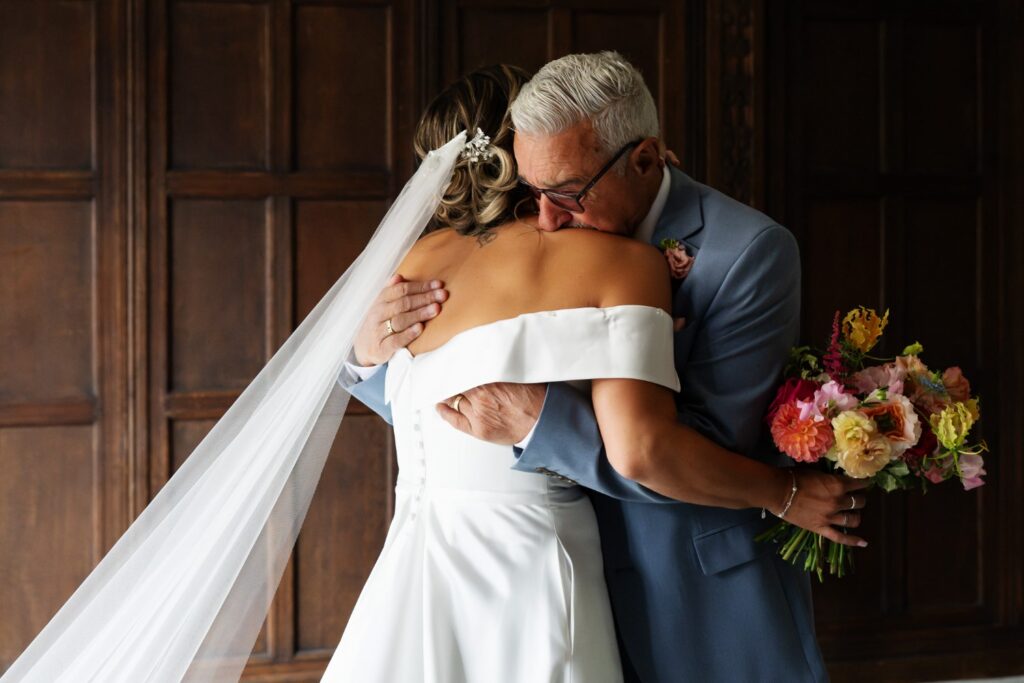
Andy Sidders Photography captures a tender kiss on the bride’s shoulder. The photograph is effective because it emphasizes the small action within the larger embrace.
The dark wood paneling provides a restrained background, while the bride’s dress, veil, and colorful bouquet create visual contrast. The father’s expression remains the emotional center of the frame.
Notice that the photographer doesn’t need both faces to communicate the story. The father’s gesture, combined with the bride’s presence, provides enough information for the viewer to understand the relationship.
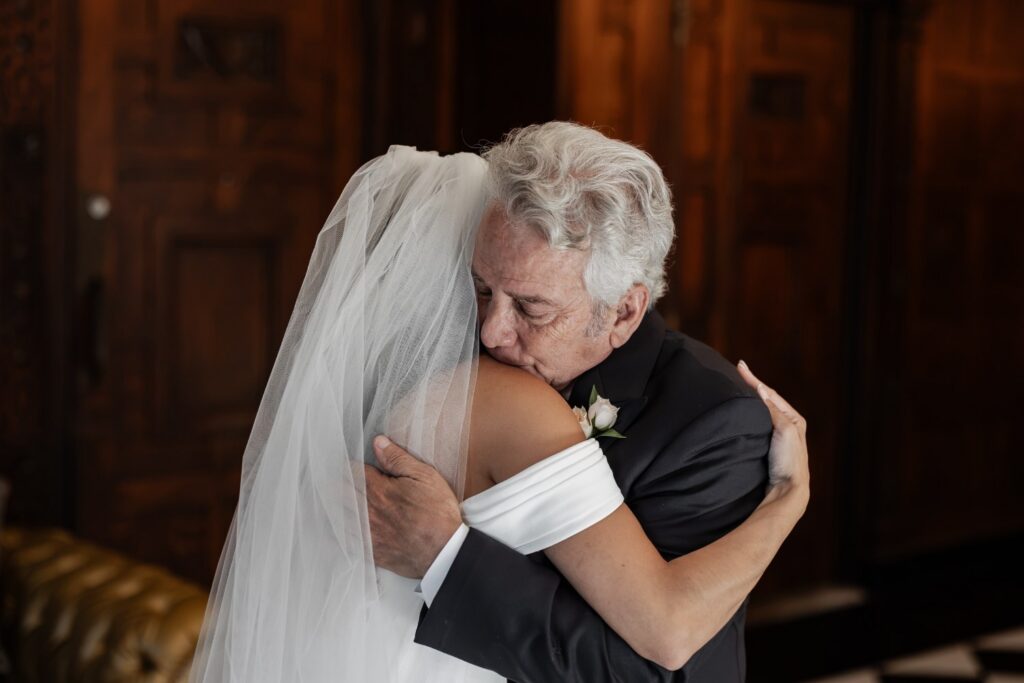
WS Photography documents a similarly intimate gesture, with the father’s eyes closed as he kisses his daughter’s shoulder. The darker room allows the brighter tones of skin and bridal fabric to stand out.
Rather than treating low light as a problem to eliminate, photographers can use contrast to create a more intimate mood. The key is maintaining sufficient detail in the faces while allowing less important areas of the scene to fall into shadow.
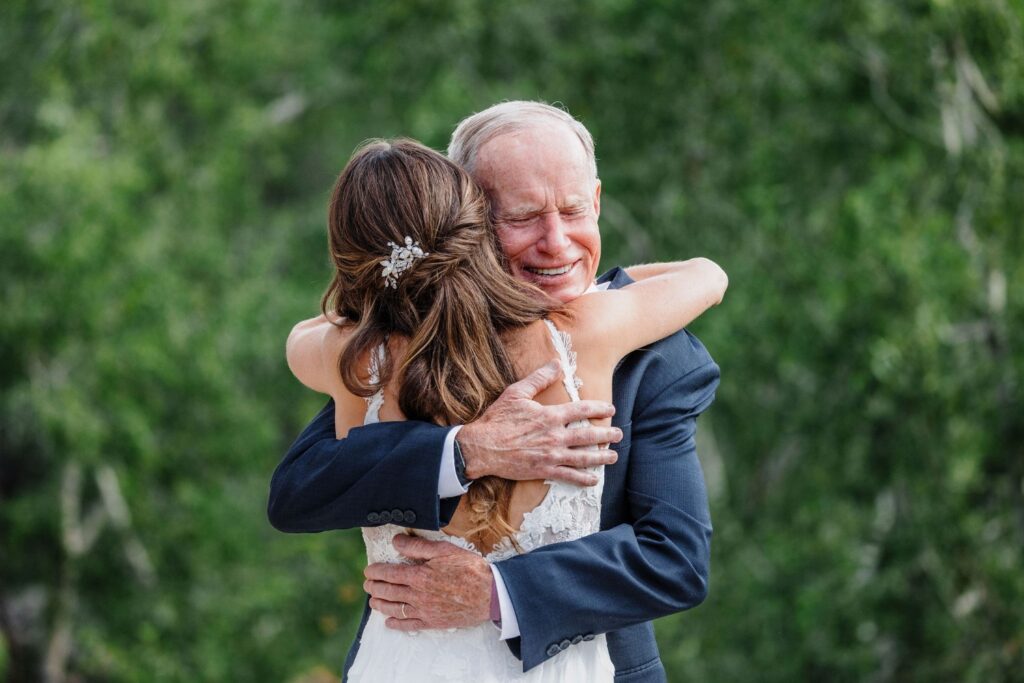
Vow of the Wild offers a more peaceful interpretation of the same theme. The father’s relaxed, closed-eye smile suggests contentment rather than overwhelming emotion.
The soft green foliage creates a pleasing, natural background that doesn’t compete with his expression. By separating the subjects from the background, the photographer allows the emotion to remain the primary point of interest.
It’s a useful reminder that powerful wedding photographs don’t always involve dramatic reactions. Quiet happiness can be equally meaningful.
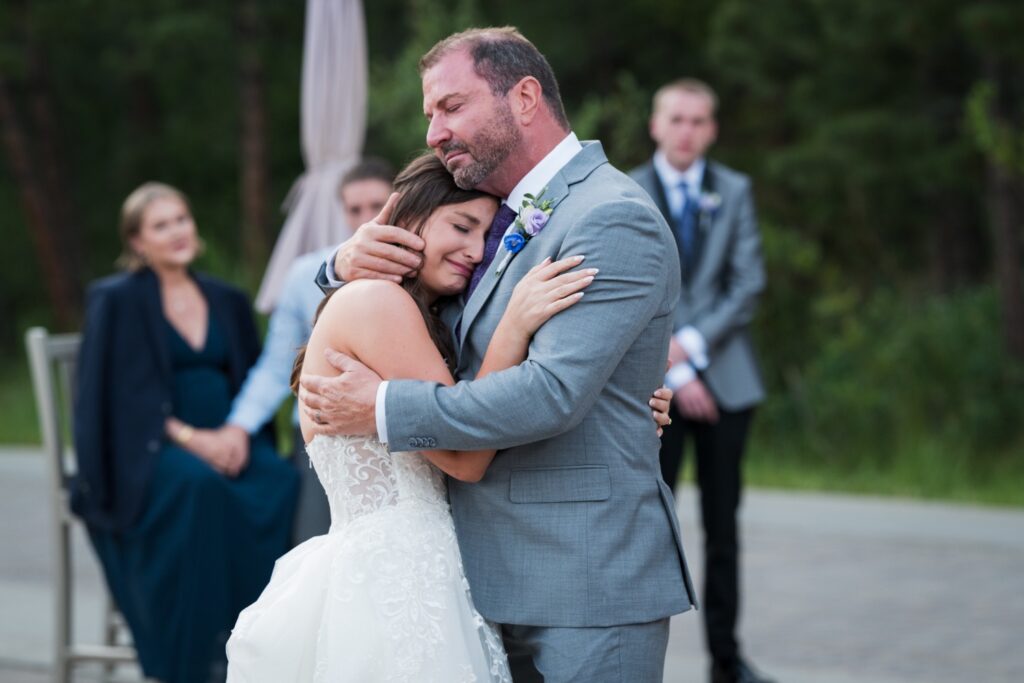
Gretchen Troop Photography captures one of the most emotionally expressive interactions in this collection. Both the father and bride are visibly moved, while his hand gently cradles her head.
The placement of his hand is what makes the photograph especially personal. It transforms a familiar wedding-day embrace into a gesture of protection and affection. This is the kind of detail that can communicate decades of family history without requiring any additional explanation.
When both faces are visible and the emotion is this strong, prioritize the interaction over maintaining a perfectly symmetrical composition.
While close-ups work beautifully for hugs, a wider perspective can be just as powerful when the environment contributes to the story.
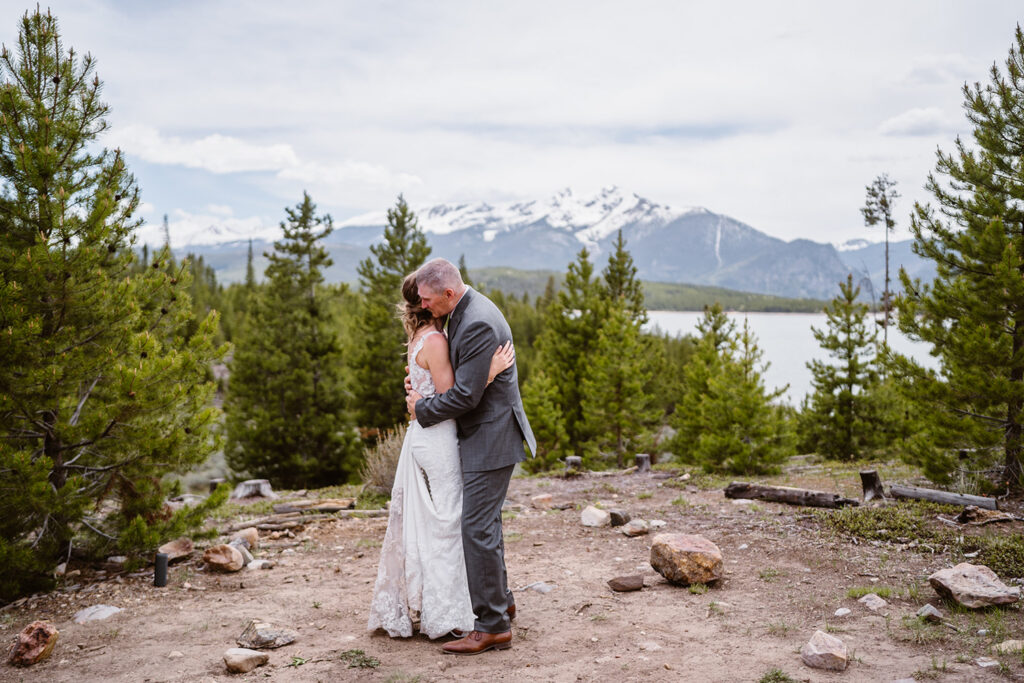
Vows and Peaks positions the embrace within a dramatic mountain landscape. The father and bride occupy a relatively small portion of the composition, surrounded by water, rugged terrain, and a snow-covered peak.
Instead of weakening the emotional impact, the wide composition adds context. It documents not only their relationship but also the setting in which this memory took place.
Environmental portraits like this can be especially valuable for destination weddings and elopements, where the location is often an important part of the couple’s experience.
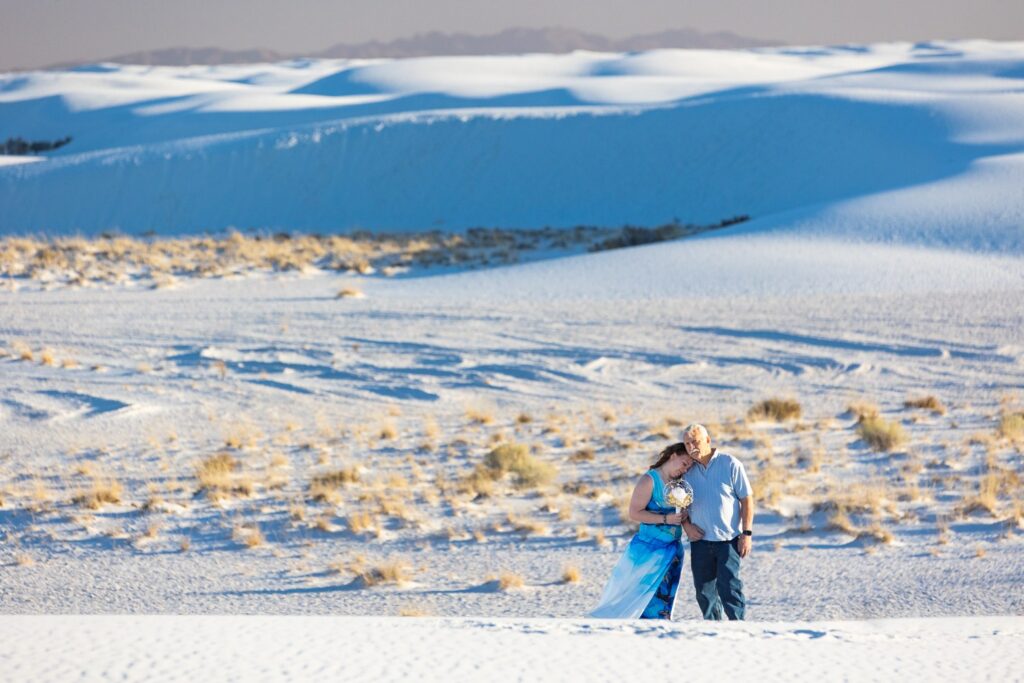
New Zealand Elopements takes environmental storytelling even further, placing the father and bride within an expansive landscape of white sand dunes.
Despite the distance, their interaction remains clear. The bride’s head resting against her father’s shoulder creates a recognizable silhouette and a strong visual connection between the two figures.
The simplicity of the environment is what allows this approach to succeed. With few competing elements, the subjects remain the center of attention even though they occupy only a small part of the frame.
Photography takeaway: For emotionally expressive embraces, move to reveal faces and meaningful gestures without intruding on the moment. Capture both tight and wide compositions when time allows. A close photograph preserves the expression, while an environmental frame preserves the experience and location. Together, they provide a richer visual story.
5. The aisle hand-off
The walk down the aisle is one of the most anticipated moments of a traditional wedding ceremony. However, photographers should pay particular attention to what happens at the end of that walk.
As the bride reaches the altar, there may be a hug, a kiss on the forehead, a whispered exchange, or a moment of hesitation before father and daughter separate. These gestures often carry more emotional weight than the walk itself.
This sequence requires preparation because photographers have limited freedom to move once the ceremony begins. Confirm the ceremony layout, understand any restrictions on photographer positioning, and coordinate with your second shooter when available. Ideally, one photographer covers the processional while another is ready for the interaction at the front.
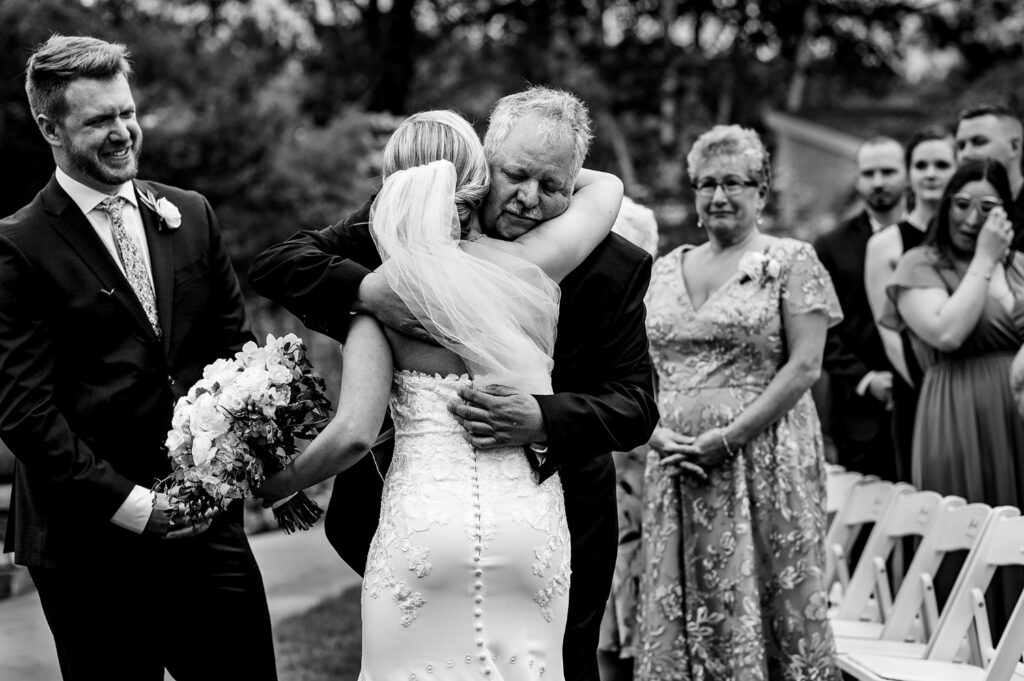
Shukhrat Kamalov Photography creates a layered narrative by including not only the father-daughter embrace but also the groom and emotional guests.
The groom’s smile and the guests’ reactions establish how the moment affects everyone nearby. Rather than isolating the father and bride, the photographer allows the supporting characters to strengthen the story.
This approach is particularly effective when multiple expressions are visible within a single composition. It allows one photograph to communicate the emotional atmosphere of the entire ceremony.
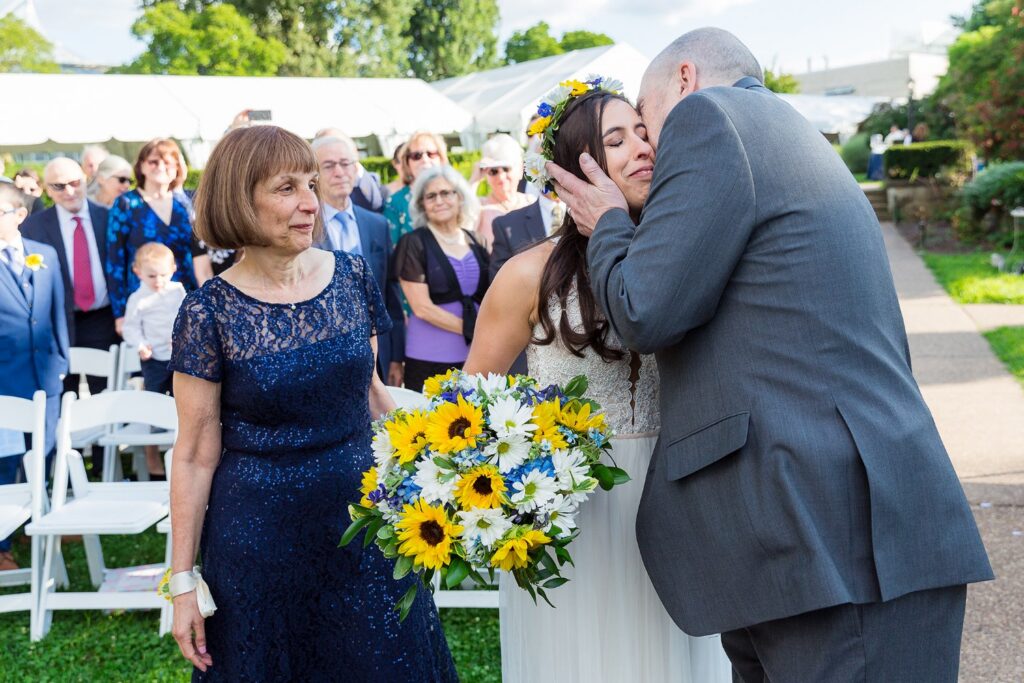
Stefani Ciotti Photography captures a gentle kiss on the bride’s forehead. The gesture is familiar and deeply human, particularly within the context of a wedding ceremony.
The colorful bouquet adds contrast, while another guest’s expression contributes a quieter secondary reaction. These details make the image feel like part of a larger event rather than an isolated portrait.
When photographing this moment, watch the father’s movement toward his daughter. The kiss itself may last less than a second, so anticipating the gesture is more reliable than waiting to react once it happens.
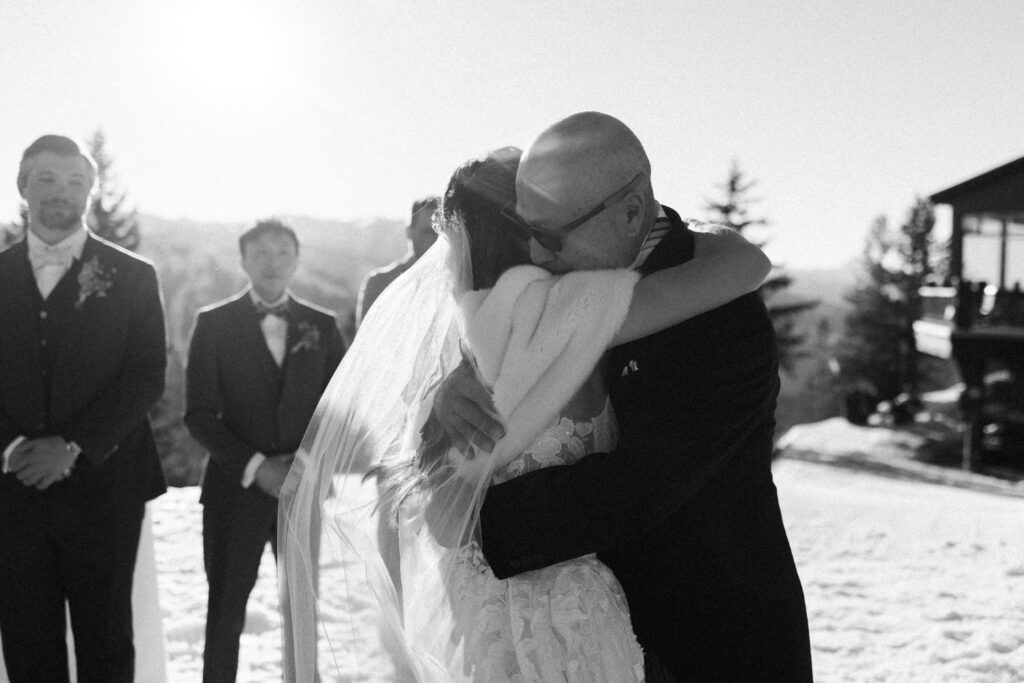
Nina Reed Photography documents an embrace during a snowy outdoor ceremony, using the strong backlight to create a luminous, atmospheric scene.
The bright snow and sunlight introduce a technical challenge: maintaining important facial details without losing the mood created by the light. The black-and-white treatment helps unify the tonal extremes and directs attention toward the subjects.
For strongly backlit ceremonies, expose with particular attention to the faces and review your highlights when possible. A dramatic lighting effect is valuable, but it shouldn’t come at the expense of the emotional expression you’re trying to preserve.
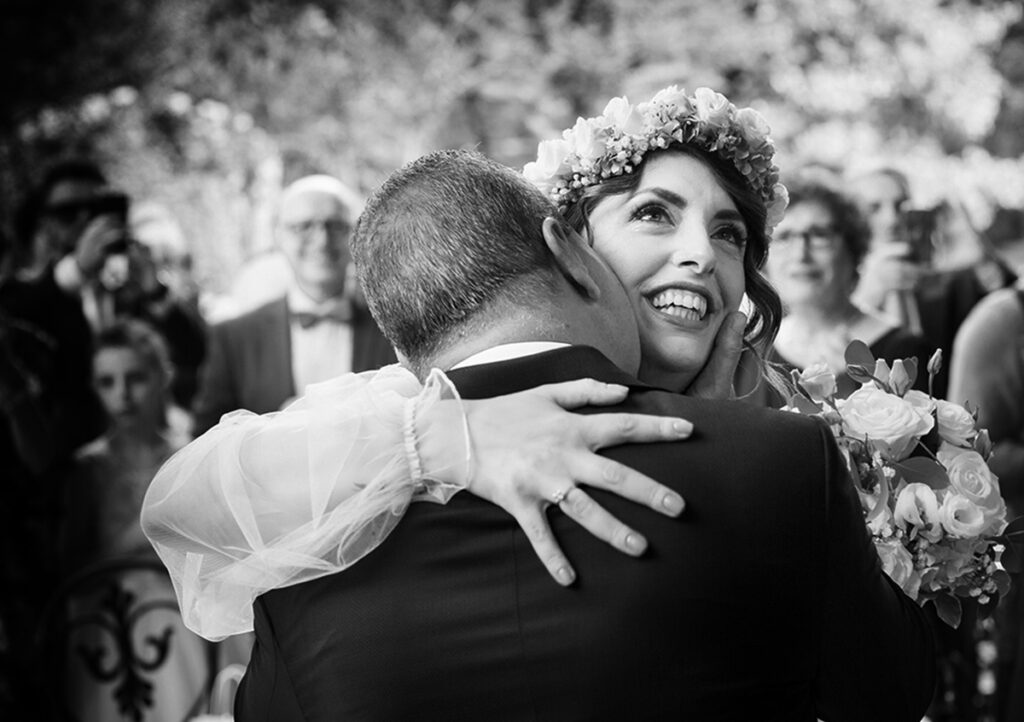
Stefano Ferrier Wedding Photography chooses an angle that emphasizes the bride’s expression as she embraces her father. Her smile, visible over his shoulder, conveys affection and happiness.
This perspective provides an important alternative to the more conventional photograph of the father’s face. The most meaningful expression isn’t always the one you initially expected to capture.
If you’re working with a second photographer, complementary angles can be especially valuable during the aisle hand-off. One person can concentrate on the father’s reaction while the other captures the bride’s face and the surrounding context.
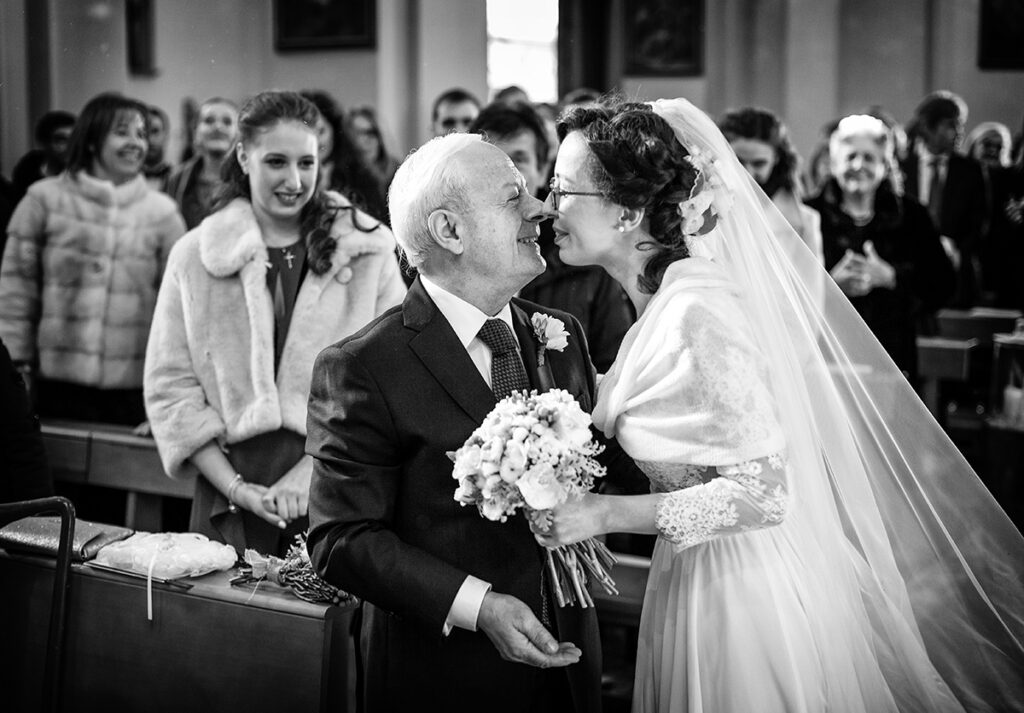
In another photograph, Stefano Ferrier captures a father and bride touching noses at the front of a church. The expression is affectionate and spontaneous, with the surrounding guests providing context.
This is a perfect example of why the camera should remain ready even after the formal hand-off appears to be complete. Sometimes a father takes an extra second to say goodbye, share a joke, or offer one last gesture of affection before returning to his seat.
Photography takeaway: Treat the end of the processional as a distinct photographic opportunity. Plan your position in advance, anticipate the embrace or kiss, and watch both the father and bride for expressions. When possible, incorporate the groom or guests to create a more complete narrative. Continue shooting until the father has returned to his seat, since meaningful reactions can happen after the hand-off.
6. The father-daughter dance
The father-daughter dance is one of the few emotional wedding moments that photographers can anticipate with both certainty and enough time to explore multiple compositions. Unlike a first look or ceremony hand-off, the dance typically lasts several minutes, creating opportunities for wide environmental images, intimate portraits, movement, and reactions from family and friends.
However, the extra time can become a trap. It’s easy to capture dozens of nearly identical photographs of the couple slowly rotating in place. The key is to approach the dance as a short visual story with a beginning, middle, and end.
Start by establishing the setting. Then move closer to capture expressions, hands, and emotional exchanges. Finally, look beyond the dance floor for family members reacting to the moment.
Start with the room and atmosphere.
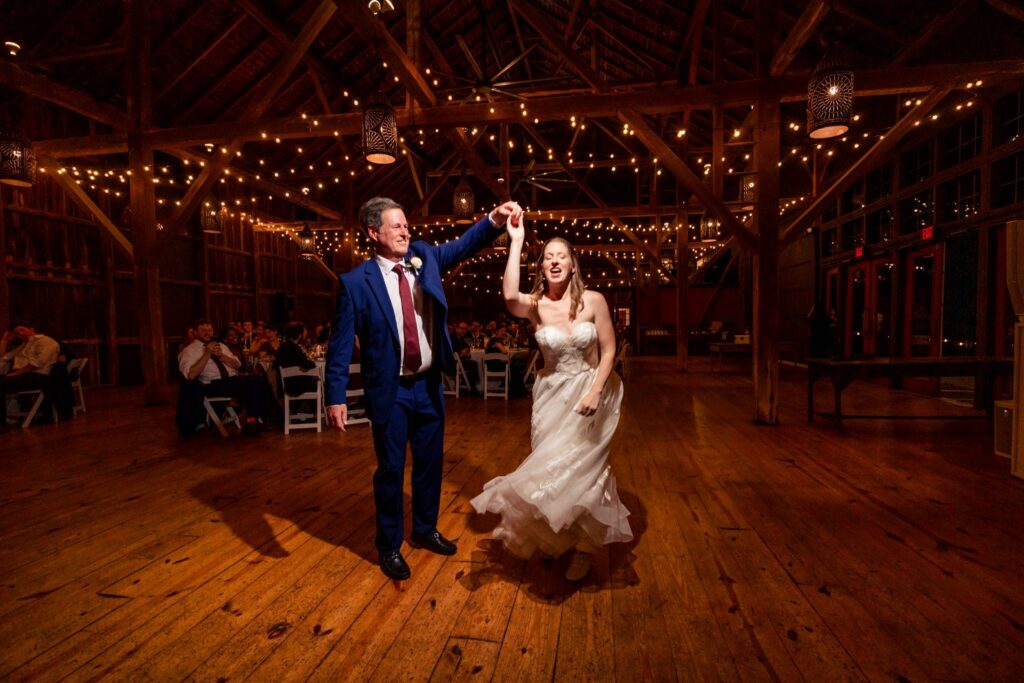
Natasha Lamalle Photography captures a lively twirl beneath string lights and hanging lanterns. The directional light defines the subjects and freezes their movement, while the ambient lighting preserves the atmosphere of the reception.
The photograph works because it communicates both the action and the setting. We see the energy of the dance without losing the environmental elements that make the venue distinctive.
When using flash during a reception, consider balancing it with the ambient exposure instead of overpowering the entire room. Preserving decorative lighting and background detail can make the photograph feel more natural and connected to the event.
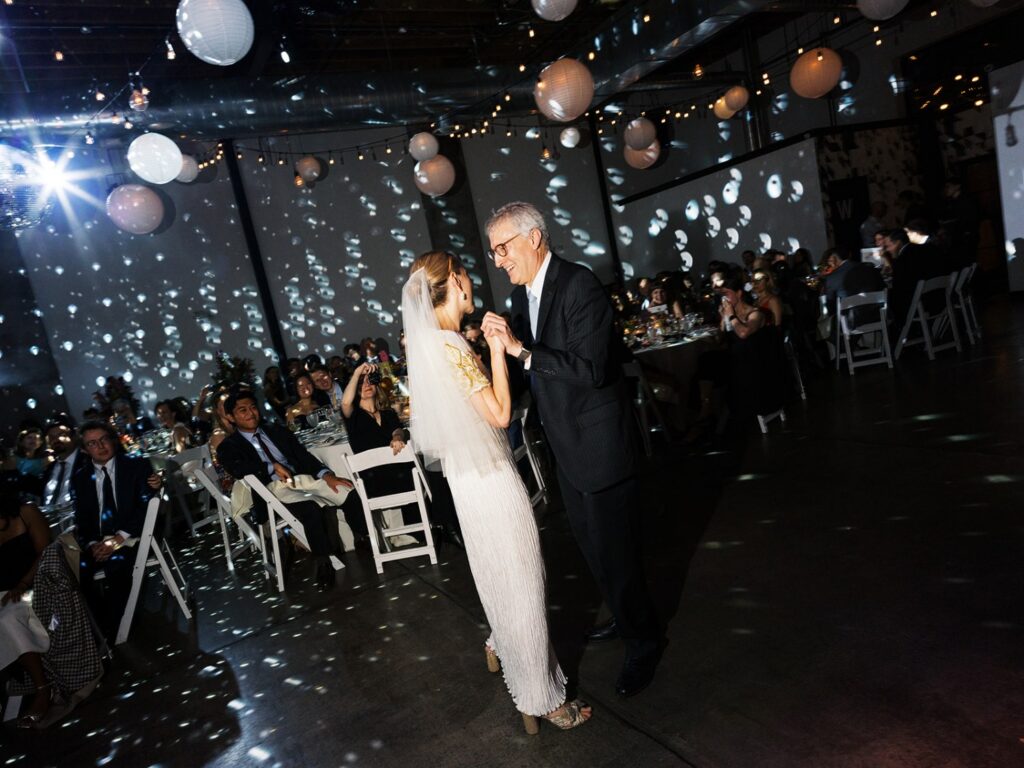
Francis Sylvest | Photo + Cinema uses a wide composition to incorporate the reception’s decorative lighting, projected patterns, and overhead paper lanterns.
The dance becomes part of the larger atmosphere rather than an isolated interaction. This type of establishing image is especially important in a wedding gallery because it records the environment the couple invested time and effort into creating.
Consider photographing these wide compositions early in the dance before moving closer. As the floor becomes crowded or other guests enter, the opportunity for a clean establishing photograph may disappear.
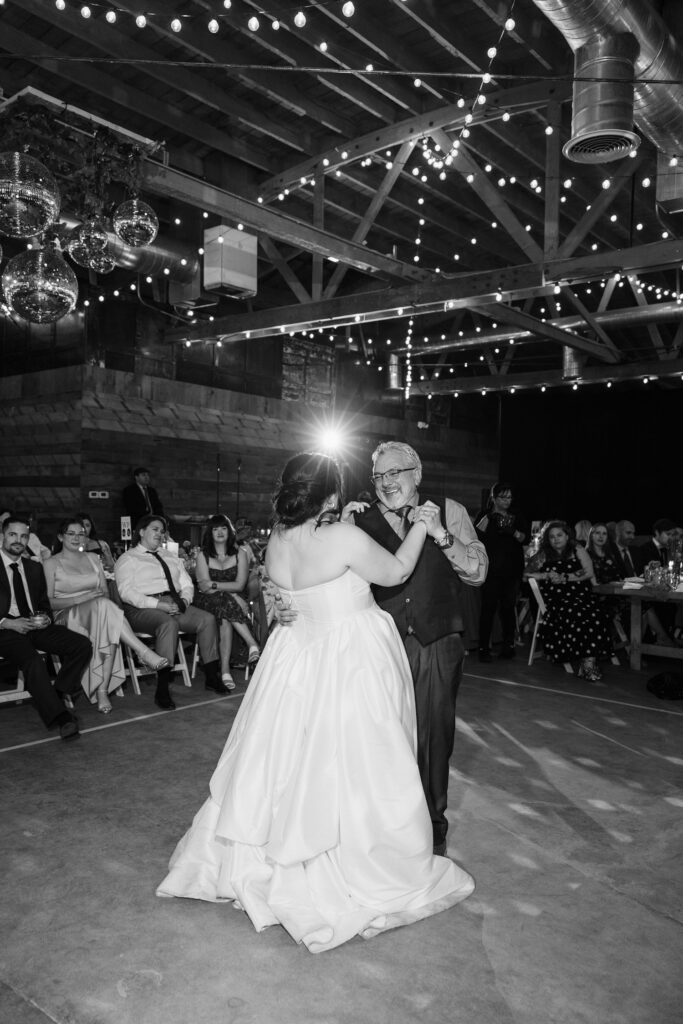
Photography by Belinda Philleo creates a dramatic composition using a light source positioned behind the dancing pair. The resulting flare draws attention toward the subjects while the disco balls and string lights establish the reception setting.
Backlighting can help separate subjects from dark backgrounds, especially when the light creates a visible rim around their outlines. The challenge is positioning yourself so the effect enhances the composition without obscuring the expressions or washing out the entire frame.
Then move closer and focus on the connection.
Once you have established the environment, switch your attention to the interaction itself. Watch the father’s face as he turns toward the camera, but don’t limit yourself to a single angle. His expression may change dramatically throughout the song.
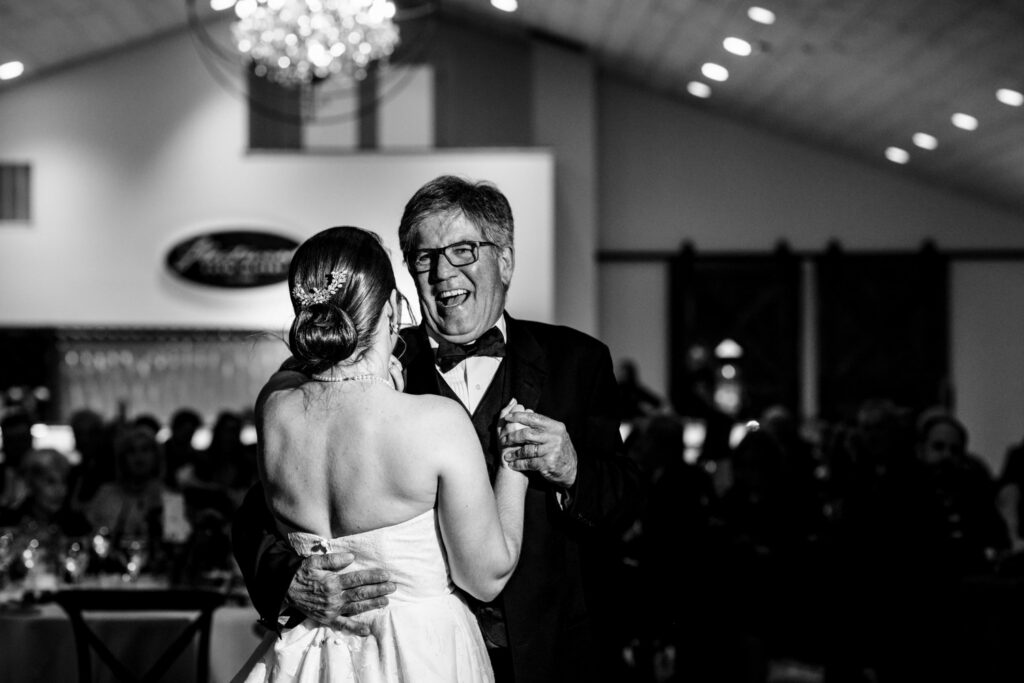
Natasha Lamalle Photography captures a father laughing during the dance, demonstrating that this tradition can be joyful and playful rather than exclusively sentimental.
His expression becomes the clear subject, while the darker background helps minimize distractions. The image feels spontaneous because the photographer has captured a genuine reaction rather than asking him to smile.
Look for moments when the father and daughter exchange a few words, make eye contact, or laugh together. These interactions often occur between more formal dance movements.
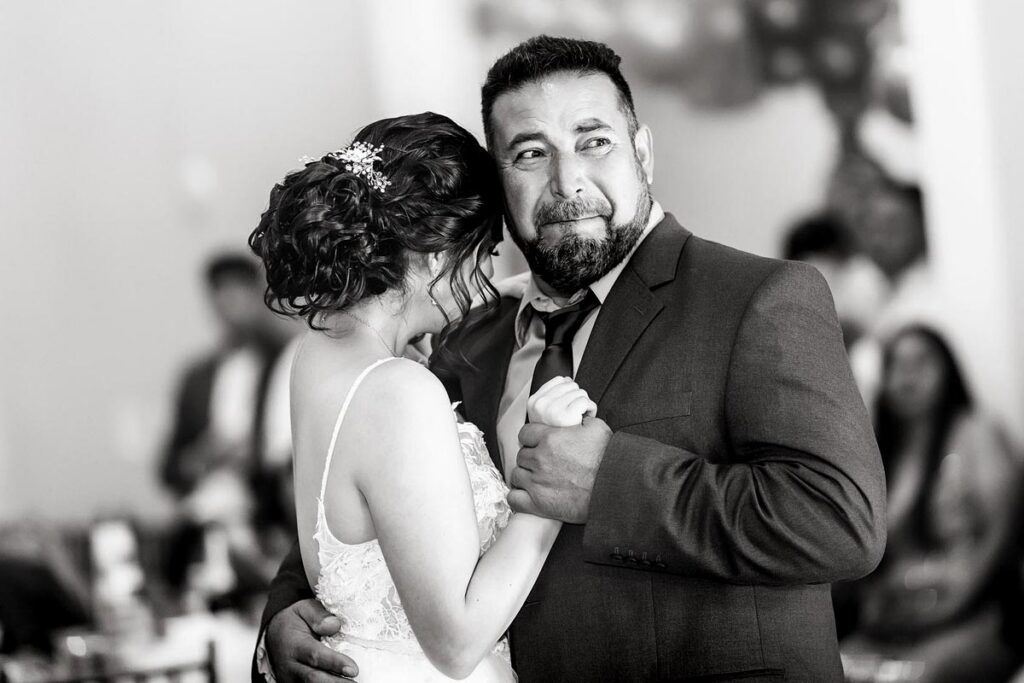
Katinov Photography & Videography captures an emotional father holding his daughter’s hand close to his chest. The gesture provides a strong visual expression of affection, while the bride’s hairstyle frames his face.
What makes this photograph successful is the relationship between the facial expression and the physical gesture. Both communicate the same emotion, reinforcing the story without requiring additional context.
During slow dances, hands can be just as expressive as faces. A tighter grip, a hand on the back of the head, or a gentle touch can communicate affection that might otherwise go unnoticed.
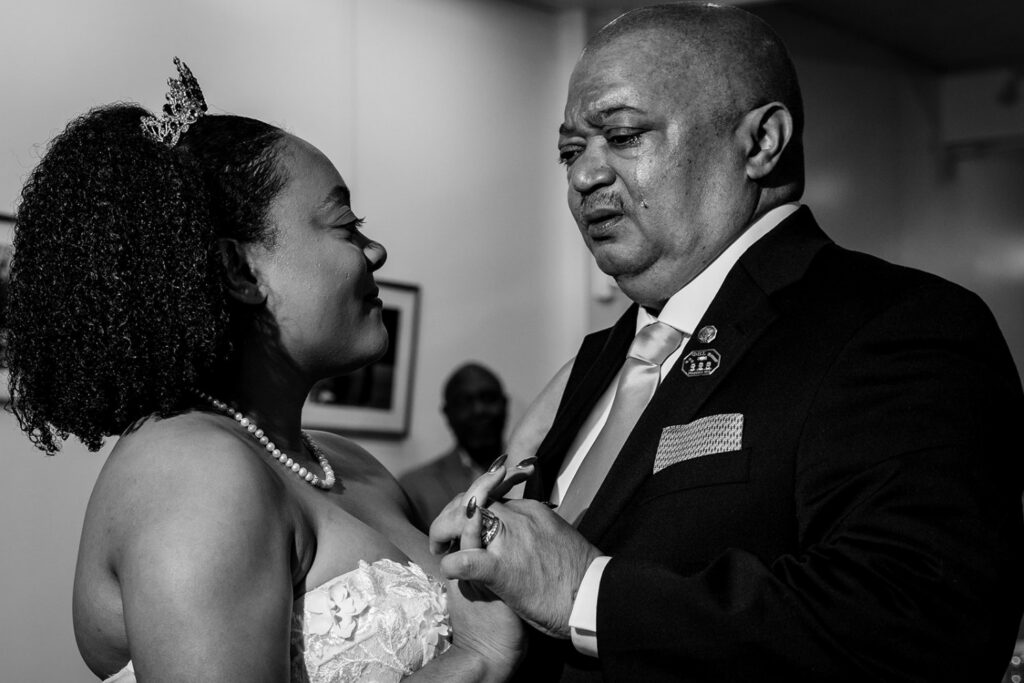
Potok’s World Photography freezes a particularly meaningful instant: a tear on the father’s cheek as his daughter smiles up at him.
The contrast between their expressions gives the photograph emotional complexity. He is visibly overwhelmed, while she responds with warmth and affection.
For these close emotional portraits, prioritize sharp eyes and a shutter speed that accounts for the subjects’ movement. Even a slow dance includes enough motion to introduce blur when working at very low shutter speeds.
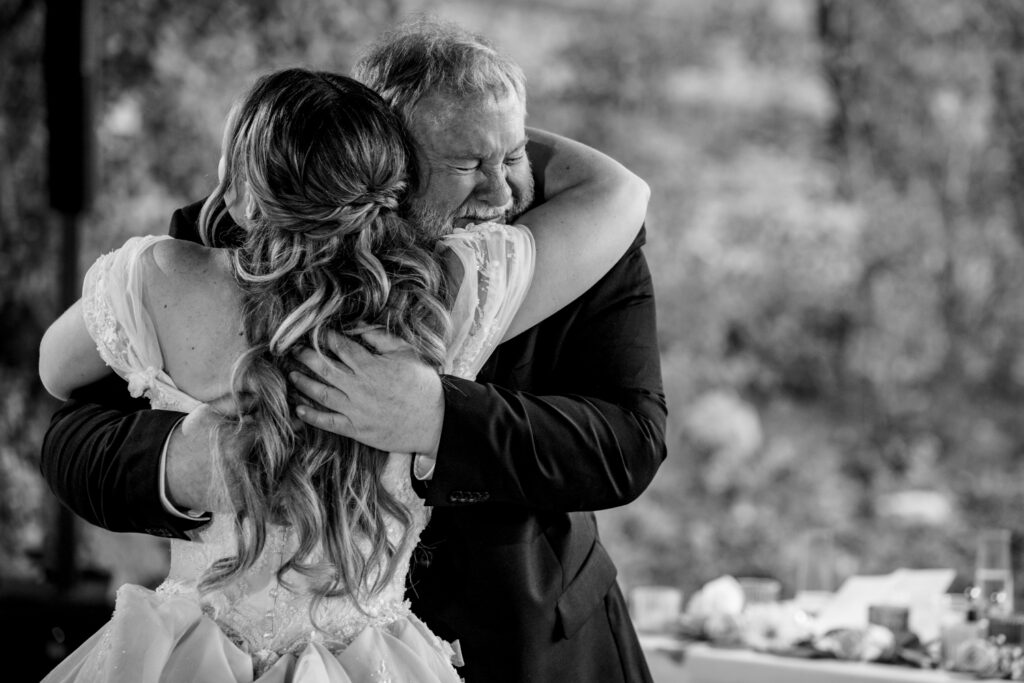
Gretchen Troop Photography captures the intensity of a close embrace, with the father’s eyes tightly closed.
The tight composition removes nearly all environmental distractions, encouraging the viewer to concentrate on the expression. It’s an effective contrast to the wide dance-floor photographs shown earlier.
When editing a complete wedding gallery, including both perspectives creates a more engaging sequence. One image shows where the moment happened; another reveals what it felt like.
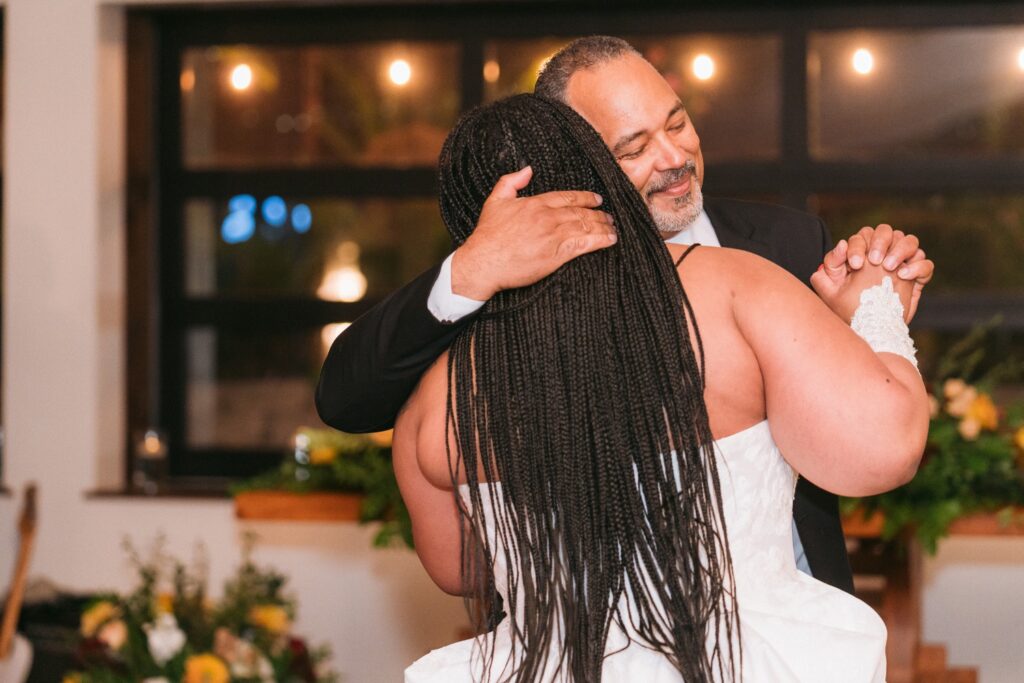
Let’s Make a Memory captures a quieter moment, with the father’s eyes closed as he holds his daughter during their dance. The warm background lights add atmosphere while allowing the interaction to remain dominant.
Notice how the hands and body language help communicate the emotional connection. Neither subject needs to face the camera directly for the photograph to feel intimate.
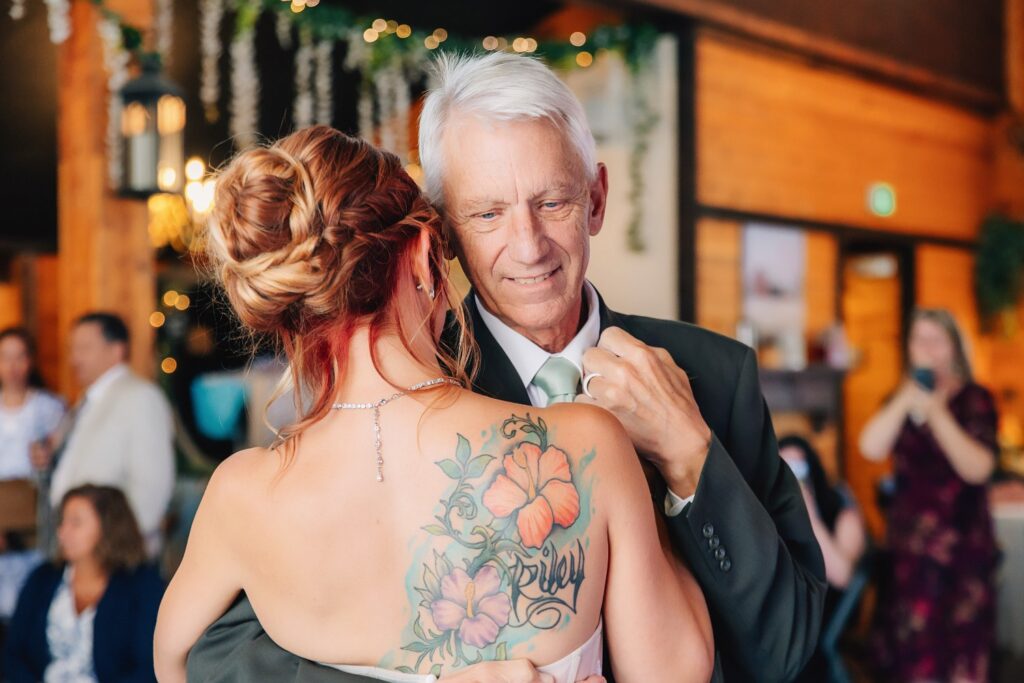
Katinov Photography & Videography captures a warm smile as the father looks down toward his daughter. Her distinctive back tattoo becomes part of the foreground, adding a personal visual element to the composition.
Including recognizable details like clothing, jewelry, tattoos, and hairstyles can help make an emotional photograph more personal. These elements provide context and individuality without distracting from the human connection.
Finally, look beyond the dance floor.
While the father and bride are the obvious subjects, the people watching them can contribute another layer of storytelling. A mother wiping away tears, siblings laughing, or friends applauding can make the photographic coverage feel more complete.
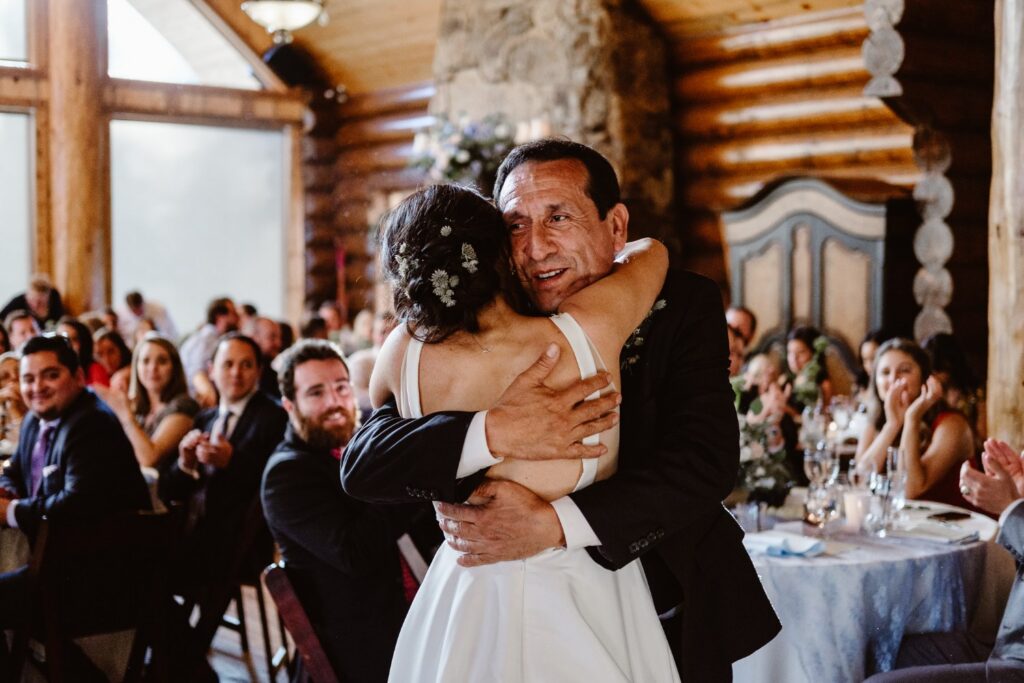
Nina Reed Photography includes the surrounding guests as they applaud an embrace inside a rustic lodge. The expressions around the couple help establish the collective emotion of the room.
The environmental details, including the wooden interior and gathering of guests, provide a sense of place. This is an excellent example of using a wider composition to show how an intimate moment is being shared by the larger wedding celebration.
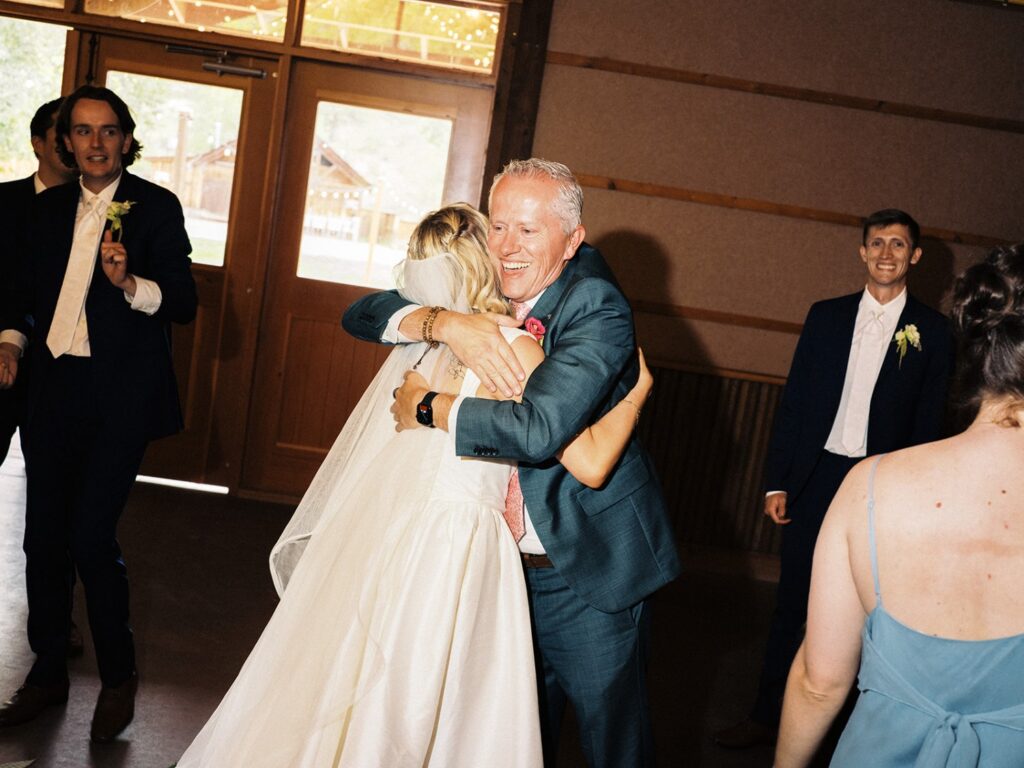
Francis Sylvest | Photo + Cinema uses the smiling groomsmen surrounding the embrace to add warmth and humor to the composition.
These secondary reactions can change the emotional tone of a photograph. Rather than concentrating solely on the father and bride, the image communicates that the moment is being celebrated by the people around them.
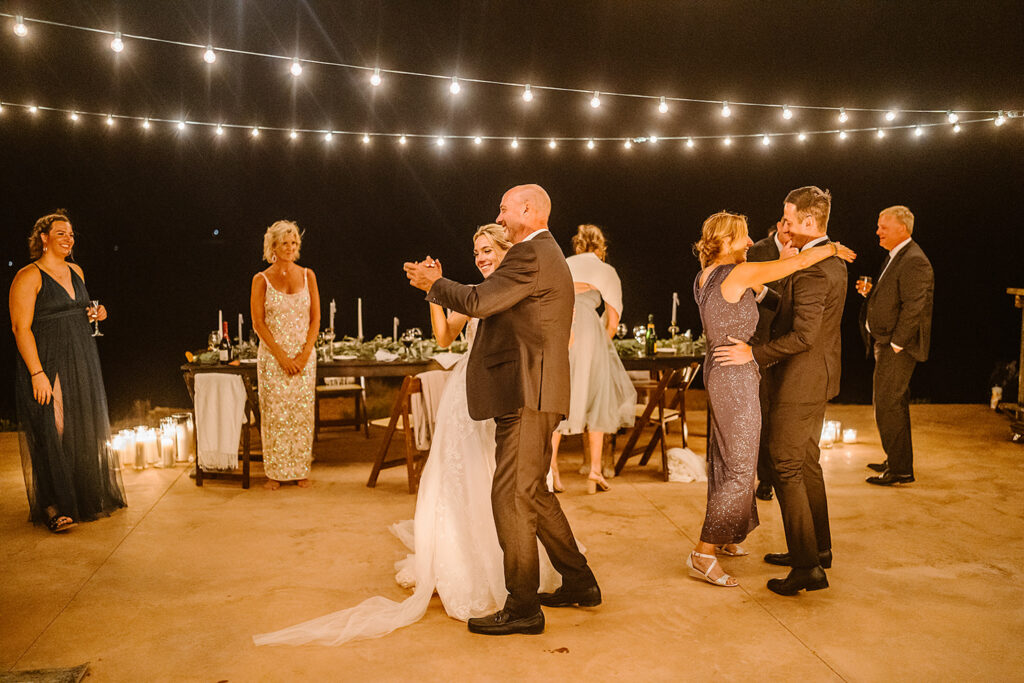
Vows and Peaks pulls back to capture a nighttime dance beneath string lights, with another couple dancing nearby. The wide perspective preserves the relaxed outdoor atmosphere and presents the family interaction within the broader celebration.
This approach is especially effective when multiple meaningful interactions are happening simultaneously. Not every important wedding photograph needs to isolate one couple or one expression. Sometimes the relationships between people within a larger scene create a more complete story.
Photography takeaway: Approach the father-daughter dance with a deliberate shot sequence. Capture a wide establishing photograph, move in for expressive portraits, look for meaningful details, and include the reactions of nearby family members. Anticipate changes in movement and expression rather than remaining in one position for the entire song. For lighting, aim to preserve the room’s atmosphere while keeping faces readable and sharp. The goal is a varied, emotionally complete collection rather than dozens of similar dance photographs.
7. The goofy dad
Not every father expresses love through tears or sentimental speeches. Some show their affection through humor, practical jokes, and an enthusiastic willingness to embarrass themselves on the dance floor.
These photographs deserve just as much attention as the emotional moments. In fact, they can be among the most personally meaningful images in a wedding gallery because they reveal a parent’s familiar personality.
A father who is known for making his daughter laugh may be remembered more accurately through a ridiculous dance move than through a formal portrait. Good storytelling means recognizing what makes each relationship unique rather than expecting every family to express affection in the same way.
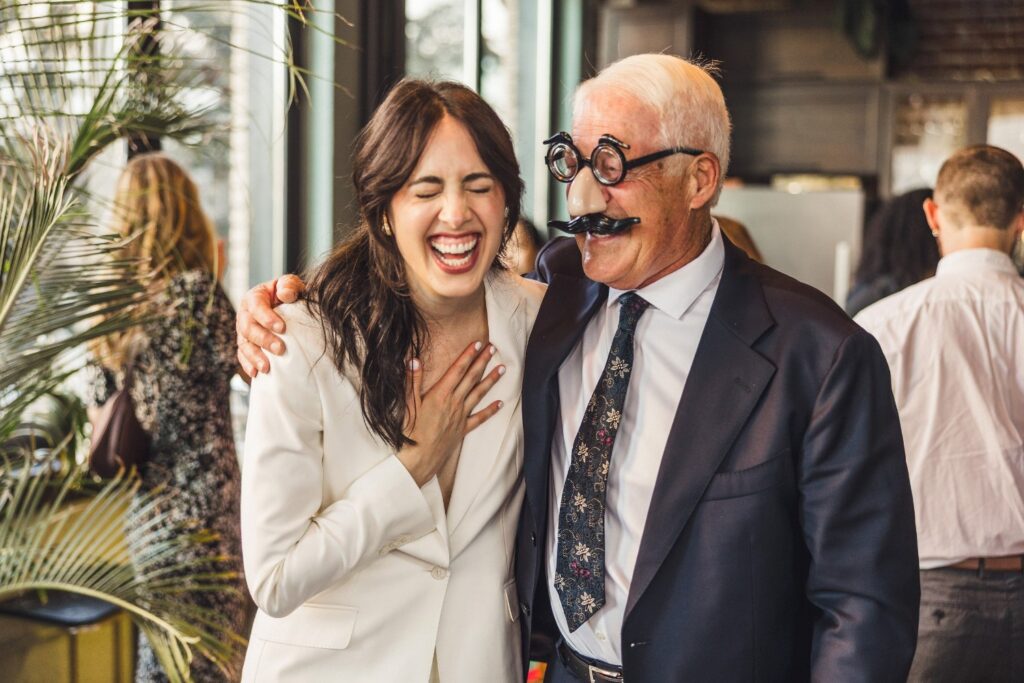
Tekoa Rose Photography captures a father wearing novelty glasses and a mustache, with the bride laughing beside him.
The photograph is memorable because the interaction reveals personality. The novelty accessories provide the visual humor, but the bride’s genuine laughter is what gives the image emotional value.
When photographing playful moments, include the reaction whenever possible. A joke becomes much more meaningful when the viewer can see how another person responds to it.
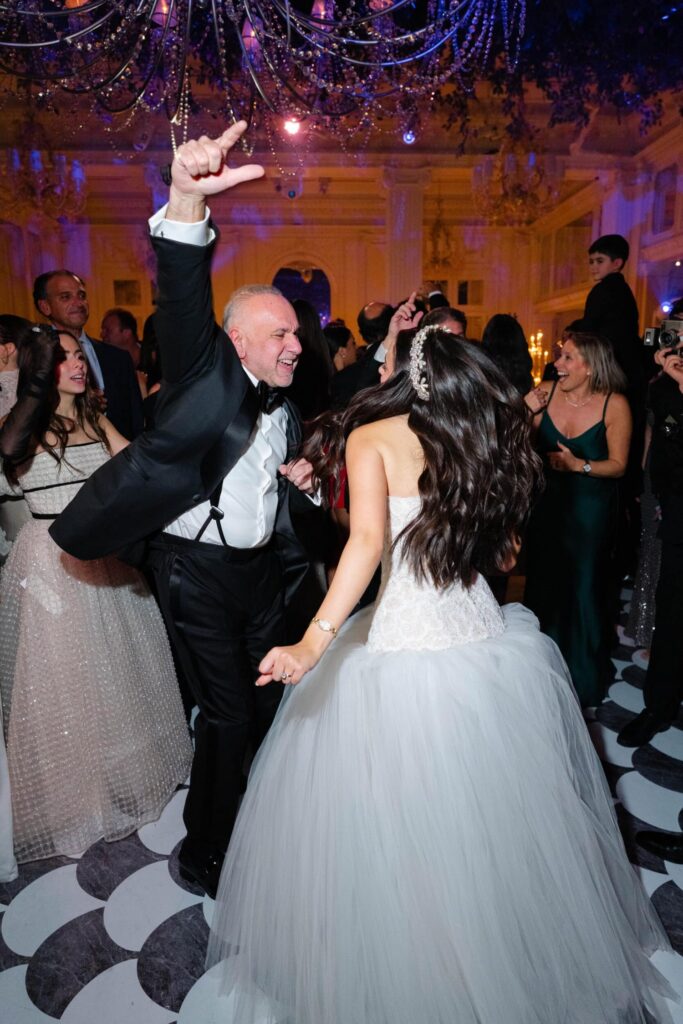
Zac Green Photo captures a father enthusiastically dancing beneath the chandeliers of an elegant ballroom. His raised arm and expressive movement create an energetic scene that contrasts with the formal setting.
The vertical composition accommodates his movement and emphasizes the height of the room. This is a useful reminder that changing camera orientation can help reinforce the energy and direction of a subject’s actions.
For animated dance-floor moments, anticipate peak gestures rather than firing continuously without considering the composition. An extended arm, expressive posture, or perfectly timed facial expression can make the difference between an ordinary reception photograph and a memorable one.
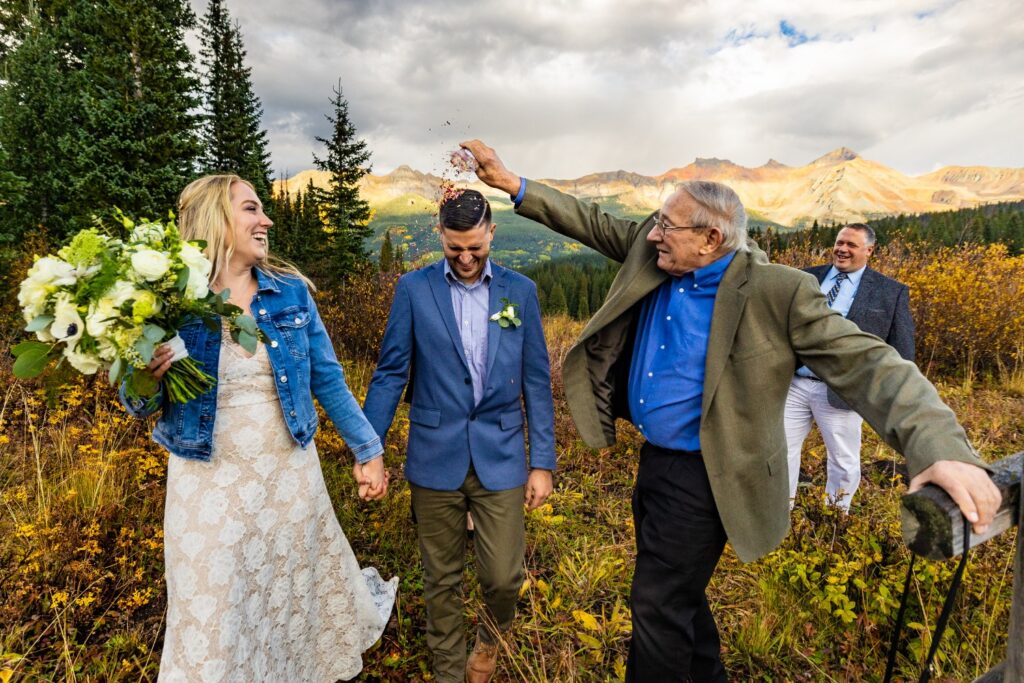
New Zealand Elopements catches a playful father tossing flower petals over the groom as the couple walks past. The action introduces humor into a beautiful mountain setting.
What makes this photograph interesting is the contrast between the grand scenery and the lighthearted interaction. The environment is visually impressive, but the father’s behavior gives the photograph its character.
Photography takeaway: Learn something about family personalities before the wedding when possible, but remain open to surprises. Photograph the joke, the person making it, and the reactions it creates. Avoid forcing humor or interrupting spontaneous interactions with posing instructions. Often, the images that make a family laugh years later are just as valuable as the ones that make them cry.
8. The other fathers
While father-daughter photographs are a familiar wedding tradition, the definition of an important father figure varies from family to family. Some brides have a biological father and a stepfather who both play meaningful roles. Others are especially close to grandfathers, adoptive fathers, uncles, or other people who helped raise them.
It’s equally important not to overlook the groom’s relationship with his father or the meaningful connections between parents and other family members.
Rather than assuming which relationships matter most, ask the couple during the planning process. A simple conversation about family dynamics can reveal photographic opportunities that might otherwise be missed, while helping the photographer navigate sensitive circumstances respectfully.
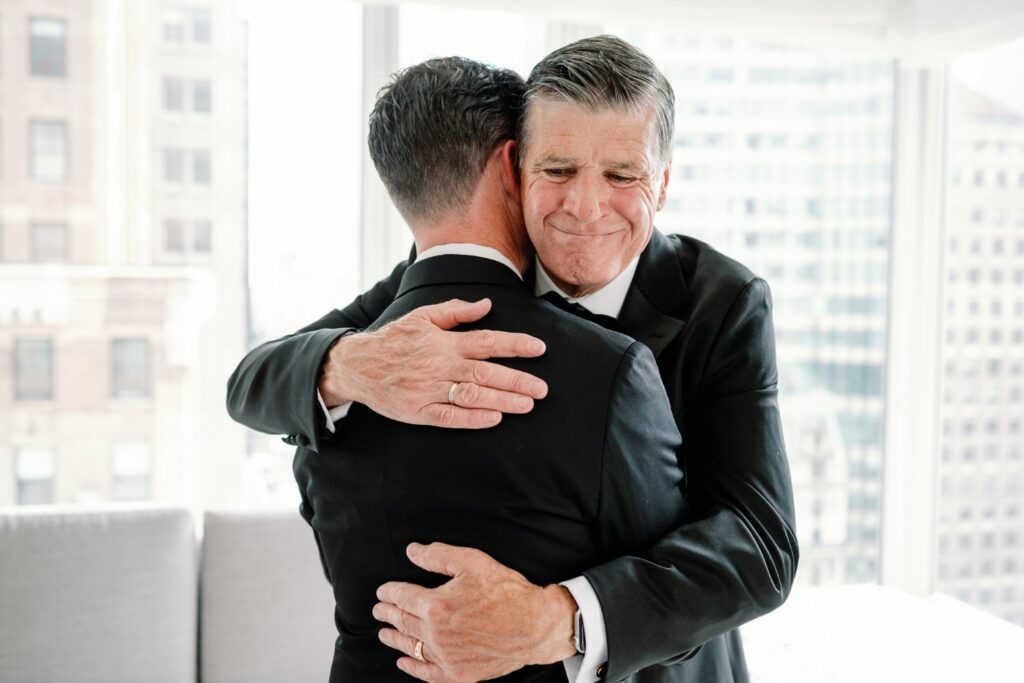
Shukhrat Kamalov Photography documents a father embracing his son near a large window overlooking the city.
The image carries the same emotional significance as the father-daughter interactions throughout this collection. The groom’s relationship with his parents can be just as meaningful, even though traditional wedding photography often devotes less attention to these moments.
For more balanced coverage, look for opportunities during the groom’s preparations, family portraits, ceremony, and reception to capture genuine interactions with his parents.
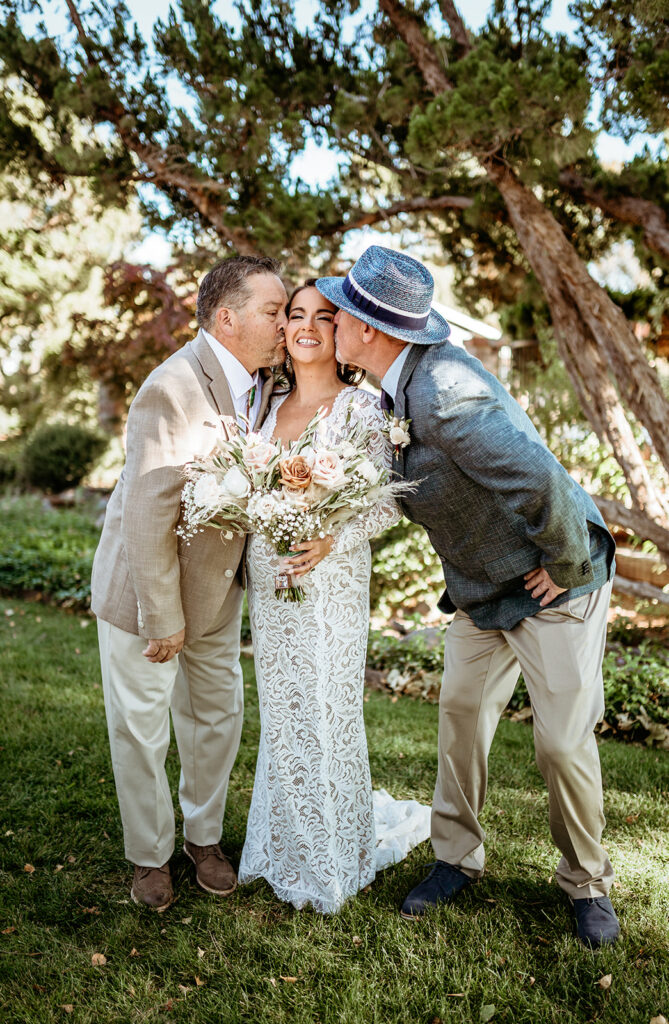
Stratus Adventure Photography captures a bride receiving simultaneous kisses from two father figures. The balanced composition and playful gesture create a photograph that celebrates both relationships together.
This type of image is particularly meaningful because it recognizes that family relationships are not always represented by traditional wedding roles. For the photographer, the important step happens well before the camera is raised: understanding who these people are and why they matter to the couple.
Photography takeaway: Include thoughtful questions about family relationships in your wedding questionnaire or planning consultation. Ask who the couple considers their important parental figures, whether any special interactions are planned, and whether there are family circumstances you should be aware of. Never assume that traditional titles accurately describe every relationship. Thoughtful preparation helps ensure that the people who matter most are represented in the final gallery.
Quick checklist
Capturing meaningful father-daughter photographs requires a combination of preparation, technical awareness, and the ability to recognize authentic interactions. Use the following checklist when planning your coverage.
- Understand the family relationships. Ask about fathers, stepfathers, grandfathers, and other important parental figures. Include the groom’s family, and discuss any sensitive circumstances before the wedding.
- Identify meaningful opportunities. Look beyond formal portraits to getting-ready interactions, quiet moments before the ceremony, first looks, processional hand-offs, dances, speeches, and spontaneous celebrations.
- Plan father-daughter first looks carefully. Choose a location with flattering light and a clean background. Position yourself to see the father’s face, and consider using the bride as a natural foreground element.
- Prepare for the aisle hand-off. Confirm ceremony restrictions and your shooting position in advance. Anticipate hugs, forehead kisses, and whispered exchanges at the front of the aisle.
- Work through a complete dance sequence. Start wide to establish the environment, then capture expressions, hands, and personal interactions. Include reactions from guests and family members.
- Watch the background. Doorways, windows, foliage, and architectural features can create natural framing. Reduce visual distractions when possible, but preserve environmental details when they contribute to the story.
- Capture more than one expression. A single interaction may move from surprise to tears, laughter, and an embrace. Keep photographing through the transition instead of lowering the camera after the first reaction.
- Prioritize genuine emotion over perfect posing. Give family members room to interact naturally. Your role is to anticipate and document their connection, not to manufacture a reaction for the camera.
- Create variety in the final gallery. Combine environmental photographs, medium compositions, tight emotional portraits, and meaningful details. This produces a richer story than a collection of nearly identical close-ups.
Ultimately, the strongest father-daughter wedding photographs are not necessarily the ones with the most dramatic expressions or elaborate lighting. They are the images that feel unmistakably personal to the people in them.
A father holding back tears, a daughter laughing at an embarrassing joke, or two people standing quietly together can all become extraordinary photographs when captured with intention.
As photographers, we cannot control how these moments unfold, and we shouldn’t try to. What we can do is understand their importance, anticipate where they might happen, and use our technical and creative skills to preserve them. Years from now, when the flowers, decorations, and other wedding details have faded from memory, these photographs may be among the most meaningful images in the entire collection.
See more from the photographers in this article: Let’s Make a Memory, Kevin Heslin, Stratus Adventure Photography, Zac Green Photo, Andy Sidders Photography, WS Photography, Tekoa Rose Photography, Potok’s World Photography, LLC, Stefani Ciotti Photography, Vow of the Wild, Gretchen Troop Photography, Vows and Peaks, New Zealand Elopements, Shukhrat Kamalov Photography, Nina Reed Photography, Stefano Ferrier Wedding Photography, Natasha Lamalle Photography, Francis Sylvest | Photo + Cinema, Photography by Belinda Philleo, Katinov Photography & Videography.