What justifies a $500 price versus a $2,500 price for a similar product or service? Put another way, how is value actually determined? For a lot of you, this might not matter much. For some of you, it could completely change how you think about your business. And funny enough, it all starts with a photographer calling me a grifter.
“You Are Insufferable”
Let’s call him Cody (not his real name). Cody was a member of my group, and I’d just posted about my new AI Foundations course, which teaches photographers how to use practical AI for all the mundane work that doesn’t bring any humanity into their brand.
Cody’s response: “God damn, you are insufferable.”
A few minutes later, I replied asking why he was even in the group. By then, he’d already left.
So I did something I don’t normally do. I reached out to him directly. A friend asked me why I’d bother. Honestly, I wanted to know if there was any justification for how Cody felt. Was I doing something specific, or was he just angry? Either way, I learn a lot about mindset from these conversations, because they show me where a lot of us live in our heads.
When Sales Matters More Than Value
Cody opened with, “Well, you’re a great salesperson.” Thank you, Cody. “But I find you to be such a grifter.”
A little harsh. So I asked him what makes me a grifter. I wasn’t trying to goad him. I genuinely wanted to understand his perception, and his answer was: when sales becomes more important than actually providing value.
Honestly? He’s absolutely right about that. When making money becomes more important than providing value, that’s manipulation, 1,000%. (Grifting goes a step further into con man territory, which is illegal.) But I teach the exact opposite in practically every piece of sales training I’ve ever done, so I kept digging.
It came down to price. “I think you care more about dollars than helping people,” Cody said. “Your courses are outrageously priced. They could be so much cheaper.”
I assume he meant my mentorship, which starts at around $4,000 for a full year. That’s more than most courses, no question, though I also have courses that start at $100 and $300. So in Cody’s view, I’m a grifter because it costs a lot of money.
“Why Not Charge $10 for Your Headshots?”
Instead of arguing, I turned the question around on his own business.
Cody was making the classic mistake a lot of photographers make: his website offered everything. Real estate, headshots, family portraits, weddings, drone work, corporate events. I also noticed he’d recently run a promotion for $113 headshots.
So I asked: why not make them free? Why charge so much?
He said he needed the promo to be cheaper because his normal rate is around $150, and not many people were booking at that price. So I pushed a little. Why is your normal rate $150? Are you a grifter? Why not charge $10? Or $25?
In Cody’s own words: “That’s silly.”
Tell me why.
I’m not sharing this to put Cody on blast. I changed his name for a reason. I’m sharing it because this is a mindset a huge number of photographers share, and honestly, a lot of business owners in general.
The Myth: A Fair Price Is a Low Price
The mindset goes like this: a fair price equals a low price, and a low price is how I establish value.
That’s completely untrue. It’s the myth I want to break.
Value comes from the result. It comes from what clients can do with what you create for them, or what someone can do with the product or service you provide. It doesn’t come from the price.
Picture a $250 Wedding. Now Picture a $10,000 Wedding.
Try this quick exercise. Picture two wedding photography offerings. I’m not going to tell you what the images look like or what the experience is like. Just imagine the deliverable.
First: wedding photography for $250. Incredible value, right? Picture it.
Now: wedding photography for $10,000. What comes to mind?
For most of us, the $250 version brings up images that aren’t shot very well. Cheesy, dated photos. Bad editing. The $10,000 version? Crazy destinations, adventurous images, something special. What you pictured is personal, but the quality bar in your head jumped the moment the price went up.
If anything, price is an indicator of value. Whether you deliver on it is a completely separate story. If I charge someone $10,000 and don’t deliver amazing images and a great experience, that’s a real problem. But the price point itself shaped the perceived value.
Researchers have seen the same thing with wine. Serve people the same wine with two different price tags, and they’ll report that the “expensive” one tastes better. Same bottle, different price, different experience.
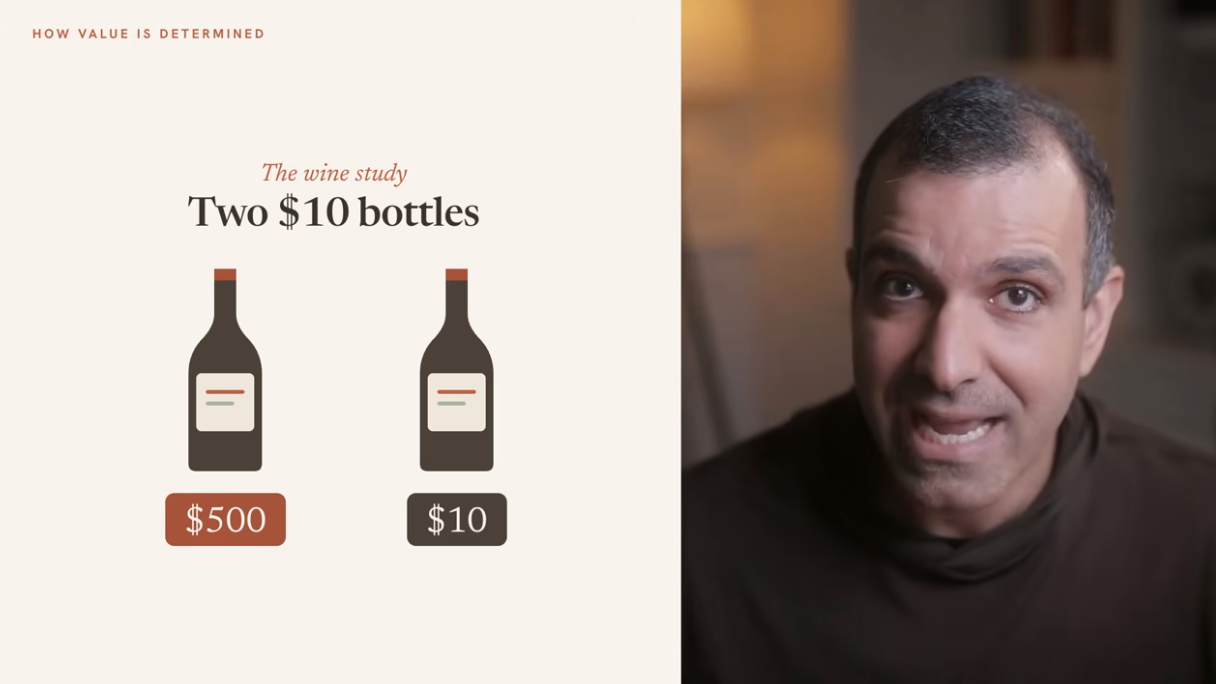
A low price doesn’t create value. It just makes you easier to compare on price alone. When something costs a significant amount, people ask, “Why does it cost that much? What’s included that makes it worth it?” When it’s cheap, they assume it’s the same as everyone else’s. It’s a $100 headshot, so-and-so offers a $100 headshot, so it must be the same thing.
Value Isn’t Measured in Hours or Image Counts
Later in our conversation, I pointed out to Cody that value isn’t dictated by quantity, either.
Photographers sell quantity constantly. Fourteen hours of coverage. 1,500 images delivered. Photography education used to work the same way. Ten years ago, the pitch was “40 hours of education for just $300.”
Around 2019, I realized I didn’t have time to watch all of those courses. What was actually valuable to me was education that got me where I wanted to go as quickly as possible. That was worth 10 times more than a 40-hour course I’d have to sift through.
Same with images. What’s the value of 1,500 images if the client only needed 20, and most of the 1,500 aren’t that good? You’ve just created more work for them.
Value Lives in the Gap Between Price and Result
Picture a bar. On one side is the price. What makes that price fair is everything the buyer gets beyond it, whether it’s a product or a service. That gap is the value, and it’s why we’ll happily say yes to a significant purchase.
Take Apple. Love it or hate it, a decent MacBook runs $3,000 to $4,000, while you can get a solid PC laptop for $1,000 to $1,500. For people who love Apple, the difference is the experience: how it feels to use, how it feels to hold, being part of the ecosystem. That’s the value that fills the gap.
If that one’s too Apple-specific, try this. Say I have a Ferrari in my garage, and we both know it’s worth $100,000. I offer to sell it to you for $75,000. Your value in that deal is $25,000, because you’re paying less than what you’re getting.
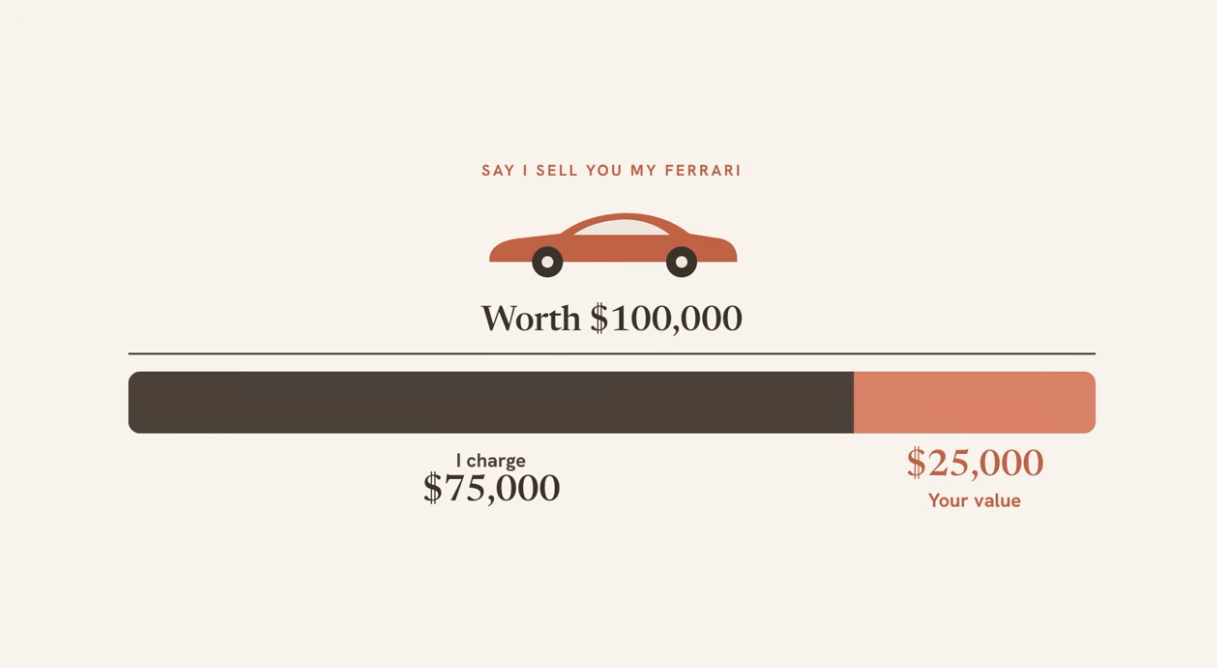
So your price should be anchored to the result, meaning the value the client walks away with, and it should sit below that value. The gap is what makes it a great deal. Which means the “right” number is completely relative to the result you deliver.
What Results-Based Pricing Looks Like for Photographers
Headshots
Since Cody’s example was headshots, let’s start there. Say I photograph actors and models, and I can prove that my clients book big jobs, $5,000 jobs, with my headshots. They use those images throughout their careers, and here’s a roster of successful people I’ve photographed.
Suddenly $500 to $1,000 is more than fair. I could even charge $5,000 and say, “Your first booking covers this, and you’ll keep booking with these images for the rest of your career.”
Architectural Photography
Now take architectural photography. Not budget real estate work, but high-end listings. Say we’re selling a $2 million home, and I can prove that the best realtors use my work to sell the best homes. On average, they make an additional $100,000 to $150,000 because of how the property is marketed with my photos and video.
Several thousand dollars becomes a completely fair price, compared to the typical real estate photographer competing at $250 to $500.
Value is determined by what the client can do with what you deliver.
Not sure if pricing is what’s holding your business back? Take my free 2-minute constraint quiz to find the one thing limiting your business right now, whether that’s brand, marketing, sales or systems.
Two Ways to Answer the Same Inquiry
Here’s where this actually matters: the sales call. I’ll use a commercial example, corporate events, but the principle applies whether you shoot weddings, families, maternity, boudoir or commercial work. For commercial clients, you’re uncovering goals. For everyone else, you’re uncovering values. Either way, your job is to get the client comparing you on those, not on price alone.
Here’s the inquiry:
We need one hour of event coverage for an upcoming event. How much would that cost?
Pretty typical. The client is doing what they know how to do, which is comparing you to other photographers on price.
Step 1: Get on the Phone, Fast
Most photographers don’t call. They reply by email with “Tell me a little more” or “I charge $700 for a one-hour event.”
I call instead. My contact forms always collect a phone number, so ideally I’m calling within five minutes of the lead coming in. If I only have an email, I reply with something like, “I’d love to set up a call. I have an opening at 3 p.m. today.”
Step 2: Learn About the Event
I start with, “This sounds awesome, and I’d love to work with you. Tell me about the event.”
Let’s say it’s a product launch. Press will be there, and so will the company’s retail partners. I spend some time here unpacking the product and the event.
Step 3: Find the Goals
Then I ask, “What are you hoping to walk away with from this event?”
They’ll say things like: we want coverage and exposure, we need a press kit, we want launch-week content for social media, and since our retail partners will be there, we want to impress them too.
Step 4: Find What Makes the Images a Success
Now the key question: “When we walk away from this event with these photographs, what would make them a complete success?”
This is where it opens up. “We’re trying to show this off to other retail partners. Each new retail partner is worth about $50,000 a year in revenue for us, and there are three we specifically want to impress.”
Boom. I repeat it back: “So our goal is to impress these retailers with the images we create. What do you think they’d want to see?”
They tell me the retailers want to see how the product would work in their own stores and how they might feature it on their websites. So I go further: “It sounds like we should feature your existing retail partners in these images. We want proof that you already serve big clients.”
“Yes. Us mingling with the VIPs from our current retailers would be huge social proof.”
Great. That goes into the plan.
Step 5: Present a Solution, Not a Commodity
The typical photographer quotes one hour of event coverage at $400. That’s easy to compare with anyone else.
I present a solution instead:
Our goal is to impress these potential retail partners, and the possible revenue there is $150,000 a year. So I want to build about three hours of coverage planned around moments where you’re interacting with your current partners. You’ll have your press kit by the next morning so you can publish straight to social, which means overnight editing with a quick turnaround, still at full quality. You’ll have everything you need for launch week, your social media and your sales decks. On top of that, I’ll deliver an additional set of footage and images specifically to showcase to these retail partners.
Then the budget: $2,500, $5,000, $10,000. Anywhere in that range is still incredibly valuable, because I’m speaking to a result: the potential to book $150,000 in additional annual revenue, plus images they’ll keep using long after the launch.
| The commodity answer | The solution answer | |
|---|---|---|
| What’s being sold | One hour of event coverage | A plan to win three new retail partners |
| Deliverables | Event photos | Partner-focused coverage, next-morning press kit, launch-week content, a dedicated set for prospective retailers |
| Price | $400 | $2,500 to $10,000 |
| What the client compares it to | Every other photographer’s hourly rate | A potential $150,000 a year in new revenue |
That’s the difference between offering a commodity and creating a solution. And that’s where value gets created in every client proposal.
Find Your #1 Constraint
Pricing and sales are just one piece of the puzzle. If your business feels stuck and you’re not sure whether the problem is your brand, your marketing, your sales or your systems, start by figuring out which one is actually holding you back.
I put together a free 11-question quiz that takes about two minutes and pinpoints your #1 constraint right now. And if it looks like you’d be a good fit for my mentorship, I’ll offer you a free 20-minute 1:1 call to talk through it.
I’d love to hear what you think in the comments. Let’s freaking grow!