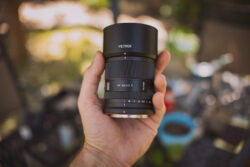
A 90mm, crop-sensor (APSC) portrait prime is indeed a rare thing. Why? Because let’s be honest: there are already so many full-frame 85mm f/1.8 primes. Some good, some bad. Some telephoto portrait primes are luxury flagship items; others are compact and budget-friendly. So, in this Viltrox 90mm f/2.2 EVO review, we are going to dive into why you really should consider this rather unique telephoto portrait prime!
With an equivalent focal length of 135mm on full-frame, this APSC-made Viltrox EVO lens is perfect for portraits of singular subjects, whether human or animal. Corporate headshots, senior portraits, fashion editorial work, etc! 135mm is a classic portrait focal length, on the longer end, of course.
Make no mistake, this is a “specialty” portrait focal length. Many portrait photographers will want to start with a normal or moderate telephoto prime lens, such as 35mm or 55mm on APSC. (That is, 50mm or 85mm on full-frame.) With that in mind, for high-end professional portraits, the results from this lens will be truly impressive and unique.
The most exciting part? The Viltrox EVO 90mm f/2.2 is not an expensive, large, heavy portrait prime, as many 135mm primes are. However, the results are stunningly professional-grade. Indeed, the whole Viltrox EVO lineup has proven this: professional results in an affordable, portable package is totally possible. This 90mm is no exception, with incredibly sharp and all-around excellent image quality.
There are drawbacks; of course, f/2.2 on APSC is certainly not the same as f/1.8 or f/2 on full-frame, indeed. So, let’s dive into this review and see what YOU all think!
Viltrox AF 90mm f/2.2 EVO | Specifications

- FOCAL LENGTH & ANGLE OF VIEW: 90mm, 18.6° (135mm full-frame)
- LENS MOUNT(S): Sony E, Nikon Z, Fujifilm X
- APERTURE & RANGE: f/2.2-f/16, 9 rounded blades
- STABILIZATION: No
- AUTOFOCUS: fully internal focusing, silent STM motor
- MANUAL FOCUS: Digitally controlled, dedicated physical ring, dedicated AF/MF switch
- OPTICAL CONSTRUCTION: 10 elements in 8 groups, 2 ED, 2 HRI elements
- MECHANICAL BUILD: Metal barrel & mount, weather-sealed, USB port in mount
- MAGNIFICATION & FOCUS DISTANCE: 0.14X magnification, 2.43 ft (0.74m) close focus
- FILTER THREADS & HOOD: 58mm, plastic hood included
- SIZE: Φ2.7×3.1 in. (69x78mm)
- WEIGHT: 11.5 oz (325g) (bare lens)
- PRICE: $369
Viltrox AF 90mm f/2.2 EVO Review | Who Should Buy It?

A 90mm does a great job of isolating subjects from the background, which makes it perfect for portraits of any kind. Wedding and portrait photography, wedding video, vloggers, content creators, cinema and movie makers, candid and street photography- all of it!
Additionally, the Viltrox AF 90mm f/2.2 does well for landscape and astrophotography, due to its incredible sharpness and other aspects of impeccable image quality.
Equivalent to 135mm, its angle of view compresses the background and renders faces so they are less distorted and much more pleasant than a normal or wider lens. At a fast, shallow DOF (depth of field), it separates any subject from the background.
For example, at weddings, a photographer is often best unseen, so having “working distance” is helpful. With the EVO 90mm, you have enough operating room to isolate subjects from guests and other background elements.
This shallow DOF concept also works well for video; in fact, it’s even more powerful! Furthermore, having a silent AF motor and a de-clicked aperture ring makes it even more perfect for wedding video by keeping clean audio and infinitely smooth exposure changes.

On the other hand, with or without shallow DOF, this focal length is a common choice for commercial work such as headshots, fashion & editorial portraits, models, etc. Simply put, 90mm on a crop sensor is a great way to showcase one person, or a product/clothing on a person, etc.
When it comes to candid and street photography, you also don’t usually want to be part of the story you are capturing. You want to be a “fly on the wall”, and 90mm allows for close-up images of subjects without having to close the distance and risk disrupting the moment itself.
Last but not least, for landscape and astrophotography, a 90mm brings mountain vistas closer to the subject by compressing the background. The wider aperture and longer focal length work with astrophotography tool, especially for deep-sky astrophotography where the utmost image quality is important at very fast apertures.
Viltrox 90mm f/2.2 EVO Review | Pros & Cons

Image Quality
We’ll let the sample images speak for themselves, of course. Simply put, we literally cannot find fault with this lens from a technical image quality perspective. The only complaint we might have would be regarding the difference in shallow depth when comparing an f/2.2 APSC lens against a full-frame f/1.8 lens. However, that is obviously and totally an “apples VS oranges” comparison, indeed.
Sharpness


Bokeh

As I mentioned, the bokeh is gorgeous; however, we should keep in mind that if you’re using full-frame equivalents, this is roughly the same as the DOF of a 135mm f/3.5 lens. Honestly? Considering how easy it is to use this lens wide-open and still get tack-sharp results, that’s not really a problem for anyone doing things like corporate headshots or fashion, editorial-type work, where stopping down is common anyway.
Colors & Contrast

The in-camera images are crisp and vibrant; anyone who shoots JPG or frequently transfers in-camera images straight to a mobile device will marvel at how little editing needs to be applied. Of course, if you’re exclusively doing raw editing with all your images, you’ll still see the benefits inherent in having such clear, crisp glass.
Vignetting & Distortion
These common optical flaws appear to be very minimal, especially when using the built-in correction profile. I tried turning the corrections off completely, and even in-camera there seems to be almost no difference. In other words, optically, the lens spared no expense, which is rare among modern mirrorless optics.
Sunstars & Flare

These more complex aspects of image quality are, thankfully, aesthetically pleasing from the Viltrox 90mm. You get a beautiful wash of golden light when you want it in certain conditions, but you avoid the annoying “dots” of flare in most scenarios, too.
Color Fringing, Aberration, Coma & Astigmatism
This is where most budget-friendly and/or compact lenses totally fail, because few photographers even care about such subtle details. However, this EVO lens is optically near-perfect, as mentioned. That means even these nerdy details are extremely minimal issues! Having virtually no aberrations of any kind, even in the corners of the image, definitely makes this lens great for deep-sky astrophotography.
Macro & Close-Up Photography

This is one area where I’ve noticed that many telephoto primes can be a bit frustrating: When you get up close with a subject, the images do look beautiful, but you often “bump into” the minimum focus distance. Especially with smaller subjects, you might find yourself wishing that the lens could focus just a bit closer. That was definitely the case with this lens whenever I would photograph things like flowers or bugs or other everyday “macro” details.
In other words, I don’t expect to use this lens as a macro lens; however, I do wish I didn’t have to pay so much attention to “getting too close” to a subject. (NOTE: for a regular portrait subject such as a close-up headshot, this shouldn’t be a problem; you can fill the frame with a human subject’s face and focus just fine!)
Autofocus & Manual Focus Performance
Another area where third-party lenses often led to disappointment in the past was when it came to autofocus reliability. Also, the precision of manual focus can be a concern, because it is electronically controlled.
The Viltrox EVO 90mm f/2.2 AF offers not just fast, silent autofocus, but it’s also reliably precise… In other words, it consistently nails focus
Design & Durability

Got caught in the rain? Whether you’re a “regular” wedding photographer, a mountain elopement photographer, or an adventure landscape photographer, you’re going to be grateful for this lens’ full weather sealing. The rubber gaskets and mostly metal construction make it a rugged lens to keep in your arsenal in any type of bad weather.
Ergonomics & Portability
This EVO lens, like the other Viltrox primes in this collection, is ultra-lightweight enough that you can hand-hold it without having to support the lens with your left hand. Even on long, all-day photo shoots! That is definitely not the case with a full-frame telephoto portrait lens of the 135mm variety.
Features & Customizations

I mentioned this in my review of the Viltrox 35mm f/1.8 EVO: I’m thrilled to see a full complement of features, such as, a dedicated AF/MF switch, a physical aperture ring that can be de-clicked, and a customizable FN button.
Also, there is a USB port for firmware updates, etc. This is built into the mount itself, so it’s protected by the weather seal gasket when the lens is mounted on a camera body.
Lastly, the one critique I have of the EVO series is that although the aperture ring can be de-clicked, it cannot be locked in the “A” position. It’s quite stiff, however, so I only managed to accidentally bump it out of “A” to f/16 once.
Viltrox 90mm f/2.2 EVO Review | Value & Competitors

If you’ve ever used a full-frame camera for portraits, you might already know that 135mm (and 105mm) are popular focal lengths for more “exotic” portrait primes. You can spend a ton of money getting a 105mm f/1.4, or a 135mm f/1.8, and such lenses also weigh a ton. Surprisingly, there are not very many ultralight, compact primes at those focal lengths on full-frame mounts. The most common compact, lightweight full-frame portrait lens is the 85mm.
Clearly, the Viltrox EVO 90mm f/2.2 is not intended to compete with the behemoth portrait lenses. EVO is all about a portable package that delivers professional results.
With that being said, there are virtually zero dedicated APSC primes at ~90mm. So, depending on your lens mount, you’ll likely find yourself comparing this lens against full-frame 85mm f/1.8 primes. (Not Fujifilm X mount users, of course, but for Nikon and Sony users, there are quite a few full-frame 85mm primes.)
The question is, are the alternatives any good? Honestly, this 90mm is downright stunning, even at its wide-open f/2.2 aperture. Even with an 85mm f/1.8 prime stopped down to f/2.2, you’ll be hard-pressed to beat this 90mm. To acquire an 85mm prime that matches the professional image quality and build quality, you’ll need to spend 2-3X more money, and carry around a lens that weighs that much more, too.
On that note, the next-closest option from Viltrox themselves, the Viltrox 85mm f/2 EVO, will set you back just $275. I haven’t tested that lens, but I strongly suspect that this newer 90mm is very hard to beat in terms of image quality.
The main reason you’d consider that 85mm lens, of course, is if you think that some day you might upgrade from APSC to full-frame. (Be warned, however, if you do that: the wider angle of view you get with a matched focal length will feel very different! An 85mm view and a 135mm view are totally different worlds.)
Viltrox AF 90mm f/2.2 EVO Review | Conclusion

A 90mm prime is an incredibly versatile lens, especially for any type of photography that could be categorized as a portrait. I’ve used the equivalent of 135mm throughout my career with fantastic results! Many types of photographers and videographers alike will find that this lens is used often.
The high-end professional image quality, combined with the entry-level ease of use, gives this prime a major thumbs up in my book. It packs a punch in overall quality, especially for the price. (A named brand lens of this quality would cost more than double!)
Admittedly, the equivalent of 135mm may not be the first choice for some portrait photographers; I honestly must recommend a more “normal” portrait prime first, before this investment. Probably 35mm on APSC, equivalent to ~50mm. However, 90mm is a very powerful tool. Especially if you do portraits of just one or two people, and certainly if you do close-up portraits; everything from headshots to fashion/product photos. You just can’t get this same look with a “normal” lens. For this reason, I strongly recommend checking it out!
Keep in mind, however, that this is an APSC lens, of course. What this means is, although the aperture is f/2.2, the depth of field you’re seeing is equivalent to about f/3.2 or so on a full-frame camera. That is the main reason why a full-frame f/1.8 lens is a massive, expensive “beast” of a lens.
With that in mind, this tiny little f/2.2 prime packs a punch in terms of image quality and overall value. The truth is, most photographers and videographers who are looking for a prime lens in this range will definitely be better off with this lens compared to a $2,000+ 2-lb (~1kg) lens!

Personally, focal length choice is still a hard decision for me to make even as a retired wedding photographer who just does a few portrait sessions here and there. Honestly? I might prefer the Viltrox 75mm f/1.8 EVO instead; it’s really hard to say. Both lenses offer incredible image quality at a great price; both are highly portable, …but the 75mm offers f/1.8, which is a fantastic plus. Since that lens is equivalent to 105mm, another popular portrait lens, I can only recommend that you spend some time shooting at both focal lengths before you decide. Grab your APSC 55-200mm kit zoom or 70-200mm or whatever telephoto zoom you have, and just see which focal length works best for your creative style.
The bottom line is that you can’t go wrong, as long as you are sure the focal length is right for you. The results speak for themselves, and the price is unmatched considering the professional build quality.
You can find the Viltrox EVO AF 90mm f/2.2 for the Sony E-mount, the Nikon Z-mount, and the Fujifilm X-mount, all currently for $369.