When a couple opens their gallery, they’re looking for the day they actually lived, not a better-looking version of someone else’s. That’s the tension every wedding photographer now sits inside. AI can wipe out a distracting exit sign in one click, but the same tool can just as easily conjure a sunset that never happened or a guest who wasn’t there. The hard question isn’t which software you run anymore. It’s knowing the moment an edit stops fixing the photo and starts changing the story.
Faster Editing Is Already Part of the Job
This isn’t a hypothetical shift. Adobe’s 2026 Creators’ Toolkit Report, based on a survey of more than 16,000 creators across eight countries, found that 75% of those using AI called it integrated or essential to their workflow. That sample covers digital creators broadly, not wedding shooters specifically, but the direction is unmistakable.
And plenty of it is genuinely useful. AI masking can isolate a dress in seconds instead of the long minutes it used to take to brush by hand. Automated tools can even out exposure between a dim ceremony and a bright reception without a dozen local adjustments. None of that changes what guests actually saw. It just gets you to delivery faster.
Small Corrections and Invented Moments Are Not the Same Thing
Here’s the line that matters. Removing a temporary blemish is not the same as reshaping someone’s face. Cleaning up a distracting exit sign is not the same as swapping out the venue. Your clients are paying for the memory of a real event, so every one of those calls carries weight.
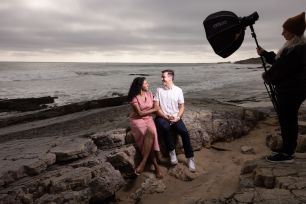
Think about dropping warm sunset light into a portrait shot under flat grey skies. With the couple’s blessing, that can be a beautiful artistic frame for the album. Painting an absent family member back into a group shot is a different thing entirely, because now you’ve changed who was in the room. A burst of AI confetti implies a celebration that didn’t happen.


A simple rule of thumb: for the documentary coverage, keep every frame tied to what the camera actually captured. Save the big transformations for clearly defined creative portraits or composites the client specifically asked for.
Competition Rules Offer a Useful Boundary
If you want an outside reference point, look at how the industry’s own contests handle it. The Professional Photographers of America’s International Photographic Competition prohibits generative AI, whole or partial, in submitted images, and it reserves the right to disqualify or recategorize any entry that undermines the integrity of the competition. Many juried competitions also reserve the right to request a photographer’s original camera files for verification.
Those rules govern a competition, not your client galleries. But they’re a clear signal of where the profession draws its own line, and why original captures plus a documented editing process still matter.
Can Detection Tools Prove a Photo Is Real?
Short answer: not reliably. An AI detector might flag content that looks fabricated, but it can’t tell you which flowers were on the arch or who actually stood in the back row. Metadata helps less than you’d hope, since it often gets stripped once a file moves through editing apps and social platforms.
There are better tools on the horizon. Adobe’s Content Credentials can record certain editing steps and any AI involvement, and the C2PA standard attaches verified history to a file. The catch is that screenshots and some export settings wipe that information out. For any dispute that actually matters, your original RAW files and edit history are still the strongest evidence you have. A missing label or a clean detector score proves nothing on its own.
Agree on the Limits Before the Wedding
The cleanest way to avoid an awkward conversation after delivery is to have it before the day. Spell out your retouching approach in your contract or an editing guide so a couple knows what “editing” means to you. Setting that expectation protects you just as much as it reassures them.
A practical starting framework:
- Standard editing covers exposure, color, and temporary blemish removal, done automatically.
- Body or permanent-feature changes require the client’s sign-off before you touch them.
- Background replacement or generated people are separate requests, discussed and priced on their own.
- Keep the RAW originals, and label any artistic composite clearly as exactly that.
The demand isn’t going anywhere. The Knot’s 2026 Real Weddings Study found that 88% of surveyed couples hired a photographer. They’re paying for a professional to capture their celebration, not to manufacture a version of it that never took place.
AI absolutely has a place in your editing room. The boundary is just this simple: make the photo better without deceiving the people whose day it records.