The award for “most diverse array of lens options” keeps going to Tamron, year after year, and this year seems to be no exception! Over and over again, this lens maker keeps delivering new, unique focal ranges that we’ve never seen before.
Today’s Tamron 35-100mm f/2.8 review is exactly that; something unprecedented, but in a modest way that is within reach of most photographers. It’s a professional quality lens, yet with a massive savings compared to the average professional f/2.8 zoom lens in this range. We’ve already seen so many unique zooms already that buck the trends of traditional zooms. We’ve seen quite a few totally unique ultra-wide lenses lately, such as the Tamron 16-30mm f/2.8 G2, the 20-40mm f/2.8, and the 17-50mm f/4. Simply put, across the board, nobody else is making lenses like these.
The thing is, with so many excellent zoom lenses on the market now, how do you know if this exact focal range is right for you? Read this review and I promise you’ll find out… I’m not an influencer, though, so don’t let my bold “clickbait” type statement trick you; instead, check out these sample photos and decide for yourself.
What I do have to offer you is, my 20+ years of experience as a photographer, including professional weddings and portraits, but also countless other types of professional work, plus more hobby / amateur subjects than I can count. That is to say, whatever type of imagery you create, I’ll probably be able to advise you on whether or not the Tamron 35-100mm f/2.8 Di III VXD lens is right for you.
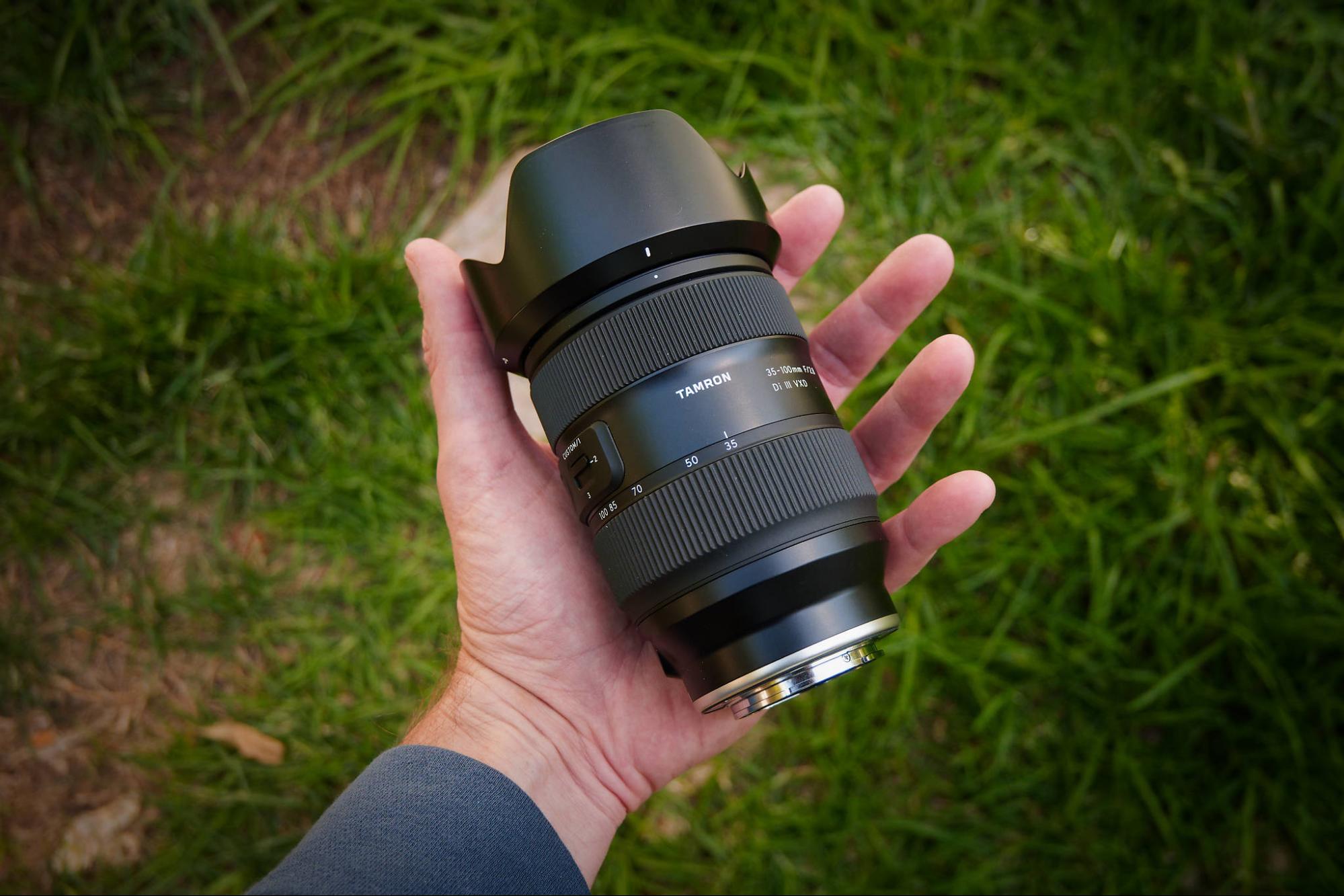
Tamron 35-100mm f/2.8 Di III VXD | Specifications

- FOCAL LENGTH & ANGLE OF VIEW: 35-100mm (63° to 24°)
- LENS MOUNT(S): Sony E (FE full-frame), Nikon Z (FX full-frame)
- APERTURE & RANGE: f/2.8 (constant), minimum f/22 rounded 9-blade diaphragm
- STABILIZATION: No
- AUTOFOCUS: VXD linear motor, near-silent
- MANUAL FOCUS: digitally controlled, dedicated focus ring, “custom function” switch
- OPTICAL CONSTRUCTION: 15 elements in 13 groups, 2 aspherical, 1 low-dispersion aspherical, 1 low-dispersion, 1 XLD (extra-low dispersion)
- MECHANICAL BUILD: metal barrel & mount, weather-sealed, USB port
- MAGNIFICATION & FOCUS DISTANCE: 0.3x magnification, 8.66” (0.22m) close focusing
- FILTER THREADS & HOOD: 67mm, 1-piece hood included
- SIZE: 3.2 x 4.7″ (80.6 x 119.2 mm)
- WEIGHT: 1.2 lb (565g)
- PRICE: $899
Tamron 35-100mm f/2.8 Di III VXD Review | Who Should Buy It?

Let’s dive right in and talk about why this lens even exists, then we’ll talk about who should consider it. Simply put, you probably already know that the most common zoom range is 24-70mm. Such lenses seem to pop up like weeds, and most of them are pretty good!
Honestly, though? Right off the bat, I will say that as a portrait and wedding photographer, I never liked that exact zoom range. Especially for almost all types of portraits except maybe large groups, I never spent much time at 24mm, and I always wished for a little bit more than 70mm.
Therefore, for portraits (and weddings) in particular, I actually find myself wondering, …where was this exact focal length 20 years ago? It’s actually perfect for so many different types of portraits. Whether I’m doing engagement portraits of a couple, or newborn / maternity portraits, or headshots, high school senior portraits, graduation portraits, …but I’m getting ahead of myself now. The bottom line is this: If you take pictures of people, and if you value bokeh (background blur) …then you should really consider making this your go-to standard, mid-range zoom, instead of a common 24-70mm.
Portrait & Wedding Photography

I’ve already set the stage for which types of photographers I’m going to recommend this lens to, so, here I will just rattle off a list of all the different types of (people) photography that I’ve done, and whether or not I think this a good lens…
This Lens Is Perfect For:
- Engagements / Couples
- Individual headshots (corporate, graduation)
- Maternity & newborns
- Editorial & fashion
- Candid street photography
- Detail shots AKA “food portraits” etc
- Concerts, theater, stage etc
I Might Prefer a 24-70mm or 28-75mm for:
- Up-close photojournalism & indoor weddings
- Large groups of families, corporate teams, etc
- Environmental portraits, elopements, etc
Vloggers & Content Creators (Video)

This is where things get complicated, especially since many cameras apply a crop factor depending on which exact video settings you’re using. There is, however, one thing I wanted to point out where this lens might feel truly perfect for you!
I imagine that there are a lot of video shooters of all types who previously used a 24-70mm f/2.8 lens. However, in the past a lot of cameras applied a crop factor when switching from photo to video, and they got used to that.
Now, more and more cameras are offering “full-width” video capture, meaning there is no longer a crop applied! Suddenly, your 24-70mm might feel “too wide”. In this specific instance, you might absolutely love the arrival of this 35-100mm.
Of course, the same logic applies to all video shooters past and present. When deciding which mid-range zoom is best for you, consider your current camera’s crop factor, (1.2x, 1.5x, etc) …and also consider what camera you might eventually upgrade to! You might decide that this lens isn’t right for you, and maybe the Tamron 28-75mm f/2.8 is a better choice. Ultimately, this decision is a complicated one because there are both creative and technical factors, so, give it a lot of thought.
Action Sports & Wildlife Photography
Both of these types of subjects often benefit from “a little extra reach”, so, again I will strongly recommend checking out the Tamron 35-100mm f/2.8. Maybe you’re photographing your kid’s gymnastics, theater, or music recital. Maybe you’re sitting in a blind waiting for wildlife to pass by. Either way, obviously your primary lens is going to be a much bigger telephoto option, but this mid-range zoom makes a much better complement to add to your camera bag.
Landscape & Nightscape Photography

Last but not least, here we have a mixed bag of suggestions that I’ll make. Simply put, I could see this lens being a great mid-range zoom if your bread-and-butter lenses are a 16-35mm and a 100-400mm. Obviously, the 35-100mm literally fits perfectly between two such lenses!
On the other hand, if I had to pick just one mid-range lens for either landscapes or nightscapes, I have to admit that it would be a good 24-70mm f/2.8.
On the other (third?) hand, honestly? I really like how much more lightweight, compact, and affordable this 35-100mm lens is. So, I come full-circle back to my initial advice: If your main landscape/nightscape lens is a 16-35mm, this is a perfect supplement. On the other hand, if your go-to is a 14-24mm or a 12-24mm, then yes, you ought to consider a mid-range zoom that is slightly wider.
Tamron 35-100mm f/2.8 Review | Pros & Cons
I’m going to be as brief as I can be in this section, because I want the photos to really speak for themselves. I’ll sum up this entire section for you right here: The Tamron 35-100mm f/2.8 Di III VXD delivers excellent image quality, is built to feel professional and rugged, yet fits into a decently compact package compared to “exotic flagship” glass.
Image Quality

As you’ll see, whether it’s the clinical sharpness or the subtle bokeh, I’m impressed with the results. Especially for a lens that is likely oriented towards portraits, it is important to find a balance between technical perfection and the “character” of an image. In each instance, I think Tamron has done a very good job.


Technical factors such as vignetting, distortion, and chromatic aberrations are minimal, or at least they seem to be. This is likely thanks to built-in lens profiles that correct (hide) some amount of vignetting and distortion. However, this is par for the course in virtually all modern mirrorless lenses, and what really matters is the end result: Not only do you get excellent final images, but you also don’t have to lug around a massive piece of glass to get those results.


I do wish that this particular lens could focus just a little more close-up. The particular zoom range could lend itself to being an excellent “semi-macro” lens, and therefore I do wish that the magnification had been capable of 0.5x compared to 0.3x. With that being said, the close-up images are indeed stunning and I’m very happy with what I can get from this Tamron.
Build Quality, Ergonomics, & Portability

The Tamron 35-100mm f/2.8 Di III VXD joins a growing arsenal in Tamron’s lineup, one that offers both professional quality yet also compact portability. We’ve seen this trend already; Tamron’s lenses getting smaller and lighter while offering different zoom ranges. Years ago, we started with lenses like the Tamron 17-28mm f/2.8 and 28-75mm f/2.8, both of which were significantly more compact and lightweight versus traditional flagship lenses.
More recently, we’ve seen options such as the Tamron 20-40mm f/2.8, and the 28-75mm f/2.8 Di III VXD G2. Across the board, there’s been a common theme: durable, professional quality, with significant weight (and price) savings.
For this particular 35-100mm f/2.8 lens, the theme is similar: It’s lighter and smaller than a 24-70mm f/2.8, and yet it feels solid and professional.
Honestly, I was expecting something even more lightweight and compact when I first heard this lens announcement. I think, maybe, I have been spoiled by such ultra-light lenses as the Tamron 20-40mm f/2.8, (365g) the Tamron 16-30mm f/2.8, (440g) or the APS-C crop sensor Tamron 17-70mm f/2.8. (530g) I think, however, that this 35-100mm f/2.8 lens is just a touch heavier than those because it is very difficult for any lens to bridge the gap between “normal”, AKA ~50mm.
Simply put, there’s no other f/2.8 zoom on the market which offers this exact zoom range, and this Tamron does it in a relatively compact package with just a tiny bit more heft than, shall we say, “weighing almost nothing”.
Autofocus Performance, Manual Focus, Focus Breathing
Compared to the older types of autofocus, Tamron’s latest VXD AF lenses are excellent. They’re virtually silent, fast, and accurate. I had no trouble nailing focus with this lens, even in low light and even with tricky subjects.
Of course, this may depend on the exact camera body you’re using; older mirrorless camera bodies don’t have the same AF chops as, say, Sony or Nikon’s latest-gen AF algorithms that use AI to help detect and track all manner of subjects.
All in all, I’m very happy, and I think anyone else considering this lens will be impressed as well. Whether you’re doing precise manual focus work for landscapes & astrophotography, or you’re pulling focus for video work, there’s nothing negative to note here.
Features & Customizations
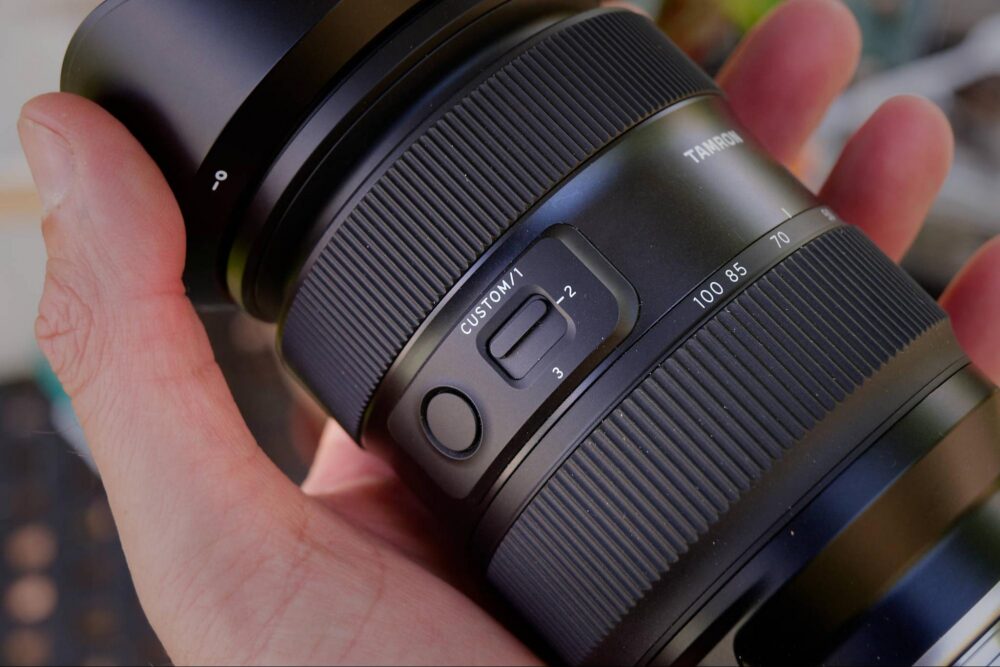
I’m delighted to see Tamron begin to include an AF/MF switch on their newer lenses. Well, this isn’t a dedicated AF/MF switch, it’s a 1/2/3 position custom function switch, but of course you can use it to switch between autofocus and manual focus.
There is also a custom function button, which I personally don’t use very often but it’s a nice professional feature for those who want it.

Last but not least, there’s a USB port for customizing the lens and updating its firmware, and apparently this USB-C port is weather-proof.
Tamron 35-100mm f/2.8 Review | Value & The Competition
Here’s what you need to know: There’s no other 35-100mm f/2.8 zoom on the market, period. If you want this exact zoom range, this is your only option. (It’s an excellent range too, in my opinion!)
Having said that, there are still alternatives, if you’re flexible. Multiple 28-70mm or 28-75mm options exist, and some of them are more lightweight & compact while others are a bit heavier. Or, if you’re looking for the most traditional option, tons of 24-70mm f/2.8’s exist.
I do want to note that Tamron themselves have yet to release a 24-70mm f/2.8 lens for mirrorless cameras. They have a phenomenal “SP” DSLR-made 24-70mm f/2.8, but so far in the mirrorless realm they have focused on alternatives that are a slightly different focal range, and much more portable. In my opinion, this was a very smart move, but it’s worth noting that if what you really want is a 24-70mm f/2.8, maybe Tamron will offer one someday.
With all of that said, here’s the bottom line: For under $900, this Tamron is in a class of its own. The flagship 24-70mm f/2.8’s start around $1400, and easily get up to $2400. Any other option in a similar ~$900 price range is going to be a significantly different offering; not just the zoom range but also the image quality, autofocus reliability, etc.
In summary, if you like this zoom range, this isn’t just your best choice by default, it is truly an excellent lens that beats any “close but not quite” alternative.
Tamron 35-100mm f/2.8 Review | Conclusion
I hope you now have a better idea of whether or not the Tamron 35-100mm f/2.8 Di III VXD lens is right for you! It’s not for everyone, however, there is definitely a huge group of both photographers and video creators who should strongly consider it.
If you photograph portraits or people in general, you should consider this lens before you think about a standard mid-range zoom. If you photograph people or animals in action, …same! To my own surprise, I’m even extending my recommendation to landscape and nightscape photographers, depending on which exact ultra-wide zoom you are using.
Currently, the Tamron 35-100mm f/2.8 DI III VXD sells for $899 on the Sony E mount, or $929 on the Nikon Z mount. From time to time you might see a $50 or $100 savings offered, as is common for many lenses, but for now (spring 2026) it’s a rather new, popular item so you’ll be fortunate if it’s in stock!