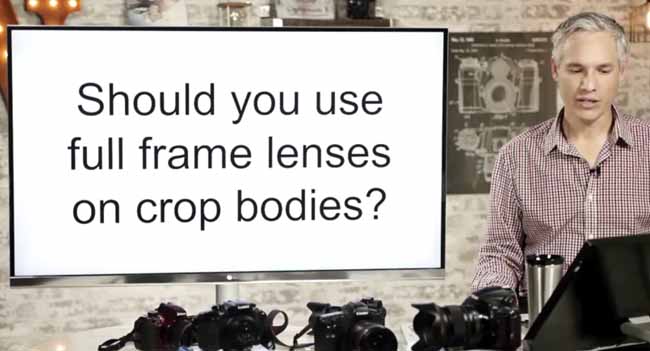
When starting out, most photographers choose to go with a crop body and invest in nice glass. This is a great way to start as you can keep your lenses and swap out your body for something newer down the road, eventually leading to that coveted full frame sensor. Starting out with the full frame lens and crop bodies may not provide you with the sharpest images though, according to Tony Northrup.
Should You Use Full Frame Lenses on Crop Bodies? Yes and No…
Lenses are far from perfect. Light and resolution can be lost when traveling through each element. Sometimes, with less expensive lenses, we are left with chromatic aberration, ghosting, flare, distortion and loss of resolution. Even the most expensive lens will not match the the true megapixels of the sensor.
[REWIND: Why You Should Multiply Aperture By Crop Factor When Comparing Lenses]

The perceived megapixel (P-MPix) are what we are left with after the exposure. Take a Nikon D610 and pair it with the Nikon 24-70 f/2.8, the resulting resolution will be 15 P-MPix. A combination of the Nikon D3300 and Sigma 18-35 f/1.8 will result in 17 P-MPix. Most of the lenses that are tested by DXO Mark will give you the P-MPix in the spec sheet. To find out what the perceived megapixels of your camera and lens combination use the formula: MP/CF2 (Megapixels divided by Crop Factor squared).

In my opinion, each lens has a character and that is why we use them. If a lens is near perfect like the Zeiss Otus 85mm f/1.4, it can be boring. One of the main reasons that I use vintage glass (besides it being inexpensive), is that it provides a look that cannot be achieved by the digital specific glass of today. If you have a crop body camera, don’t let the P-MPix prevent you from taking pictures; you can still achieve excellent results from the basic kit lens. Check out our newest workshop DVD, Photography 101 to see what we’ve created using entry level DSLR and lenses.
[Via Tony Northrup Youtube / Images Screen Captures]