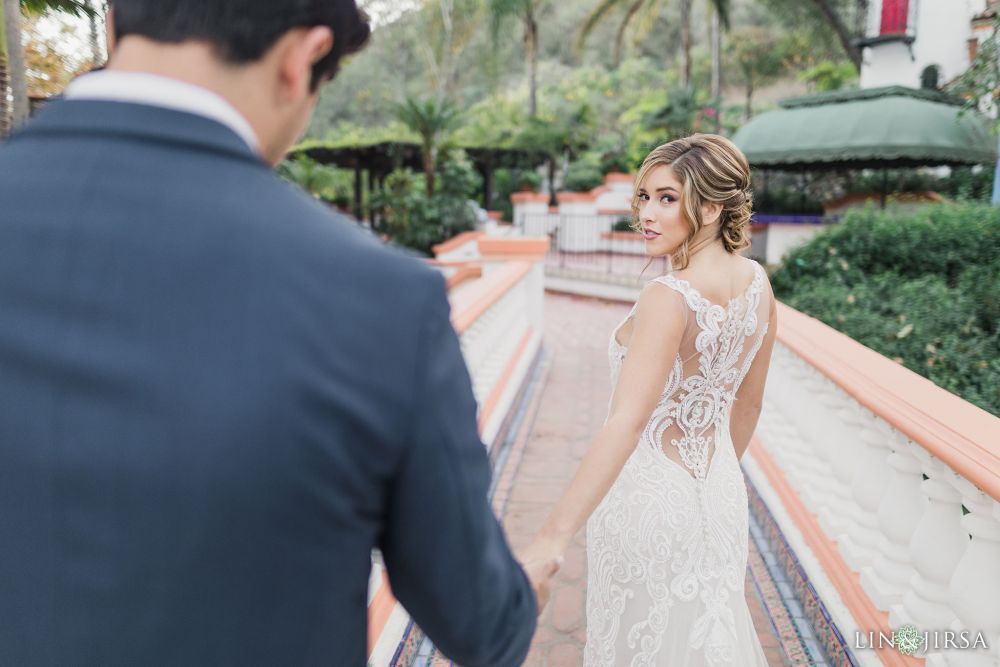
Wedding Pose Breakdown is a series where we take one pose apart: why it works, how to direct it, what can go wrong, and how to turn a basic setup into something worth delivering. We are starting with one you probably shoot at nearly every wedding: the couple holding hands and walking away.
On paper, there is almost nothing to it. Put two people next to each other. Have them hold hands. Tell them to walk. That simplicity is exactly why the pose gets underestimated.
It is an easy photograph to get and an equally easy photograph to waste. Two backs walking toward the middle of nothing is not much of an image. The difference between a throwaway transition frame and a photograph that earns a full spread in an album usually comes down to everything around the pose: where the couple is going, how their bodies separate, where you place them in the frame, what the environment is doing, and the exact fraction of a second when you press the shutter.
The frames below, from a recent Wedding Maps contest, show how much range there is inside one deceptively simple idea.
Why the walk-away works
The walk-away works because it already has a story built into it. A couple moving forward together reads naturally as transition: leaving the ceremony, heading toward the reception, exploring somewhere new, or simply moving into whatever comes next. In wedding photography, where the entire day is about transition, that symbolism does not need much explanation.
More importantly, the couple does not have to pretend very hard.
Standing still and being photographed can make people intensely aware of their hands, faces, posture, smiles, and whatever else they suddenly think they are doing wrong. Walking gives the body a job. Instead of trying to manufacture a pose from scratch, the couple is completing a simple action together.
With their backs to you, they also stop thinking about their faces. That makes the walk-away particularly useful early in a portrait session when a couple is still getting comfortable with you. Their shoulders tend to loosen, their hands begin to move naturally, and they start talking to each other instead of waiting for the next instruction.
That means the walk-away is not just a finished photograph. It can also be a reset button.
If a couple has become stiff after several formal portraits, send them away for twenty seconds. Let them move. Let the conversation start again. Then photograph them coming back toward you. Very often the photographs that follow feel noticeably less posed.
The pose also gives you something front-facing portraits cannot: a clean view of clothing, silhouette, movement, landscape, and direction. A detailed dress back, long veil, train, jacket, floral arrangement, unusual shoes, kilts, or even the way two outfits work together may read better from behind than from the front.
What makes a walk-away photo fall flat
The biggest mistake is assuming movement automatically creates a dynamic photograph. It does not.
If the couple is walking through an arbitrary patch of grass, their bodies overlap, their arms are locked straight, the background has no visual destination, and you press the shutter during an awkward part of the stride, the result can look more like two people leaving the photo shoot than two people moving through a story.
Before giving the direction, look past the couple and ask a few questions. Where will the viewer’s eye go after it reaches them? Is there a path, mountain, doorway, patch of light, line of trees, architectural feature, or horizon that gives the movement somewhere to continue? Does the frame feel like the couple is entering something, or simply disappearing out of it?
Then look at the couple themselves. If their hips, shoulders, and arms all merge into one shape, create a little separation. If one person walks considerably faster than the other, slow them down. If a dress has a train, decide whether you want it dragging naturally, lifted slightly for movement, or carefully arranged for one specific frame.
The point is not to micromanage every step. It is to establish the conditions for something natural to happen inside a composition you have already thought through.
How to direct it
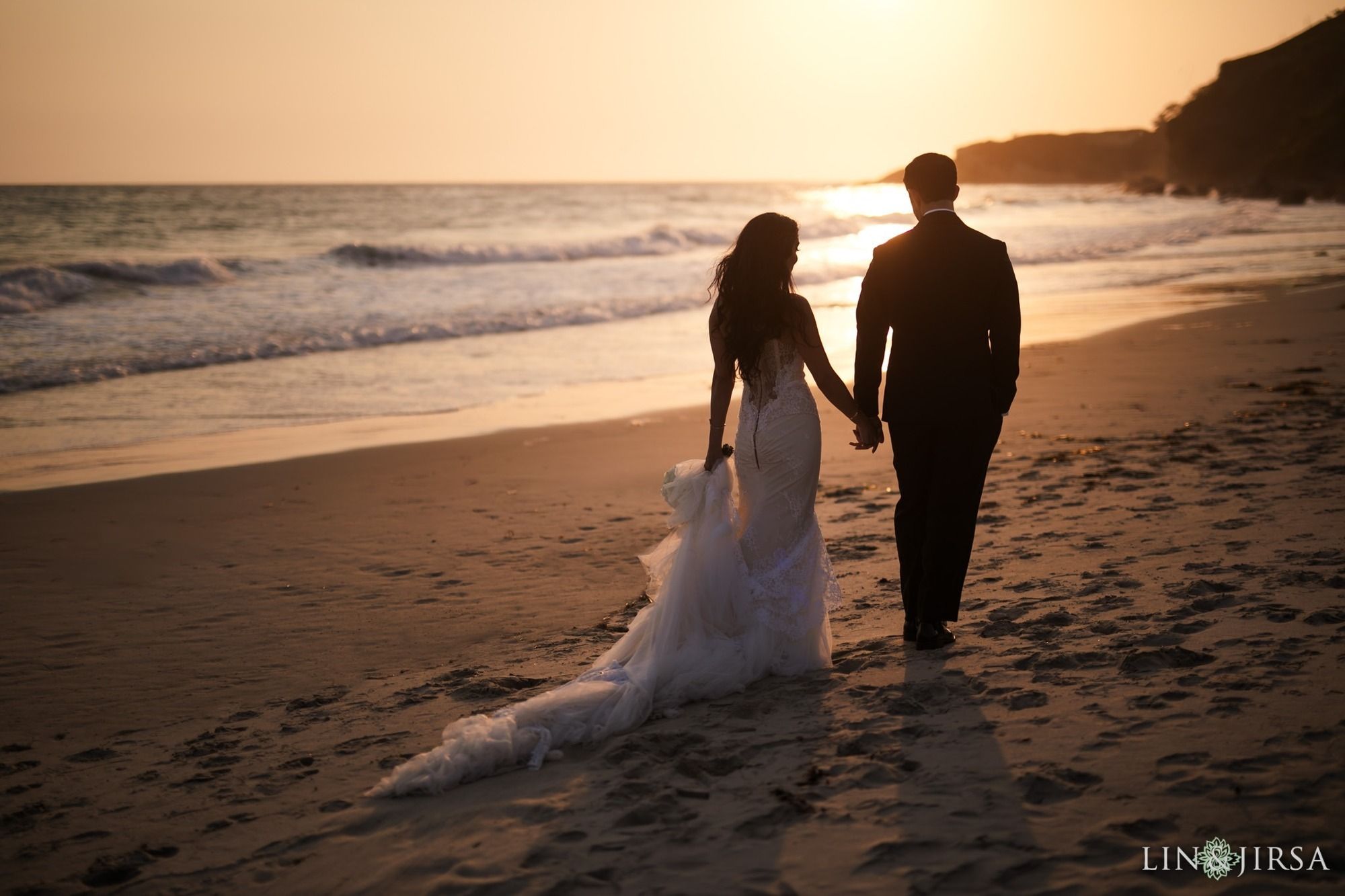
Good walk-away direction should be simple enough that the couple can remember it once they start moving. Give them three or four instructions and their attention goes back to performing for the camera.
Usually, a destination, a pace, and one interaction cue are enough.
- Have them hold hands with a little slack in the arms. A sliver of space between them reads better than two bodies merged into one shape.
- Tell them to walk slower than feels natural. A slightly slower pace gives clothing time to move, keeps one partner from outrunning the other, and gives you more usable phases of each stride.
- Ask them to talk to each other while they walk. It gives their heads, shoulders, and free hands something natural to do instead of leaving both people rigidly facing forward.
- Give them a destination: the tree, the end of the path, the edge of the lawn, the doorway, the patch of sunlight. A walk with no endpoint tends to drift.
- Have them walk out ten or fifteen steps, then turn and walk back. One setup gives you backs, profiles during the turn, and front-facing movement on the return.
- If there is a train, have someone set it before each pass when you need a clean, intentional shape. For looser documentary frames, let it move and fold naturally.
- Watch the handhold. Hands pulled tight behind the hips can make both shoulders look stiff. A lower, relaxed connection usually photographs better.
- Do not be afraid to run the walk more than once. The first pass gets the couple comfortable. The second is often where you can refine the composition or add a variation.
And unless you have a completely clear path behind you, resist the urge to spend the entire sequence walking backward while looking through the camera. It is safer, and often compositionally stronger, to establish your frame first and let the couple move through it.
Watch the stride, not just the expression
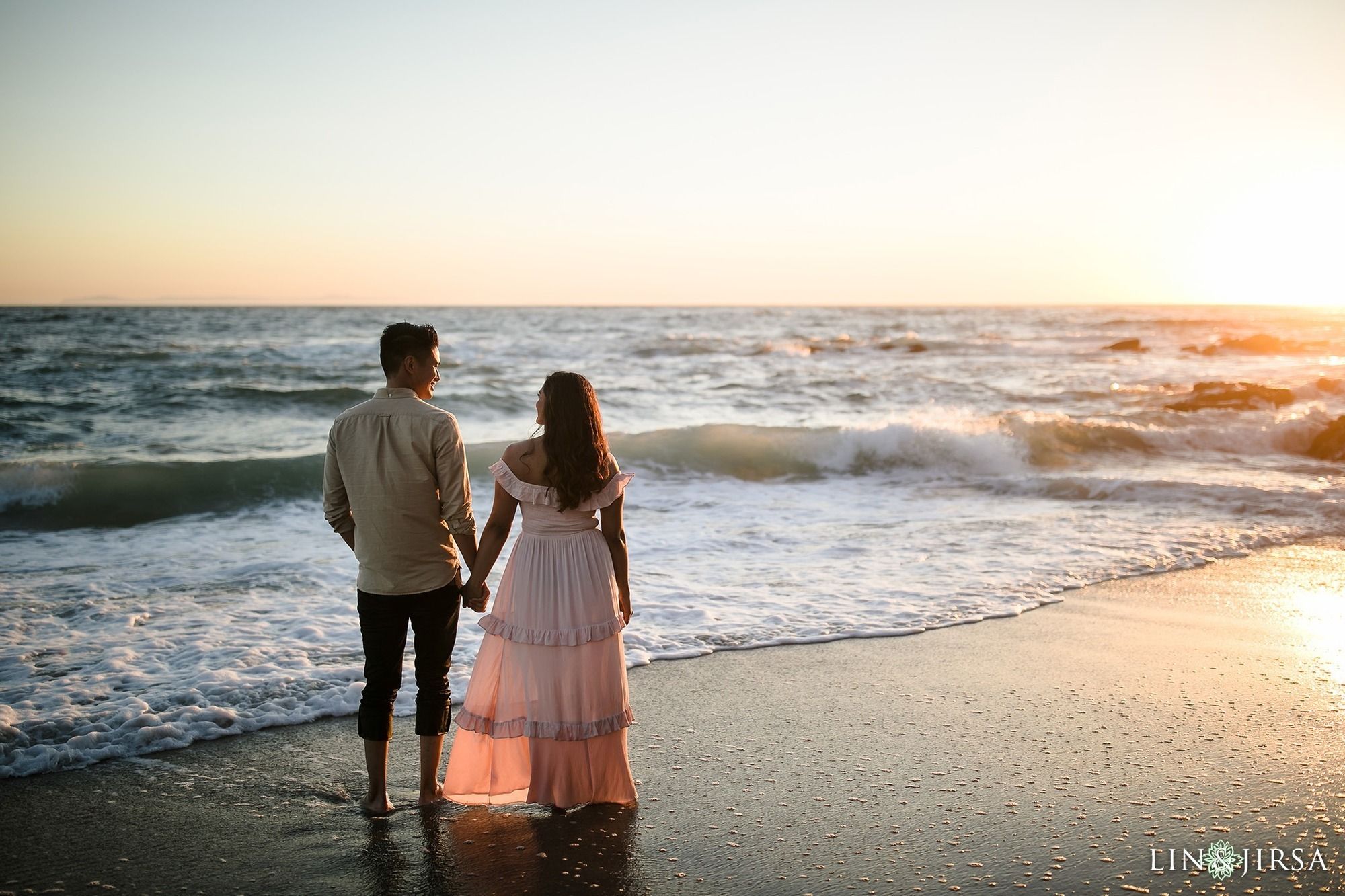
Walking photographs change dramatically from one frame to the next even when the couple barely moves across the scene.
A frame where both people have their legs together can look static. A frame where one foot is just leaving the ground creates a clearer sense of motion. If both people happen to hit nearly identical strides at the same time, the image can feel strangely choreographed. Often the most natural frame comes when their steps are slightly different.
Clothing has its own rhythm too. Veils rise and fall. Dresses flare and collapse. Jackets open during one step and sit flat during the next. When the clothing matters to the photograph, keep shooting through the motion instead of assuming the first clean stride is the best one.
This is one reason the walk-away works well as a short sequence rather than a single shutter click. You are waiting for several independent pieces to line up: the feet, the hands, the dress, the spacing between the bodies, and whatever the environment is doing at that moment.
1. Go wide and let the background carry it
With no faces to read, the environment has to carry more of the storytelling. Give it room.
This is where the walk-away becomes especially useful for destination weddings, mountain elopements, dramatic venues, and any location that deserves more than a blurry suggestion behind the couple. Instead of treating the landscape as a backdrop, make the couple part of it.
The key is scale. A couple does not need to fill the frame to remain important. In the right setting, making them smaller can actually make their presence feel more meaningful because the viewer immediately understands where they are and what surrounds them.
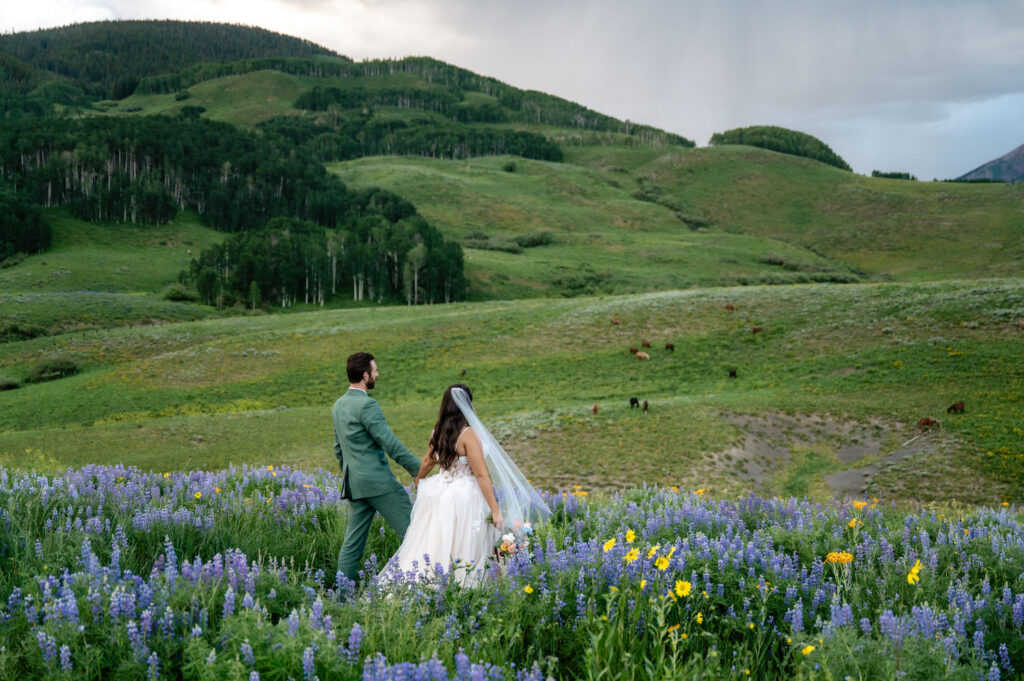
The top-placed photo in the contest is a good example of letting several layers work at once. Authentic Collective set the couple low and left of center, leaving the upper right open for the incoming storm. That placement matters because the couple is not fighting the weather for attention; both can exist in the same story.
The lupine in the foreground does another important job. It creates a near layer before the eye reaches the couple and then the mountains, preventing the photograph from reading like a flat landscape with two people dropped into it. The grazing horses only become part of the story because the frame is wide enough to let them remain.
When the environment gives you multiple layers like this, resist the instinct to immediately zoom in. Take the wider frame first. You can always move closer afterward.
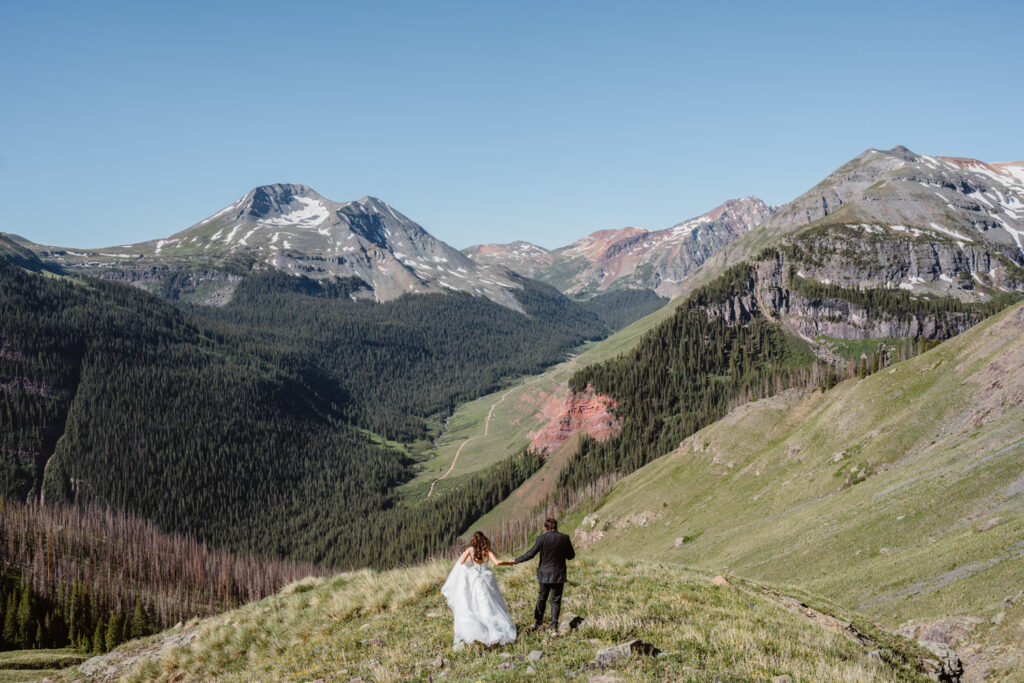
Vows and Peaks put the couple at the bottom of the frame with a whole valley opening up ahead. Their direction of travel points straight into the view, which is what makes all that empty space feel intentional.
That distinction is important. Negative space works best when the subjects appear to have somewhere to move into. Empty space behind them can feel accidental; empty space ahead of them feels like possibility.
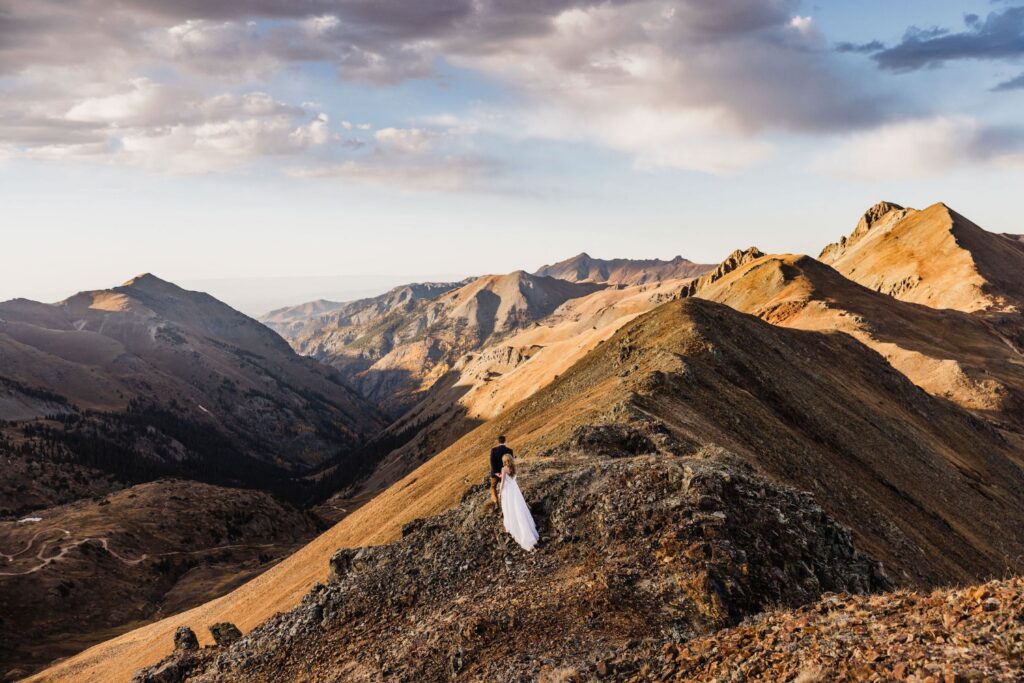
Vow of the Wild went further, with the couple almost a silhouette on a ridge while late light rakes across the peaks. At this size they are there for scale rather than as the dominant subject, which is a valid call when the landscape and light are this strong.
Small figures also tell the viewer how enormous the terrain really is. Without people, a ridge may simply look like a ridge. Add two recognizable human forms and suddenly the photograph has a measurement built into it.
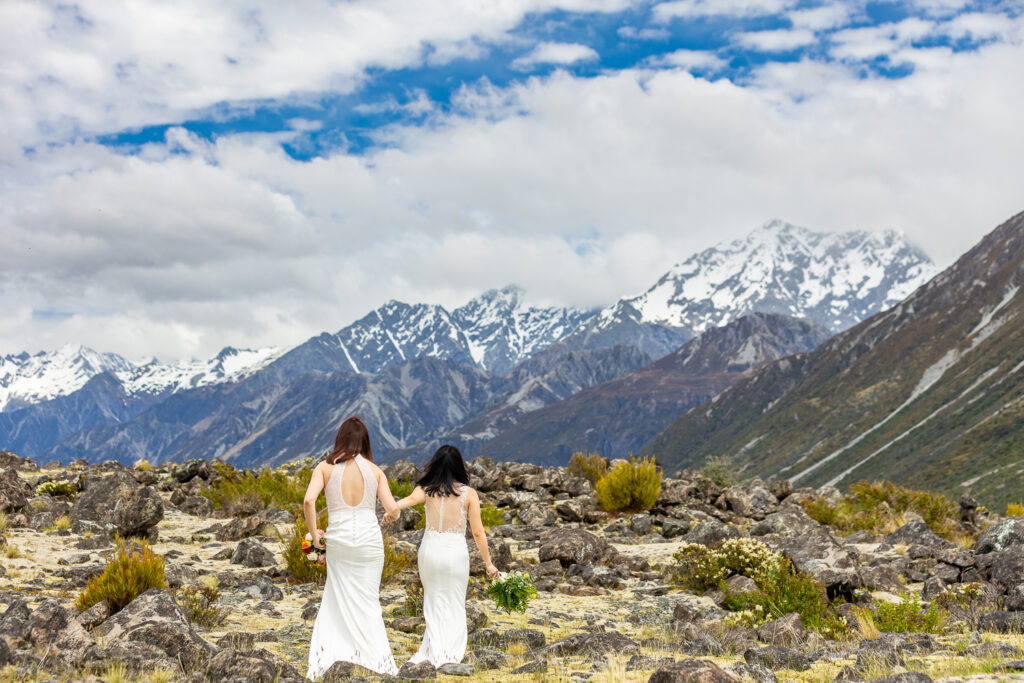
New Zealand Elopements kept both brides large enough for the lace backs, silhouettes, and handhold to read while still giving the mountains most of the frame. That middle distance is a reliable choice when you want the people and the place to carry roughly equal narrative weight.
Notice too that the backs of the dresses are not a secondary detail here. They are part of the composition. A front-facing portrait in this location would tell a different story.
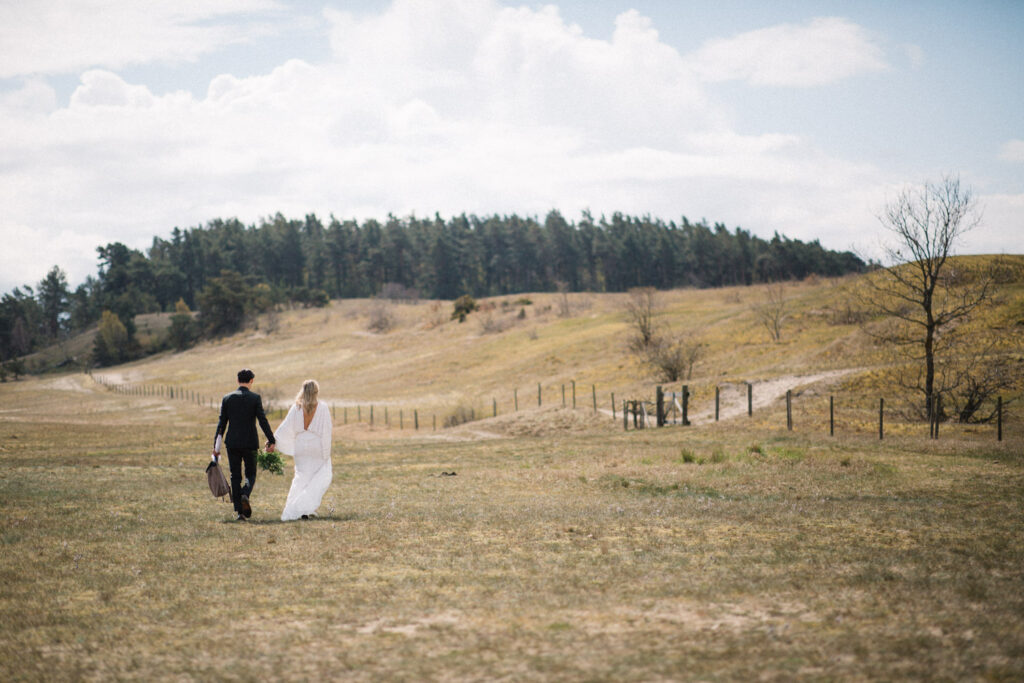
Tove Lundquist gave roughly half the frame to sky. Big negative space suits quiet, open landscapes where there is no single mountain, building, or tree that needs to dominate the composition.
The lesson is not that every walk-away should be wide. It is that if the location is important, you should make a deliberate decision about how much of the story belongs to the couple and how much belongs to the place.
2. Give them a line to walk on
Roads, drives, stairs, shorelines, rows of trees, building edges, and trails do two jobs at once. They give the couple somewhere to go, and they give the viewer’s eye a path into the photograph.
This is one of the easiest ways to make a walk-away feel composed instead of incidental.
You do not need a literal painted line. Any repeated edge can work: the boundary between grass and gravel, the shadow side of a building, fence rails, a curve in the landscape, or the opening between two rows of trees.
Before directing the couple, decide whether you want them centered on that line or offset from it. A centered path creates symmetry and formality. An off-center placement tends to feel looser and may leave room for scenery, weather, or architecture to carry the other side of the frame.
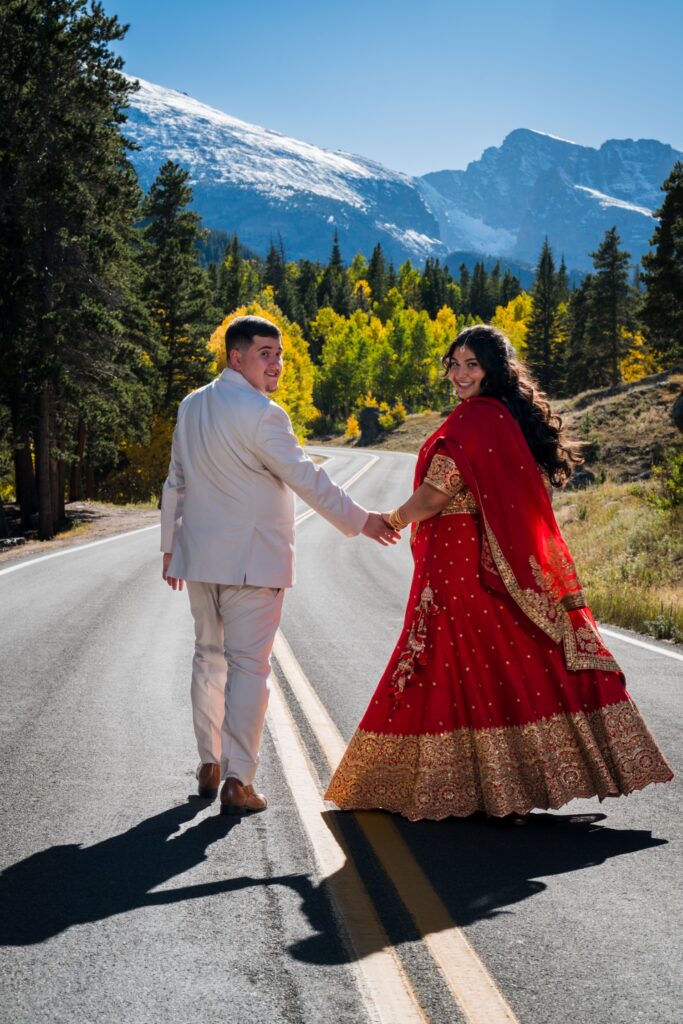
Gretchen Troop Photography put the couple directly on the double yellow line, so the road stripes run toward them instead of competing with them. Their long shadows stretch back toward the camera and visually anchor the lower half of the frame.
There is another useful lesson here: when a scene already contains a strong graphic element, commit to it. Being almost centered on a road line can look like a mistake. Being clearly centered looks intentional.
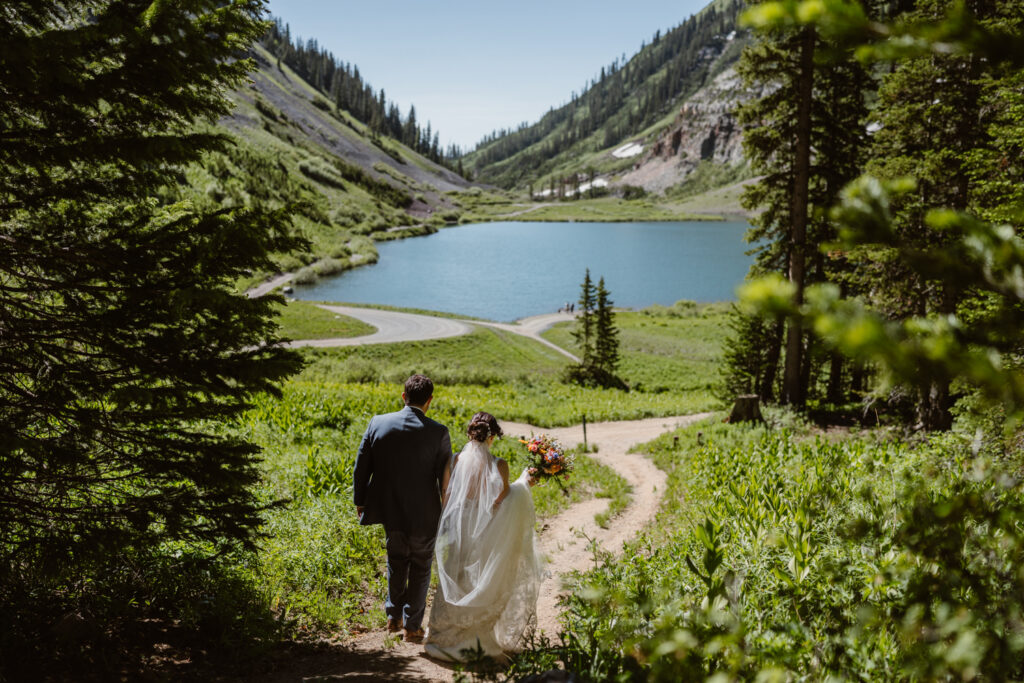
Vows and Peaks used a trail curving down to an alpine lake and shot through evergreen branches on both sides. The dark foreground framing contains the brighter center of the image and pushes the eye down the path toward the couple and the water.
This kind of natural framing can also hide clutter. Instead of fighting every branch at the edge of the scene, sometimes the better solution is to move farther behind one and let it become an intentional foreground element.
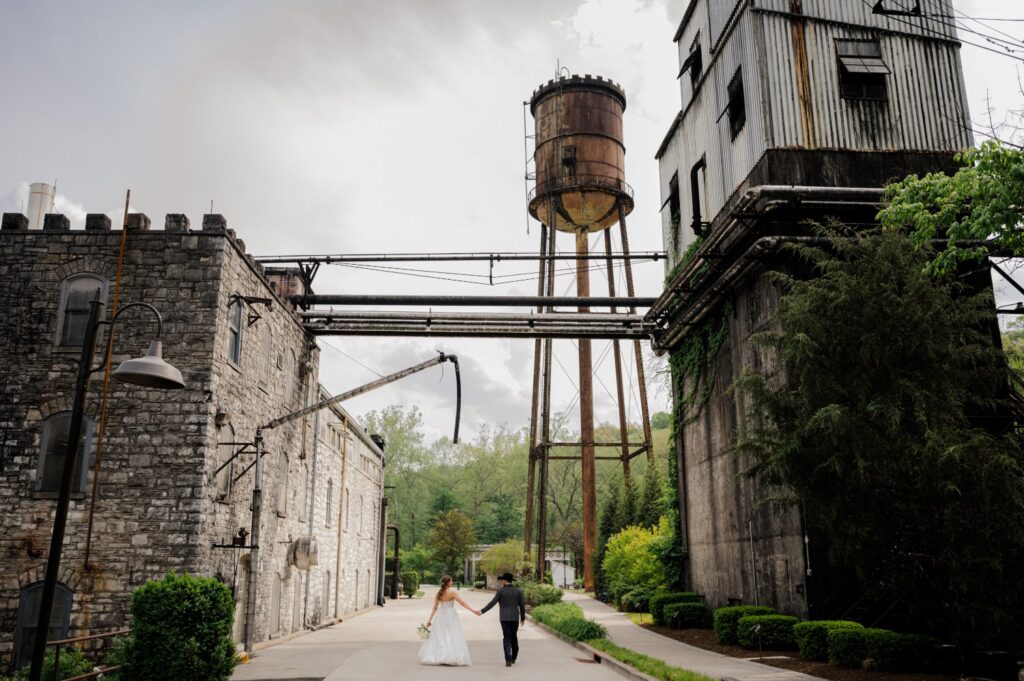
In a built setting, the line can come entirely from architecture. Green Apple Photography placed the couple small at the bottom of a walkway between two buildings, with the distillery’s water tower and overhead pipes creating a structure around them.
Architecture rewards precision. Take an extra second to look at where verticals intersect heads and shoulders, whether the couple is actually centered when symmetry matters, and whether moving a few inches left or right cleans up the geometry.
3. Shoot for the details nobody else sees
Front-facing portraits almost never show the back of the dress, the full shape of a train, jacket details, shoe soles, or the way clothing moves from behind. The walk-away is your chance to make those details part of a real photograph instead of treating them as separate documentation.
That can be especially valuable when the back of a garment is one of its strongest design features. Lace panels, buttons, open backs, embroidery, corsetry, veils, capes, and trains often need both direction and light before they really read.
Think about the light across those details. Flat light documents them. Side light or backlight can reveal texture, edges, and movement. Neither approach is automatically better; they simply tell the story differently.
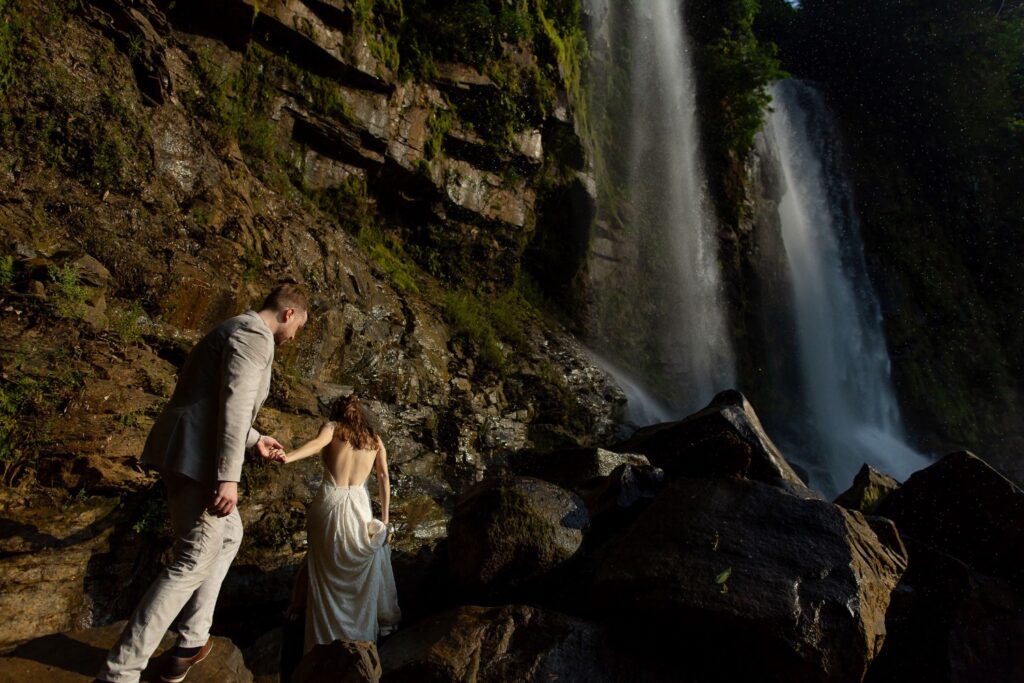
Kevin Heslin caught an open-back dress in hard, raking sunlight as the couple climbed toward the falls. The directional light defines the shape of her back while the bright mist behind them gives the scene atmosphere.
The climbing motion also fits the location. This would lose some of its credibility if the couple were standing perfectly posed on the rocks. Their movement makes the photograph feel connected to the terrain.
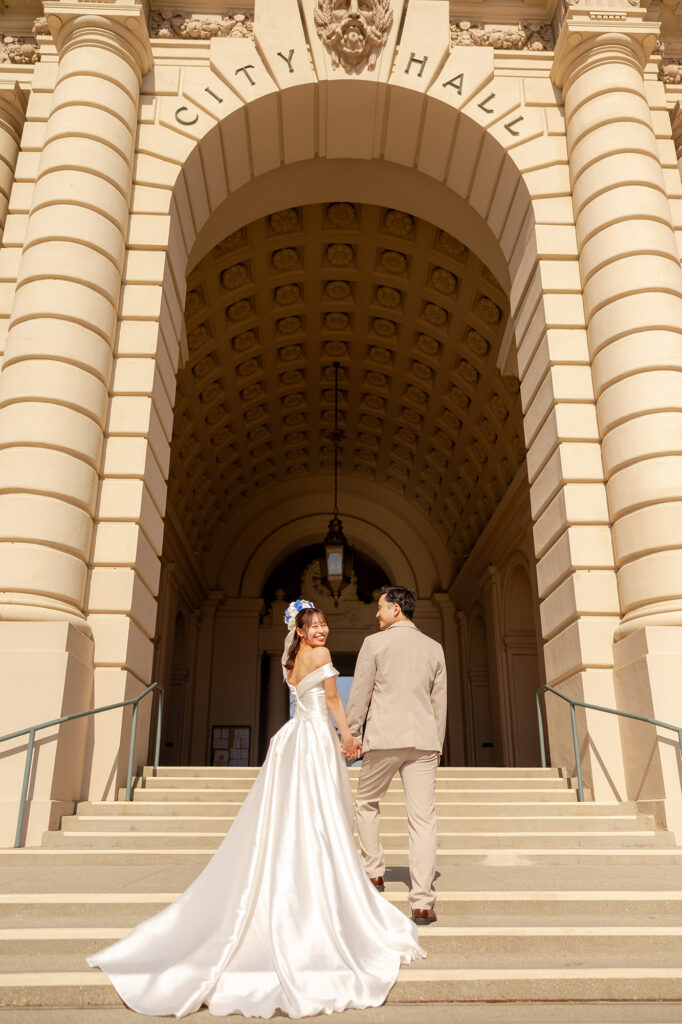
NZ Wedding Studio shot from low on a set of city hall steps, which stretches the train down the stairs toward the lens while keeping the arch and its coffered ceiling above the couple.
The lower camera position matters. From eye level, much of the train would stack visually behind the bride. Shooting from below gives it distance to travel through the frame and makes the stairs part of the design instead of merely the surface the couple is walking on.
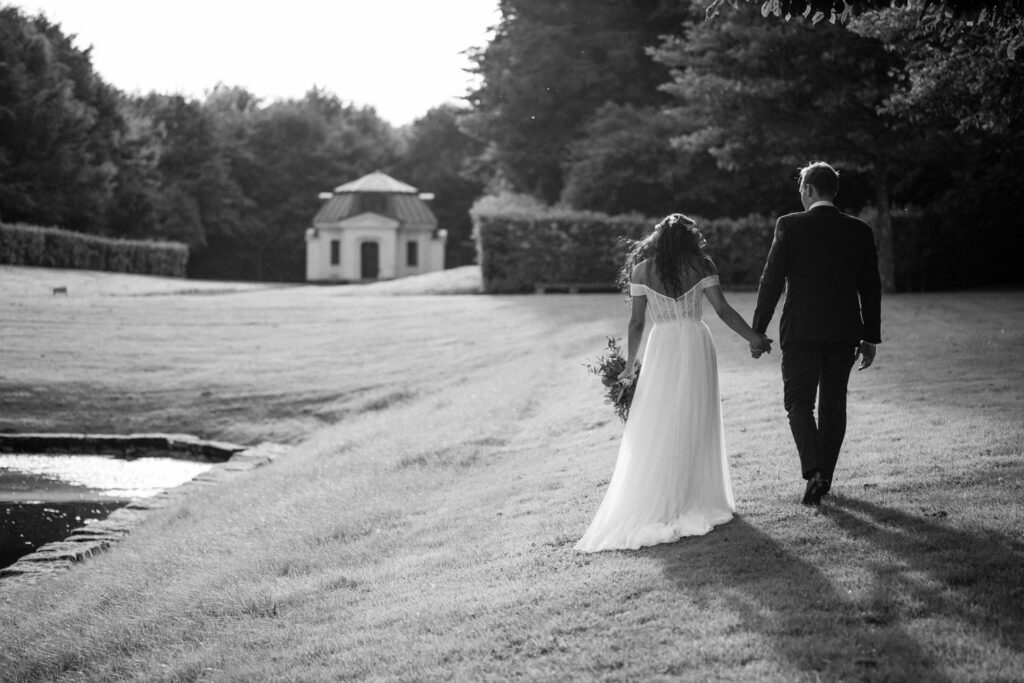
Tove Lundquist shot straight into low sun, which rims the bride’s hair and throws long shadows toward the camera. In black and white, color drops away and the photograph relies more heavily on shape, tonal separation, the bodice, and the striped pattern in the lawn.
Backlight can be especially useful for walk-away photographs because the subjects do not need perfectly lit faces. You can prioritize outline, atmosphere, and the edges of clothing in a way that would be harder to justify in a conventional portrait.
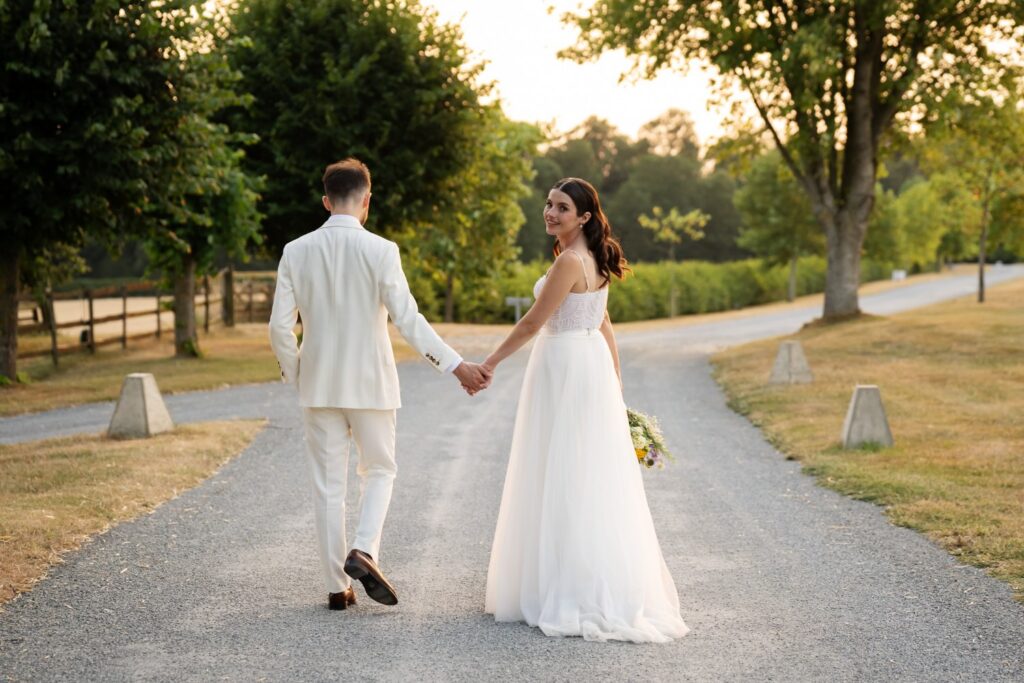
Time the shutter to the stride. Andy Sidders caught the groom with his heel lifted and the sole of his shoe showing. If a couple has a message, date, design, or other detail on their soles, a mid-step frame like this may be the only natural way it appears in the gallery.
Details are strongest when they are discovered inside the photograph rather than forced to become the entire photograph. The viewer notices the couple first, then the expression, then the movement, then perhaps the shoes. That layering gives an image more staying power.
4. Get the glance back
The pure walk-away hides both faces. A look over the shoulder gives you a portrait inside the same composition without completely changing the pose.
This works particularly well when the frame is beautiful from behind but you still want one point of human connection. One face is often enough. In fact, asking only one partner to turn can feel more spontaneous than having both rotate toward the camera at exactly the same time.
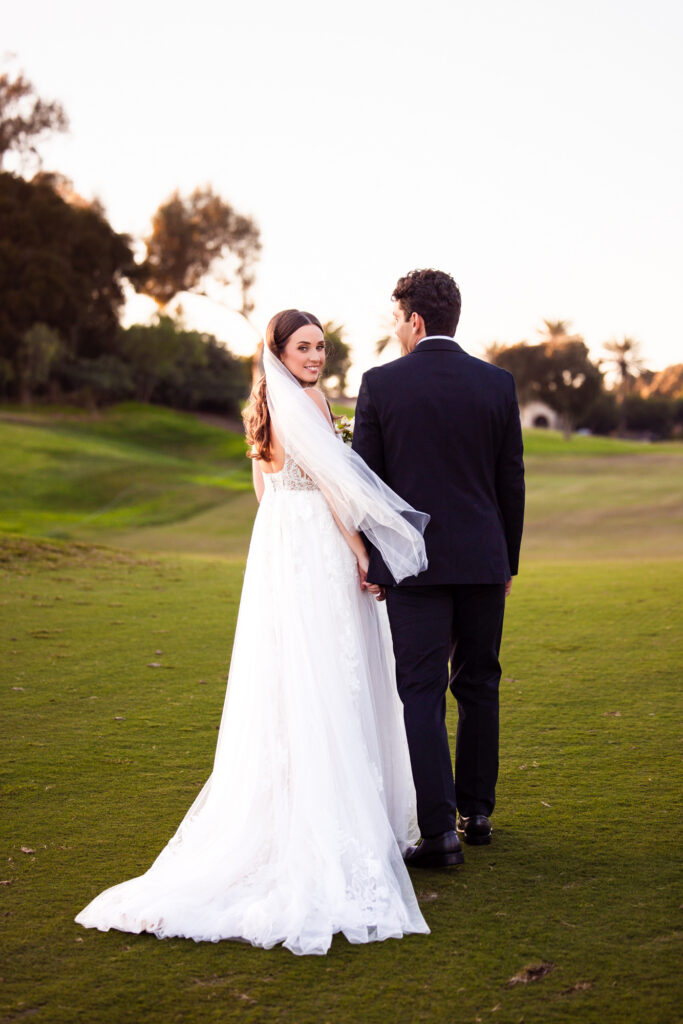
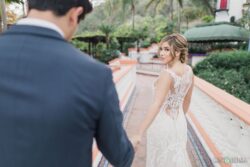
PMC Photography had the bride look back while the groom kept facing forward, and a breeze lifted her veil across his back. One glance is enough to reconnect the viewer with the couple while preserving most of the walk-away feeling.
The movement of the veil is important here too. It crosses the space between the two people and keeps the frame from feeling like two separate figures simply standing next to each other.
You can also ask both partners to turn, as in the mountain road frame above, or catch the look as Andy Sidders and NZ Wedding Studio did, with one partner turning mid-step.
Instead of giving a mechanical direction such as “turn your head forty-five degrees,” try calling one person’s name once they are already moving. The reaction is faster and less calculated. Shoot through the turn, because the transition into the glance often looks better than the finished position.
5. Change the direction
The walk-away has a few close cousins worth shooting during the same setup. You have already positioned the couple in good light and found a useful background, so there is little reason to get only one composition from it.
A small change in direction can alter the story dramatically.
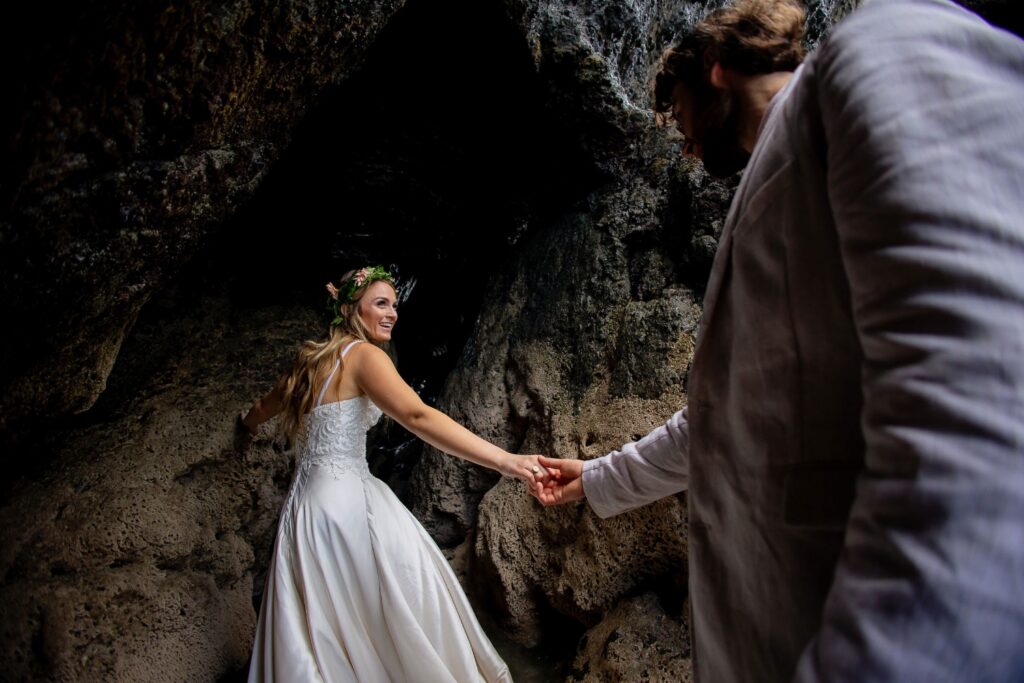
The follow-me. One partner leads while you shoot from behind the other. Kevin Heslin photographed over the groom’s shoulder as the bride pulled him into a cave and looked back laughing.
His shoulder in the foreground does more than add depth. It puts the viewer roughly in his position. Instead of observing two people from a distance, you momentarily feel like the person being led.
This variation works well when one partner is naturally more animated or when you want the photograph to feel playful instead of reflective. Ask the person in front to lead rather than drag, then let the back person react.
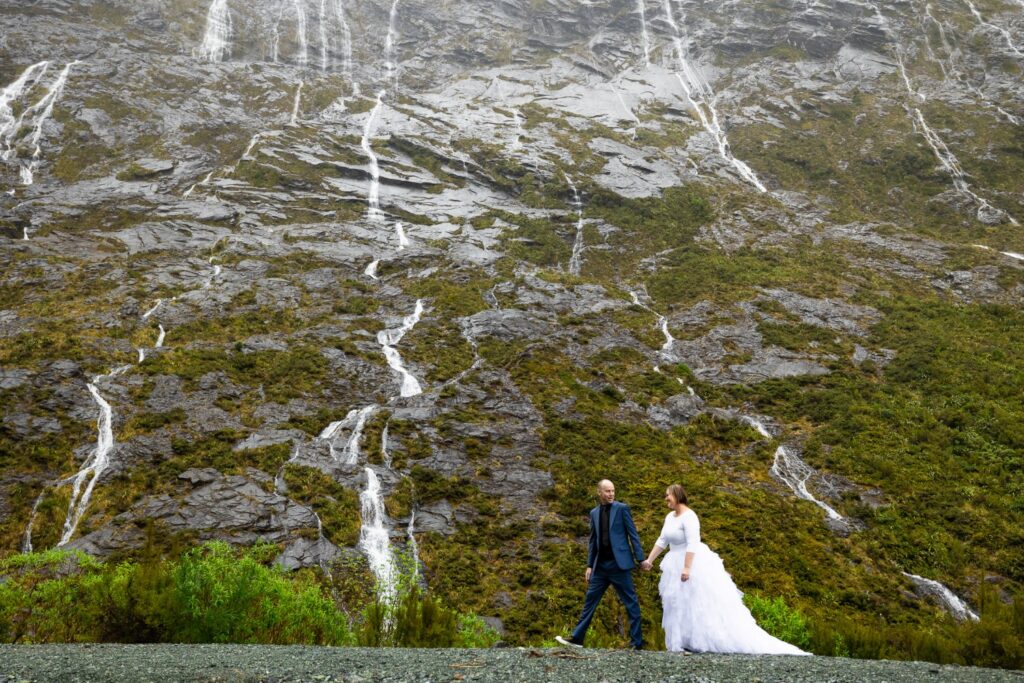
The walk across. Turn the couple ninety degrees so they cross the frame in profile. New Zealand Elopements kept them tiny against a cliff running with waterfalls, and the side view lets their stride read clearly even at that scale.
Profile movement is especially effective when the backdrop itself is mostly vertical. The couple’s horizontal movement cuts across the composition and gives the eye an obvious route through the frame.
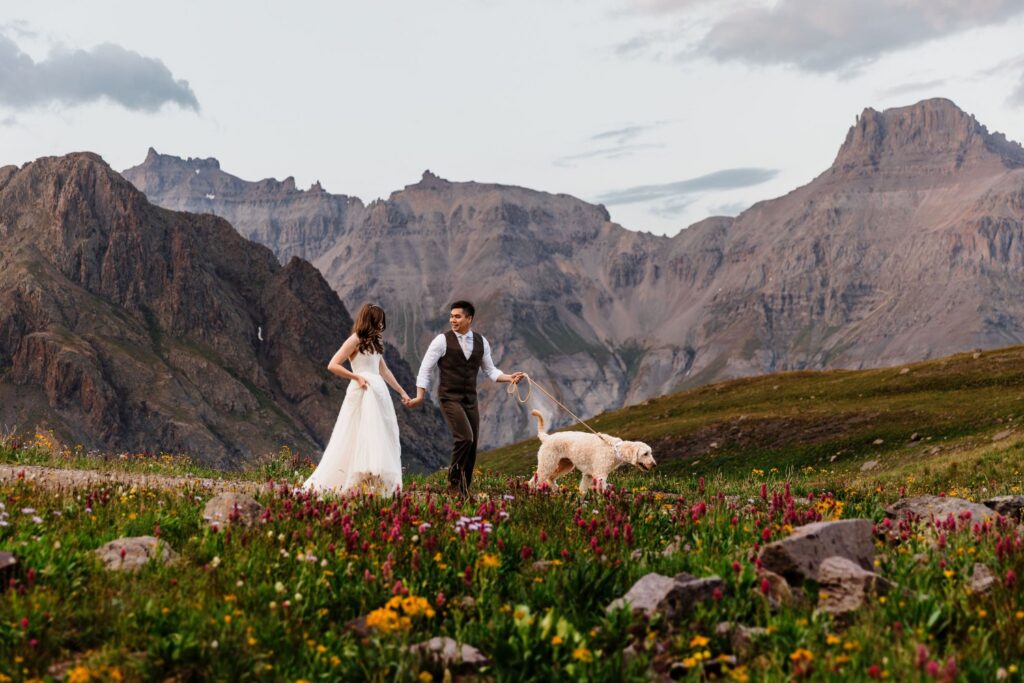
Vow of the Wild did the same across a wildflower slope, with the groom leading a dog on a leash. A profile walk handles a third companion well because the subjects can spread across the frame instead of stacking on top of each other.
The same idea applies to children, wedding-party members, or anyone else joining a walking portrait. When there are more bodies to organize, giving everyone lateral space is often simpler than trying to keep them separated while they move directly away from the camera.
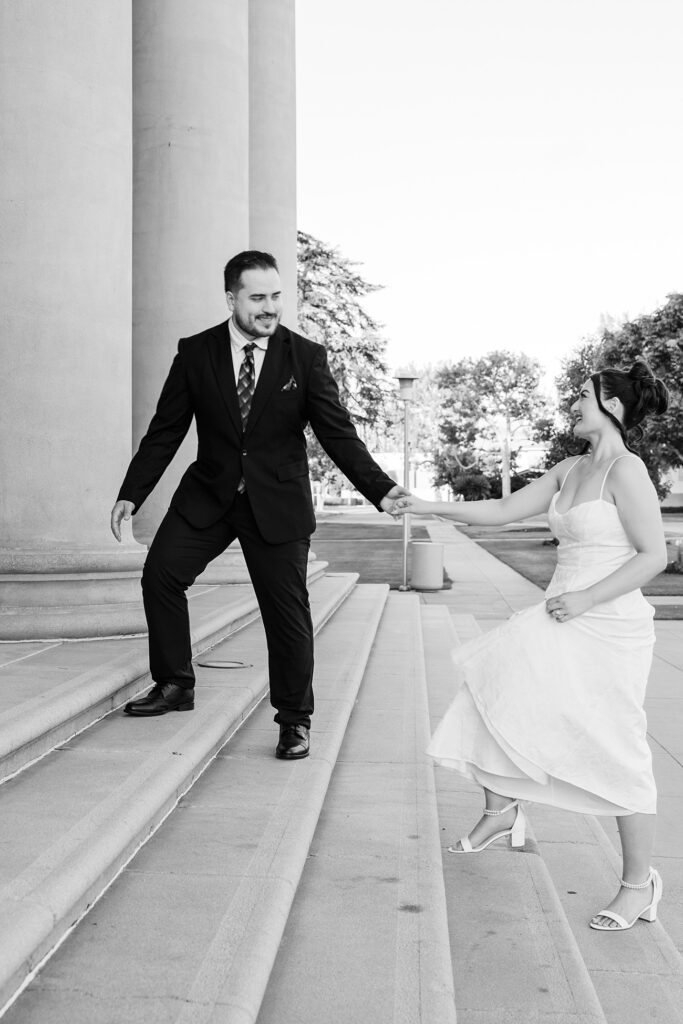
The pull. Photography by Belinda Philleo had the groom lead the bride up a set of steps while she swung her skirt. It is less a walk than a burst of motion, and it brings an energy the slow walk does not.
The important thing is that the movement still has direction. “Do something fun” is vague. “Grab her hand and pull her up the stairs” creates an action, a destination, and a relationship between the two bodies. The expression can happen on top of that.
Change your camera position before changing the pose
If you have a strong walk-away working, do not immediately abandon it for the next pose. Change your own position first.
Shoot one frame at normal height. Drop lower and see whether the foreground becomes more prominent. Move farther back and turn the couple into a smaller part of the landscape. Step to one side and see whether the path begins to curve through the frame. If there are leaves, flowers, railings, doorways, or other foreground elements nearby, see whether you can use them as a partial frame.
One simple walking direction can produce a surprising amount of visual variety when the photographer does the moving.
Your lens choice changes the relationship between the couple and the location as well. A wider view can emphasize foreground and scale, while a longer perspective can simplify a cluttered environment and make distant elements feel more prominent in the composition. Neither is inherently more “correct.” Choose based on what you want the viewer to notice.
Use the environment to decide the pose
The best walk-away photographs usually feel as though the couple belongs exactly where they are walking.
On a mountain trail, that may mean a loose handhold and plenty of landscape. On formal stairs, it may mean careful train placement and more symmetry. On a windy coastline, trying to make every piece of clothing behave perfectly can work against the scene; letting the wind become part of the photograph may be stronger.
Do not bring the same walk-away to every location and expect the location to adapt to it. Let the environment give you the instructions.
Look for what the scene already wants to do. If everything leads toward a doorway, send the couple toward the doorway. If the light is strongest along one edge of a field, use the walk to move them through it. If a mountain ridge is the visual payoff, place their travel toward the ridge instead of parallel to it unless you specifically want a profile.
The pose is simple enough that the composition can do the heavy lifting.
Common problems and fast fixes
They look stiff. Stop giving posture instructions and give them something to talk about. You can also let them walk once without photographing seriously, then reset and run it again.
Their bodies keep merging together. Ask them to leave a hand’s width of space between their hips or put one partner half a step ahead. Small changes are enough.
One person keeps pulling the other. Slow the pace down. Tell them this is a photograph walk, not an airport walk.
The arms look rigid. Have them loosen their grip and let the joined hands hang lower. Conversation usually helps the free arms relax as well.
The destination looks arbitrary. Change your angle or give them something specific to walk toward. Even a small visual target can make the direction feel more deliberate.
The dress or train keeps disappearing. Separate the couple slightly, change the camera angle, or reset the train for one clean pass before returning to looser movement.
The frame feels empty. Decide whether the emptiness is useful negative space. If it is not telling the story, move closer, lower your angle, add foreground, or reposition the couple against a stronger part of the scene.
Every frame looks the same. Change one variable at a time: go wider, get lower, ask for the glance back, shift to a profile walk, let one partner lead, or photograph the return trip toward you.
A simple walk-away sequence to use at a wedding
If you want to turn this into a repeatable workflow, keep it simple.
- Frame one: the clean walk-away. Both partners facing forward, relaxed handhold, strong environment.
- Frame two: one partner looks back.
- Frame three: both look at each other while continuing to walk.
- Frame four: change to a side angle and photograph the profile stride.
- Frame five: let one partner lead for a little more energy.
- Frame six: have them turn around and walk toward you while continuing the conversation.
That gives you a surprisingly complete mini-sequence without asking the couple to memorize six different poses. To them, they mostly just walked down a path and came back.
More from the set
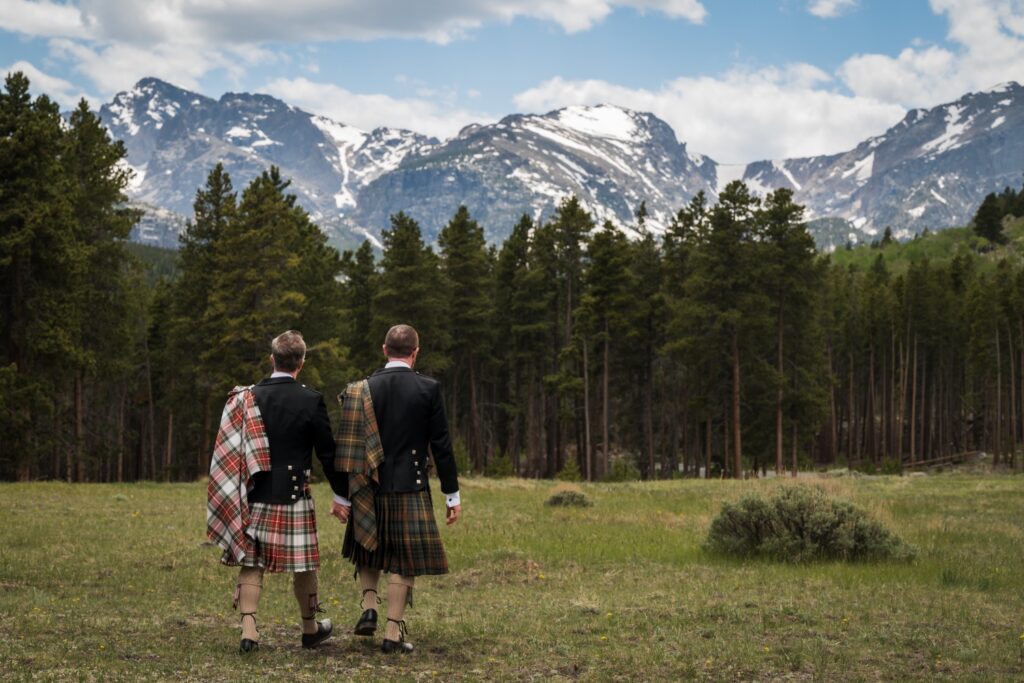
Two grooms in kilts crossing a meadow toward the peaks. A centered, symmetrical composition lets the tartans carry the color while the mountain backdrop gives the walk a clear destination.
It is also a reminder that the pose does not depend on a dress or train to work. At its core, the photograph is about two people, a connection between them, and a direction of travel.
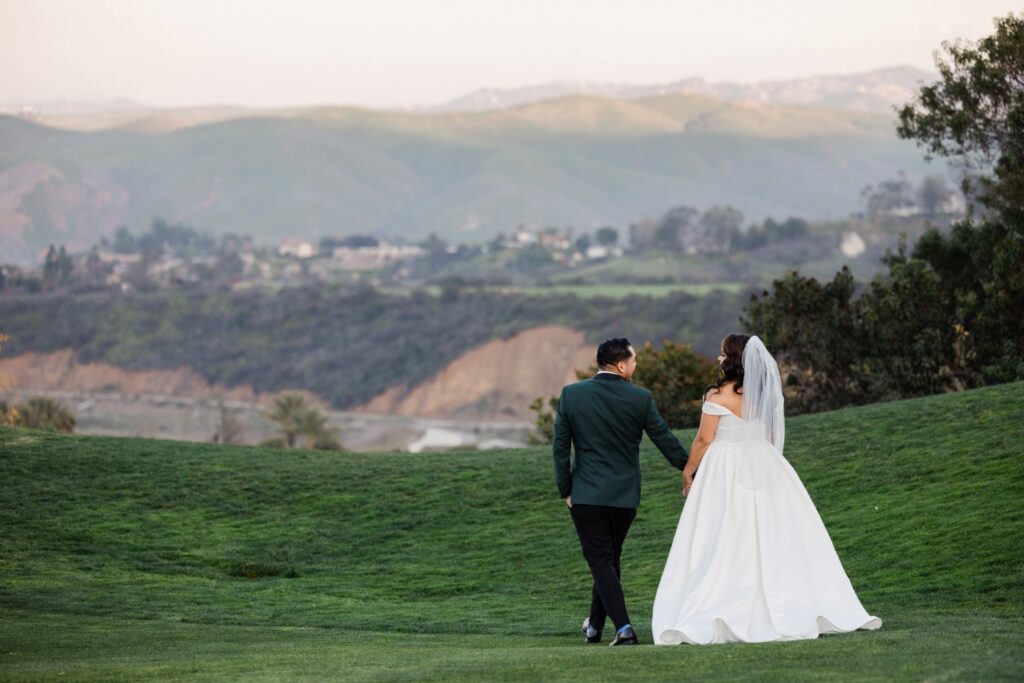
Here the couple walks down a green slope at a golf club with hills and homes behind them. The background is kept soft enough that the couple remains separated from a setting with considerably more visual information.
Not every walk-away needs a once-in-a-lifetime mountain, waterfall, or dramatic piece of architecture. A clean direction, good separation, controlled background, and well-timed stride can make the pose work in ordinary locations too.
The takeaway
The walk-away is basic. That does not mean it has to look basic.
Start with the action, then build the photograph around it. Give the couple somewhere meaningful to go. Keep enough separation for both bodies to read. Watch the hands and the stride. Decide whether the story is about the couple, the clothing, the environment, or some balance of all three.
Then shoot past the obvious frame.
Go wide. Get low. Let them become small. Wait for the dress to move. Catch the heel lifting. Call one person’s name. Turn them sideways. Have one lead. Photograph them coming back.
The direction may only be “hold hands and walk over there,” but what you build around those six words is what turns a pose into a photograph.
See more from the photographers in this article: Authentic Collective, Andy Sidders Photography, NZ WEDDING STUDIO, New Zealand Elopements, Tove Lundquist, Vows and Peaks, Gretchen Troop Photography, PMC Photography, Kevin Heslin, Photography by Belinda Philleo, Vow of the Wild, Green Apple Photography.