What Is the Golden Ratio Mathematical Formula?
If you are not a mathematician or a physicist, that may sound complicated. The formula for the Golden Ratio is a + b over a = a over b = Phi, where Phi (Greek symbol) equals 1.6180339887, and so on, the numbers go.

The Golden Ratio helps you come up with a composition that is perfectly balanced from the perspective of your viewers, which creates a photograph or a scene that is most pleasing to the human eye. You naturally prefer to look at images or scenes that are balanced and harmonized, and the Golden Ratio provides that.
The Golden Ratio has been a powerful composition tool for centuries. Famous works of art (Mona Lisa, the Birth of Venus, the Last Supper) are all rumored to be captures on the basis of the Golden Ratio. It is also called nature’s number because you see it all around in nature.
In photography, you can use the Golden Ratio as an element of design to achieve a strong composition in an organic way. This draws viewers to your images or scenes and ensures their interest from the start. Not only that, the Golden Ratio also lets you guide your viewer around the photo or scene.
Your viewers do not want to work to see a beautiful composition; they just want to see it. Photography and cinematography are about coming up with something that is visually aesthetic, and the use of the Golden Ratio in your photography is one way that you can achieve this.
How to Improve Your Photography with the Golden Ratio?
There are many interpretations of how you can use the Golden Ratio to improve the composition. Two of the most common compositions when applying it in photography, film, or video production are the Phi Grid and the Fibonacci Spiral.
Fibonacci Sequence or Spiral
Around the 12th century A.D., a man named Leonardo Fibonacci, who was a mathematician, came up with a set of numbers to form compositions that people find aesthetically pleasing.
The Fibonacci spiral is made by drawing a chain of squares, and the size of each square is decided by Fibonacci’s numbers. When the diagonal points are placed inside those squares, they connect and form a path where the spiral shape moves through the frame.
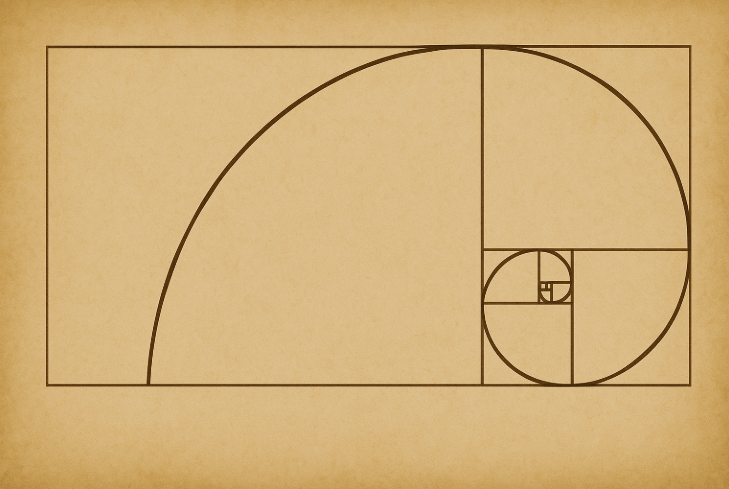
If you use the spiral to set up a photo or scene, it guides the viewer’s eyes because their attention follows the spiral naturally around the image.
Phi Grid
The Phi Grid almost looks the same as the Rule of Thirds, but there is one key difference between them. The Rule of Thirds splits the frame into three equal parts of 1:1:1.
The Golden Ratio does it differently. It splits the frame into sections or grids measured as 1:0.618:1. As a result, the lines where the sections cross end up nearer to the center of the frame.
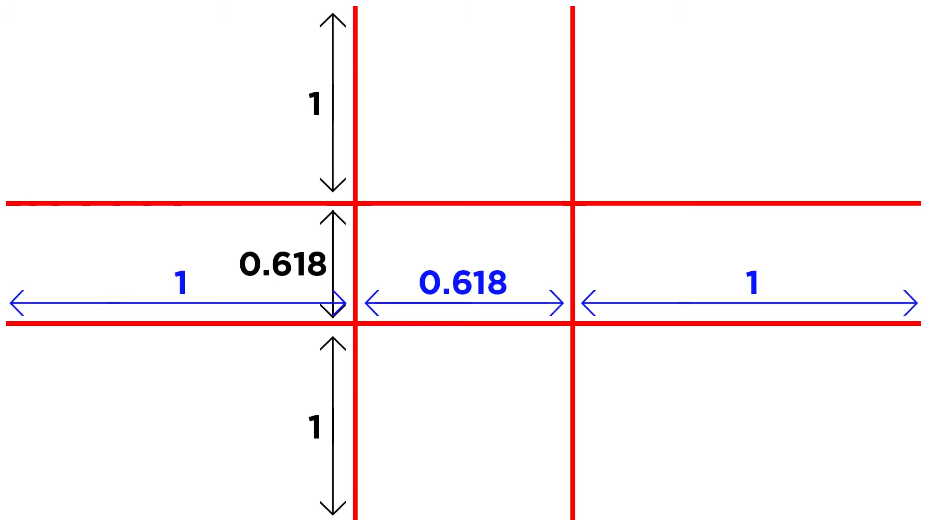
In design, there isn’t a single correct or incorrect way to use the Golden Ratio. You can apply any version when creating a photo or scene. Every version of the Golden Ratio is different, and you can use each one in its own way. Also, each version of the Golden Ratio can fit certain types of scenes and make your image look better overall.
The Fibonacci Spiral might work well on capturing a portrait, and the Phi Grid does wonders for a landscape. These guides for composing an image or scene are flexible and not limited to one type of image.
In photography and cinematography, experimentation and creativity are key factors. Never let the design principle dictate how you photograph or shoot a scene. The Golden Ratio is just a tool. You can use it to arrange your shots so the composition is strong, but it should work alongside your own creative choices.
Why Not Only Use the Rule of Thirds?
The most common design principle in photography or videography is the Rule of Thirds, and many consider it a manifestation of the Golden Ratio. The truth is otherwise.
The Rule of Thirds provides a simple way for photographers to locate the sweet spot, or the point at which the human eye is first drawn, based on the Golden Ratio. The simple 9-section grid helps you compose an image using easy-to-locate focal points where you can place interesting aspects of a scene.
Although the Rule of Thirds works well in many situations, the Golden Ratio can often be a more pleasing design concept to apply. This is because the ratio allows for a more balanced image.
The Rule of Thirds can sometimes leave elements of a scene, like the horizon line, in an awkward position. Dividing the frame into equal thirds can make the placement of a horizon line look too obvious. When you use the Golden Ratio, the balance often appears more natural and less rigid.
How to Take Photos with Golden Ratio?
Although the math in the Golden ratio can be a bit hard to understand for a newbie, applying it to your photography, cinematography, or video production is not, with the use of both the Fibonacci Spiral and the Phi Grid.
To use the Fibonacci Spiral, picture a small rectangle starting from one corner of your camera’s frame. Next, imagine cutting that rectangle in half by drawing a diagonal line that stretches across the entire frame. That diagonal line passes through a few important points that belong to the Fibonacci Spiral inside the rectangle. At that point, you can picture the spiral starting at your main subject and curving outward in a wide arc that flows beyond the frame.
In the Phi Grid composition, picture your frame split into nine smaller sections, the same way you do with the Rule of Thirds. But unlike the Rule of Thirds, the Phi Grid doesn’t have equal spaces. It uses the ratio 1:0.618:1, which means the four corner rectangles get more space than the others. Because of this ratio, the crossing lines in the Phi Grid end up nearer to the center of your frame.
Taking photos with the Golden Ratio takes practice. After you get used to where the important focal points of the Golden Ratio usually appear, seeing them in your viewfinder will become second nature.