City venues hand you a background most photographers would pay for, and then immediately make it hard to use. The skyline is brighter than your couple. The roof deck is windy and shared with an HVAC unit. The good light lasts about twenty minutes and lands in the middle of dinner service.
The frames below all came out of a recent Wedding Maps City Views challenge, shot in Washington DC, London, Dallas, San Francisco, San Diego, Los Angeles, Malmö and small-town Colorado. We are using them as worked examples for eight techniques that transfer to any urban venue you get booked at.
1. Let the couple be small
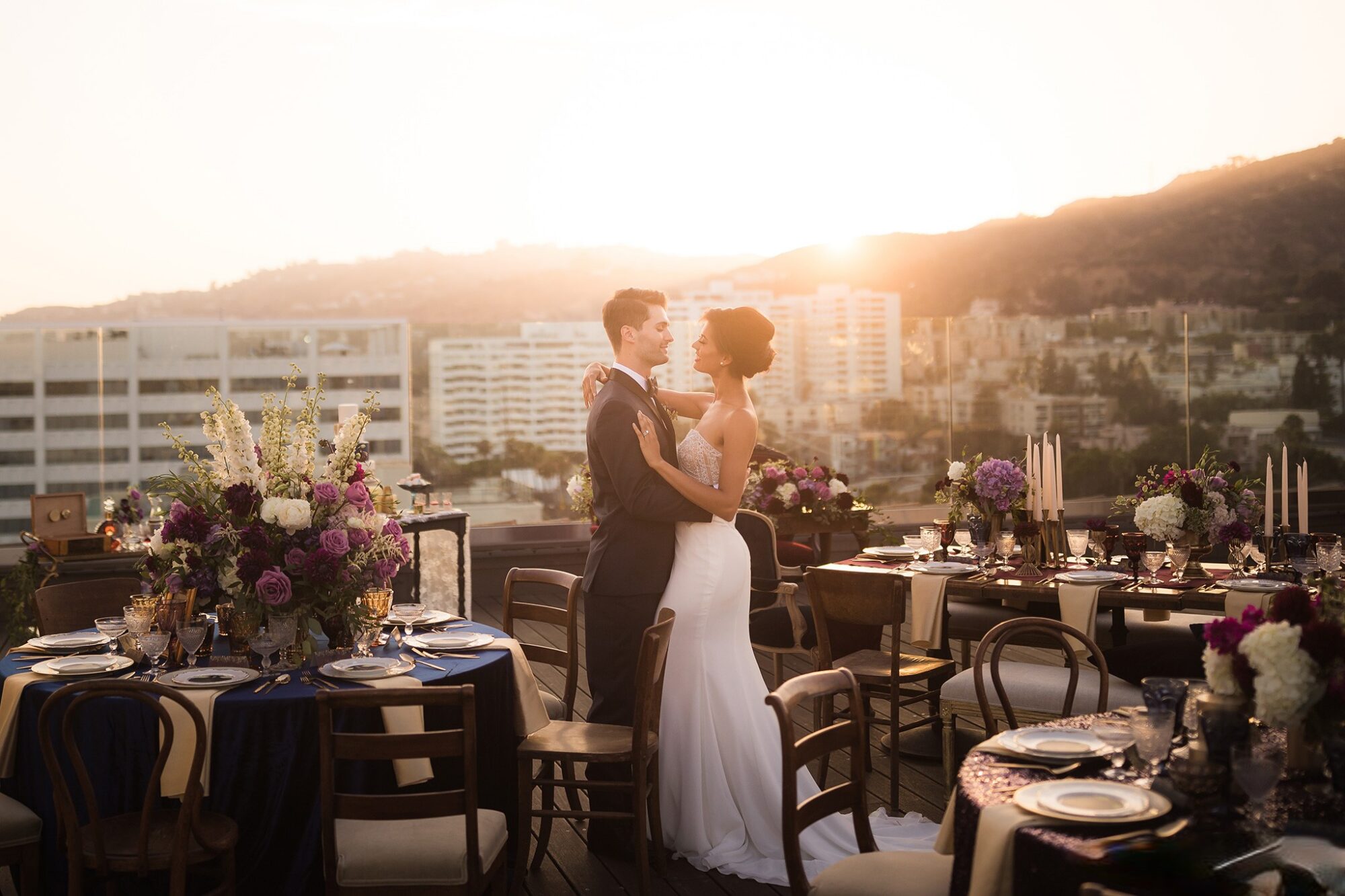
The reflex on a portrait is to fill the frame. In a city, that throws away the reason you are there. If the environment is the story, shoot wide enough that the scale reads.
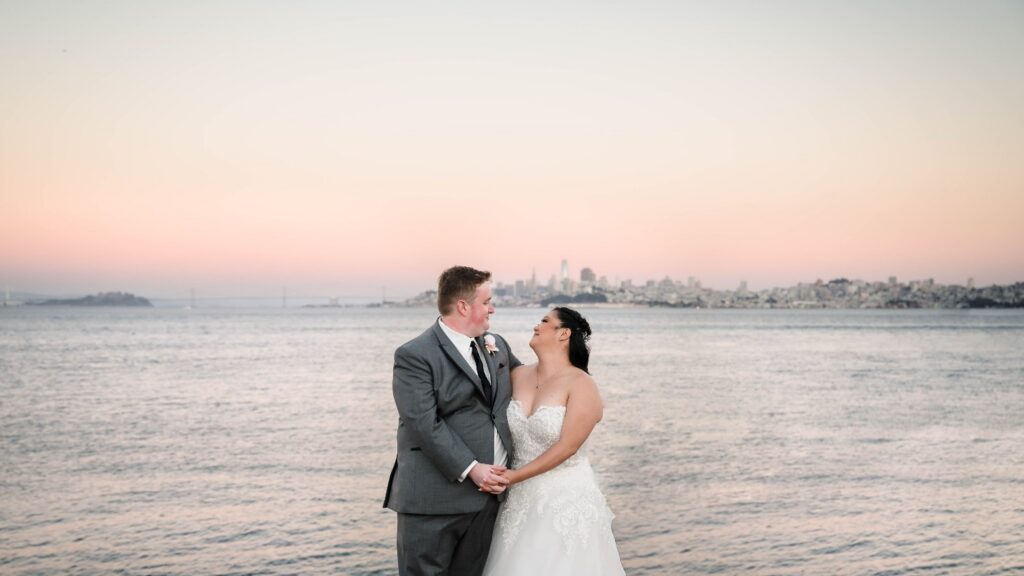
Picturist Photography put the couple at roughly a sixth of the frame height here, on a 16:9 crop, with the San Francisco skyline reduced to a thin band on the horizon. The subjects are still the brightest thing in the frame and still sit on a third, so your eye finds them immediately. Everything else is sky and water doing the work.
2. Shoot at golden Hour or Night
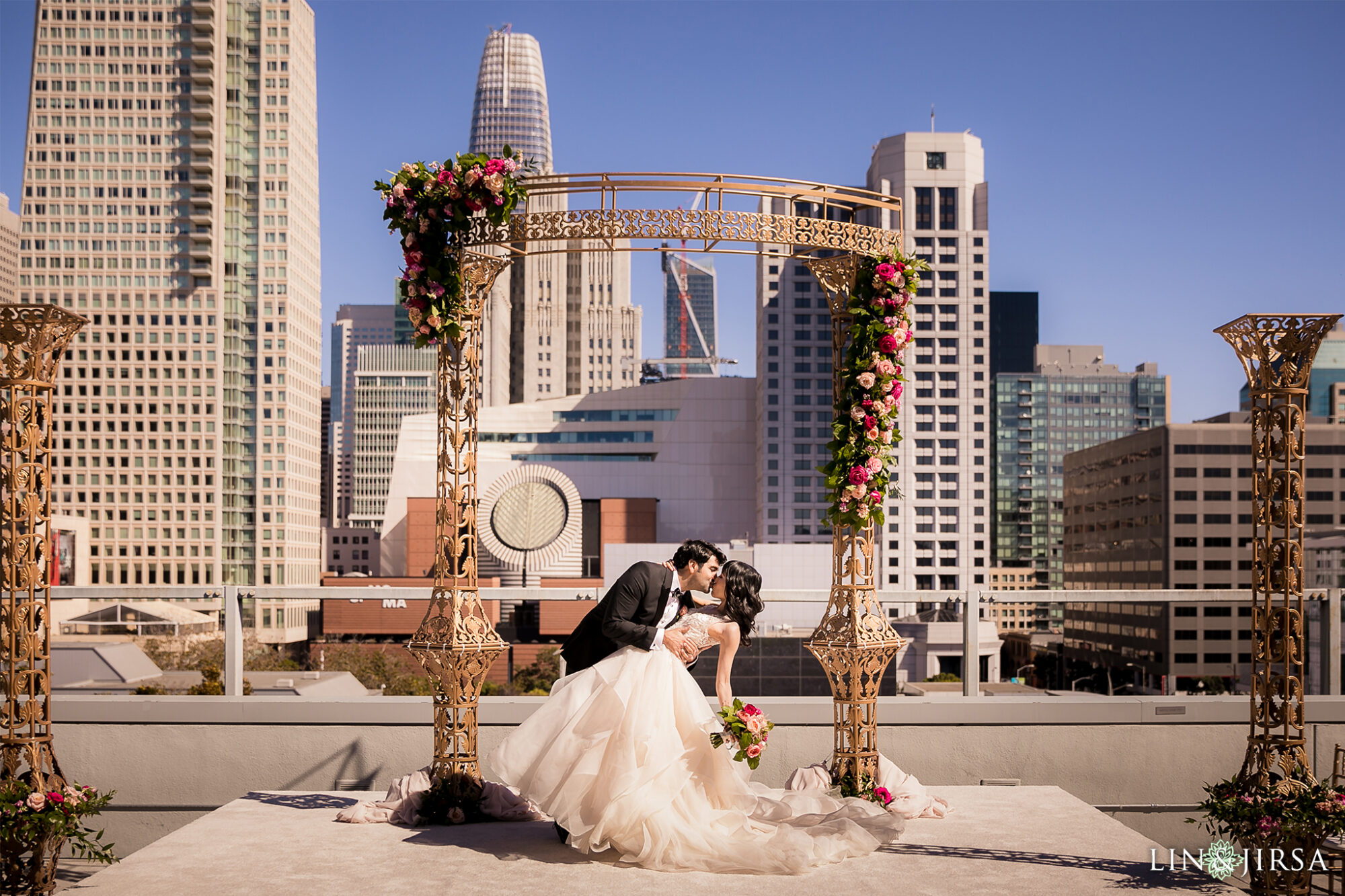
Most rooftops don’t have any shade so timing is critical. Ensure that the wedding schedule has a golden hour, blue hour or evening couples session on the rooftop. For obvious reasons, avoid midday sun. Use a suntracker app to determine the best time.
3. Get low and find the reflection
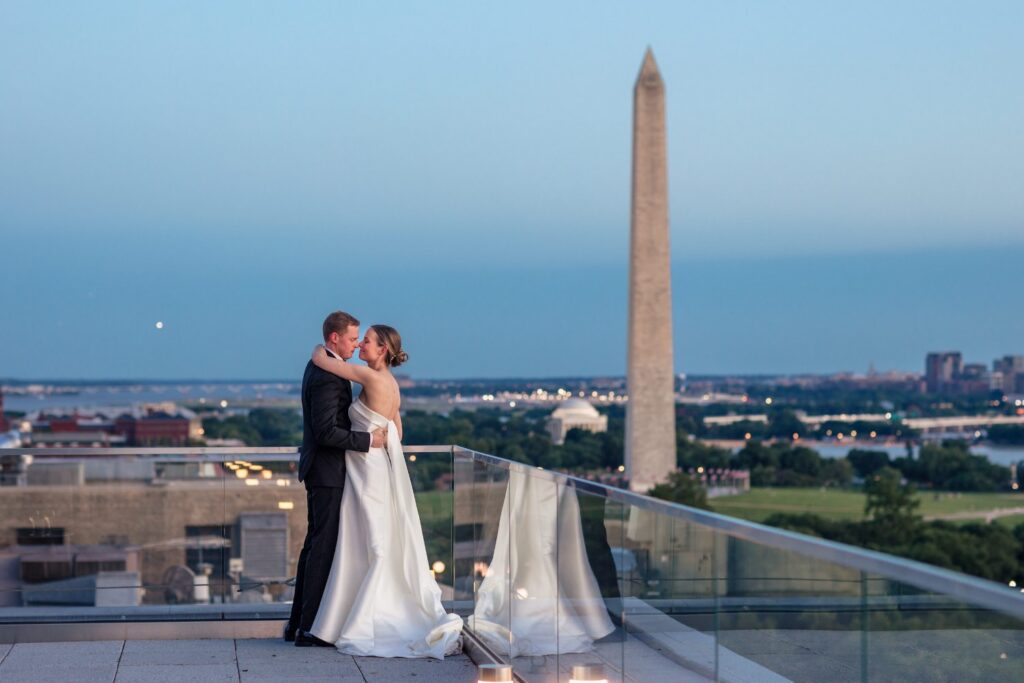
Cities are full of specular surfaces: fountains, reflecting pools, polished plaza stone, and wet pavement after a shower. Drop the camera close to the surface and you get the skyline twice.
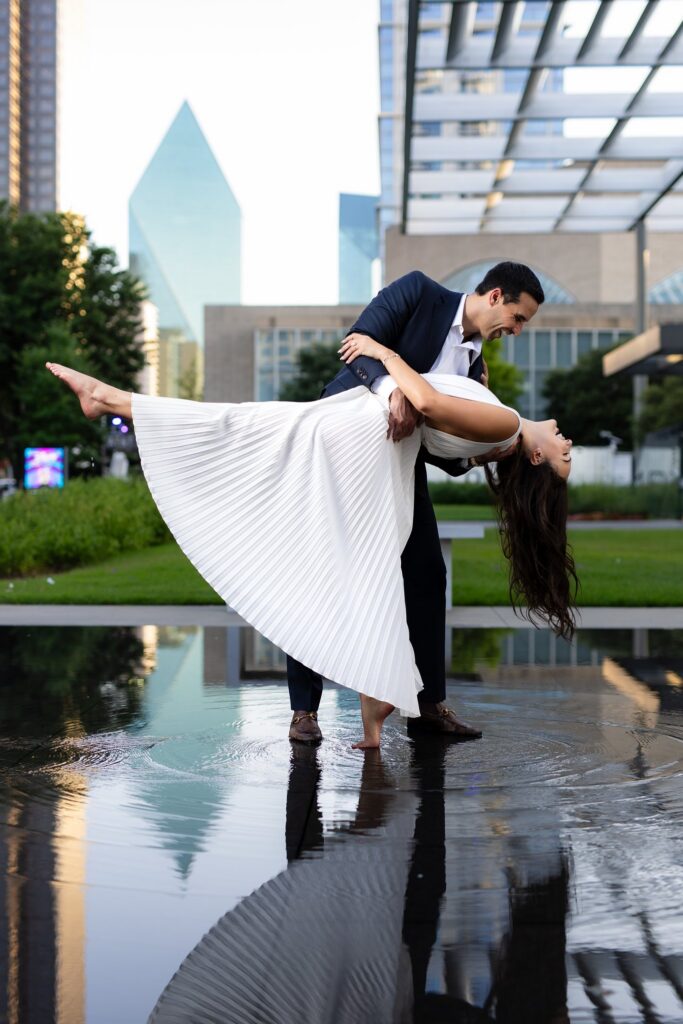
Stefani Ciotti Photography worked a shallow reflecting pool in downtown Dallas, shooting from low with the couple barefoot in maybe an inch of water. The pleated skirt gives the reflection a shape to hold, and the ripples keep it from reading as a mirror trick.
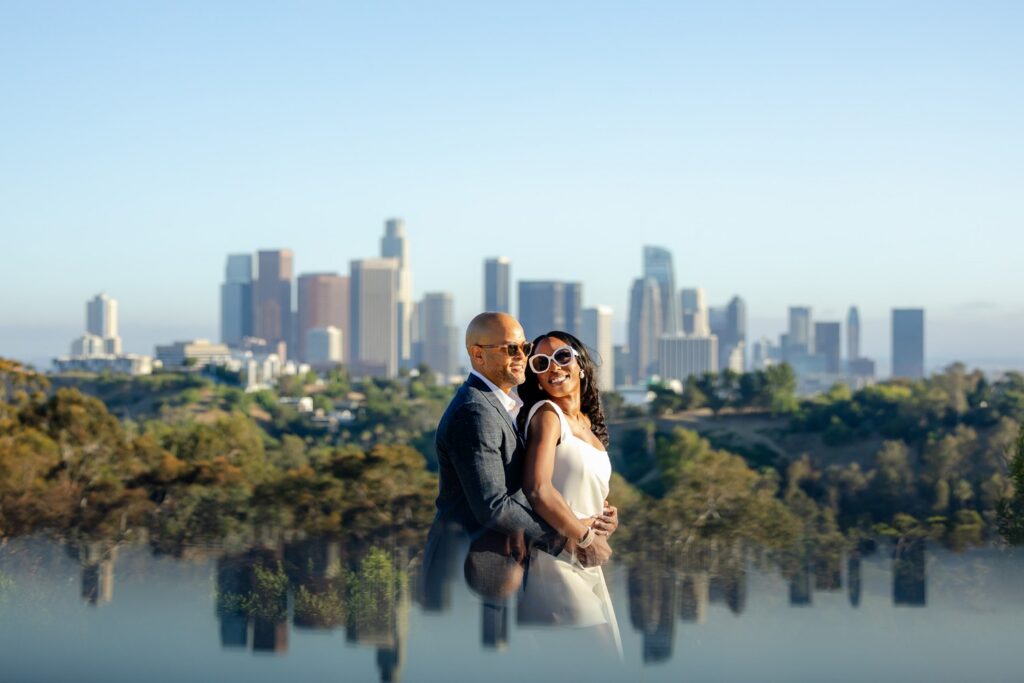
NZ Wedding Studio ran a mirrored foreground under a downtown Los Angeles skyline for a more graphic version of the same idea.
4. Use the architecture as a frame
Downtown cores are full of corridors, colonnades and service alleys between towers, and on a Saturday afternoon they are usually empty.
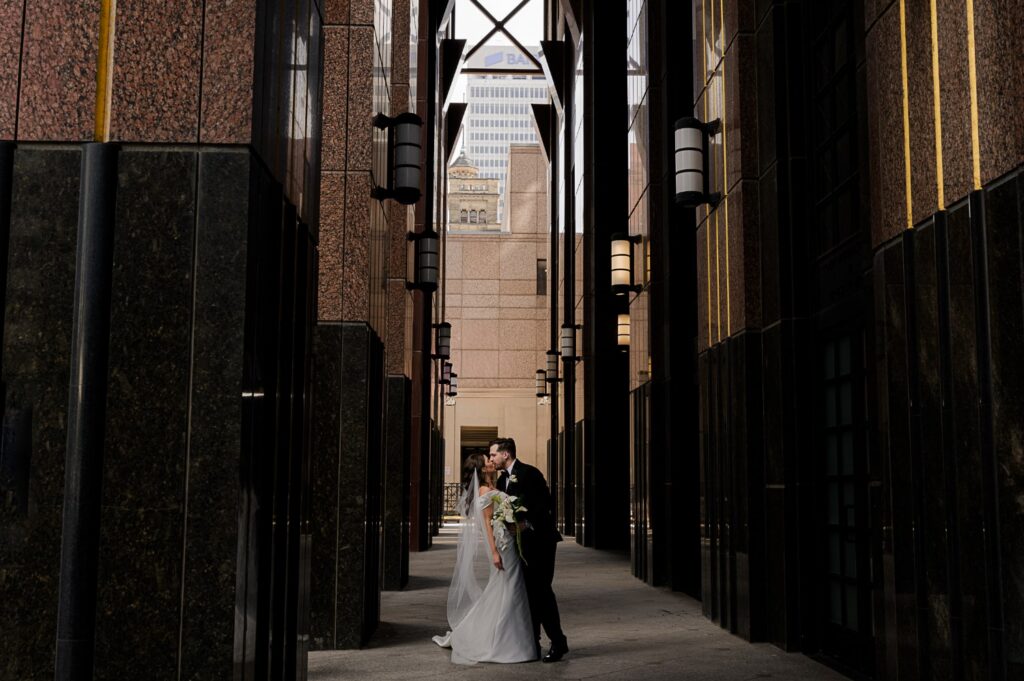
Green Apple Photography placed the couple at the far end of a granite passage between two office buildings. The two walls converge, the run of wall sconces repeats down both sides, and the bright opening behind the couple stops the eye exactly where it should. Note the exposure decision: the walls are allowed to go almost black so the couple and the gap read.

Look for these on the venue walkthrough, not on the day. You want to know where the light falls and at what hour before you have a couple standing next to you.
5. After dark, flash plus a dragged shutter
Once the sky is gone, you have two exposures to reconcile: the skyline, which is a distant constant, and your couple, who are three feet away and unlit.
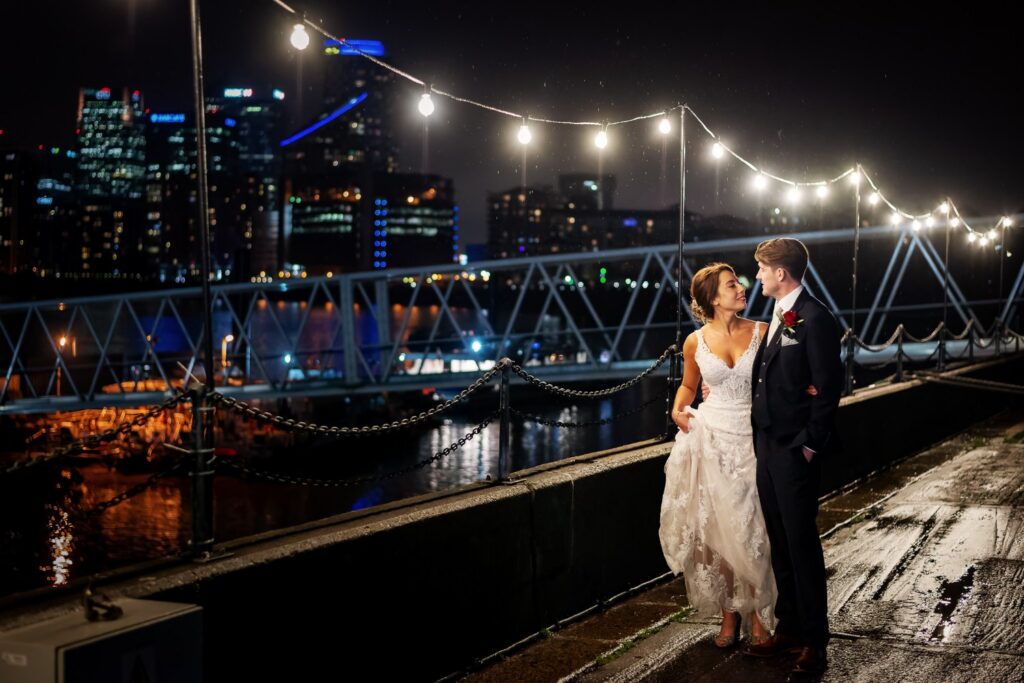
Andy Sidders Photography shot this in the rain at Trinity Buoy Wharf with Canary Wharf lit across the water. The ambient exposure is set for the far bank, so the towers hold detail rather than clipping. Off-camera flash handles the couple, feathered enough that the wall and the ground next to them still fall off naturally. The festoon lights overhead render as clean points, and the wet concrete carries the light down into the foreground.
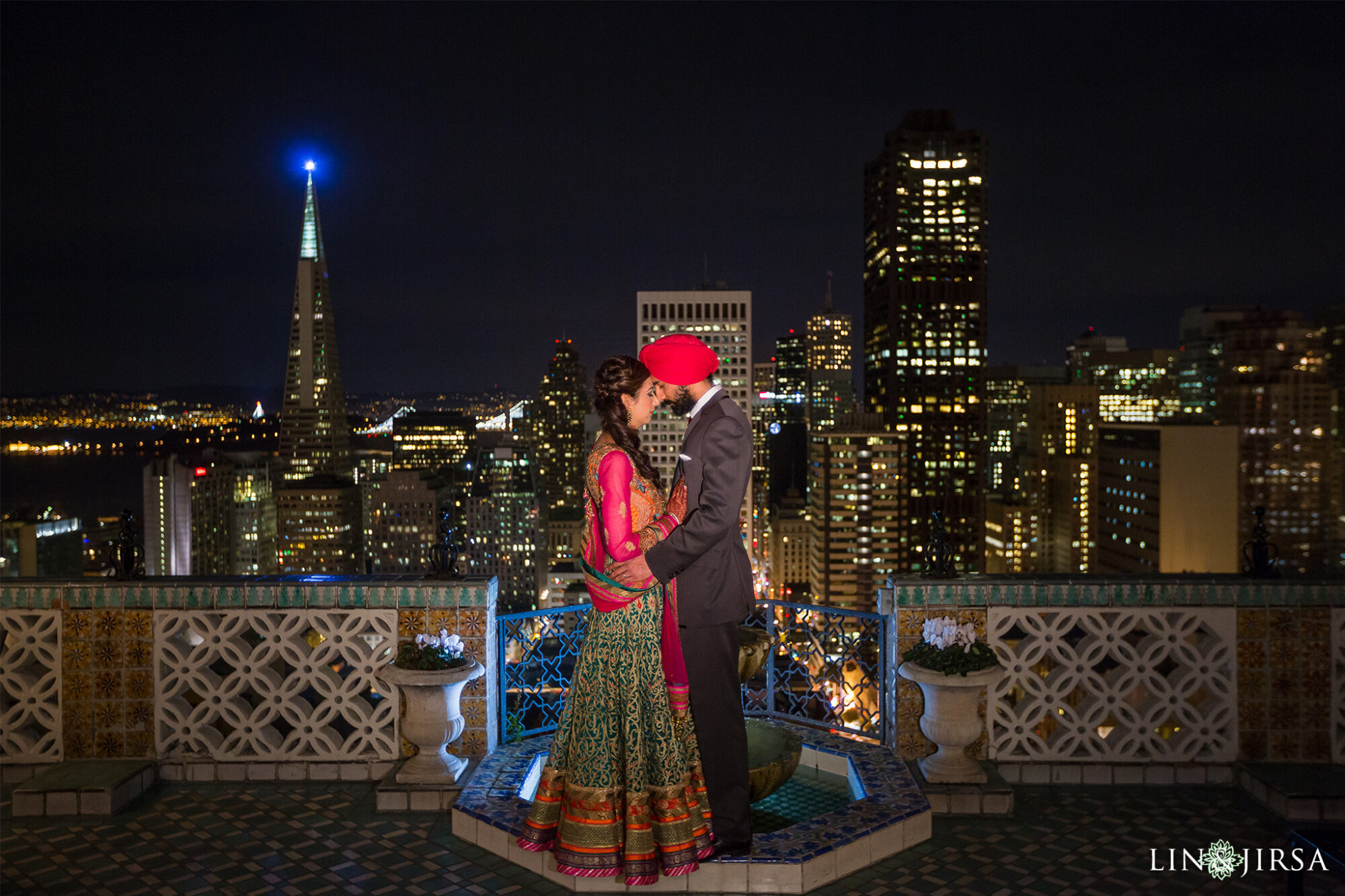
Practical starting point: expose for the background first, in manual, and get that right before you add any light. Then bring the flash up until the couple sits about where you want them relative to the city.
6. Rain is an asset in a city
Wet pavement is the cheapest reflector you will ever be handed. Every street lamp, headlight and shop window doubles.
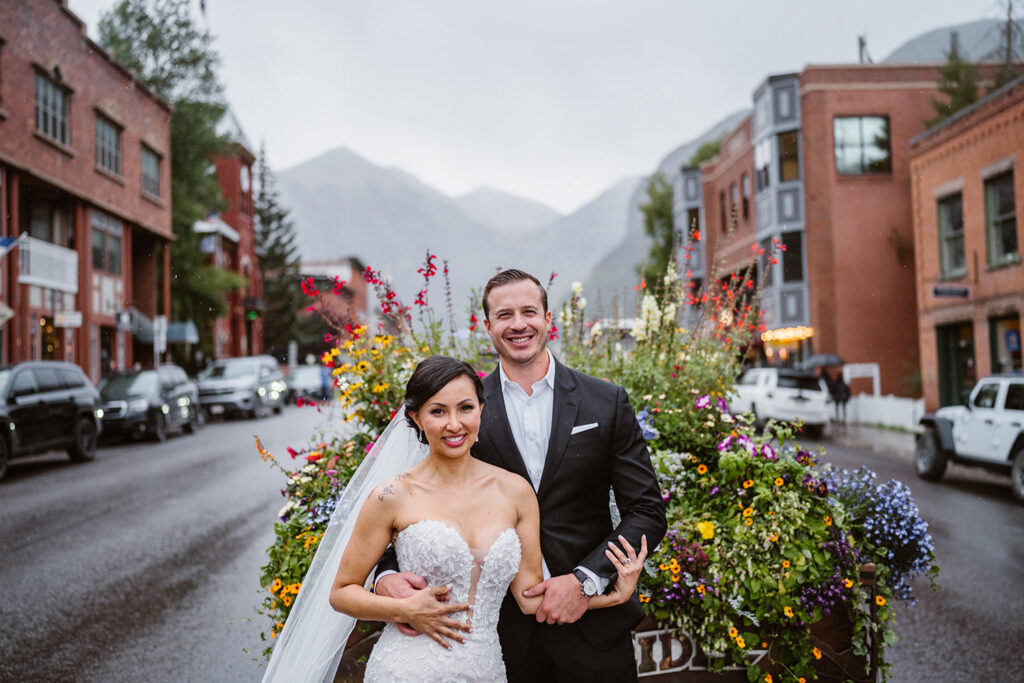
Vows and Peaks shot this on a Colorado main street in active rain. The asphalt is carrying the whole street, the cloud has softened the peaks at the end of the road into a backdrop rather than a distraction, and the planted flowers are fully saturated in a way they never are in sun.
Have the umbrella conversation early so a light shower does not turn into forty minutes indoors.
7. Decide what backlight is doing before you shoot it
Rooftops mean shooting into open sky, which usually means shooting into the sun. There are two defensible answers and you should pick one deliberately.
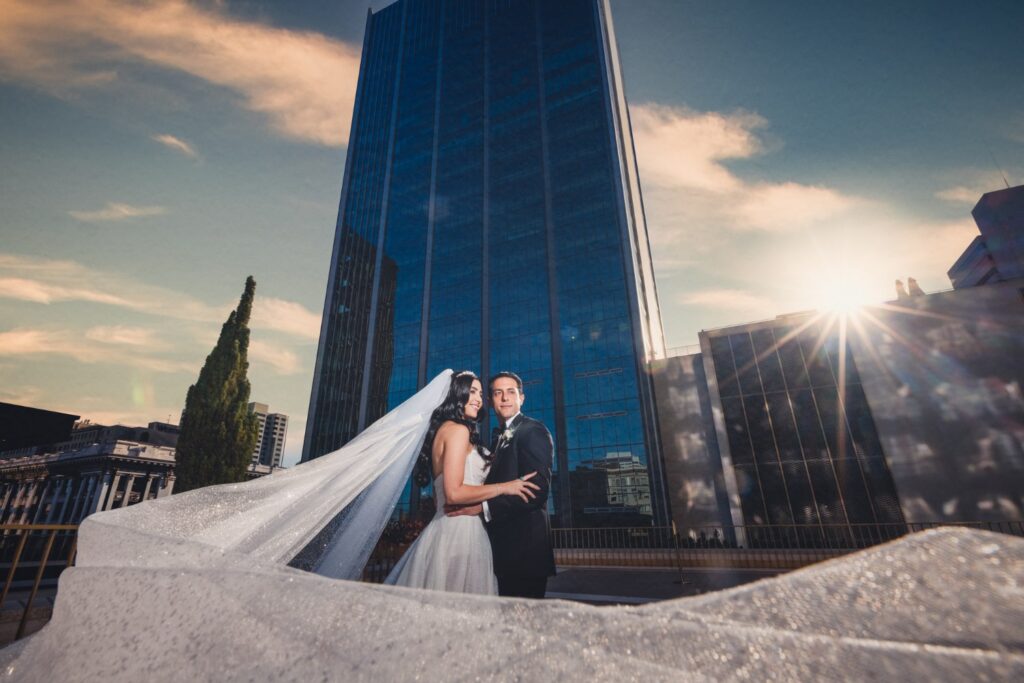
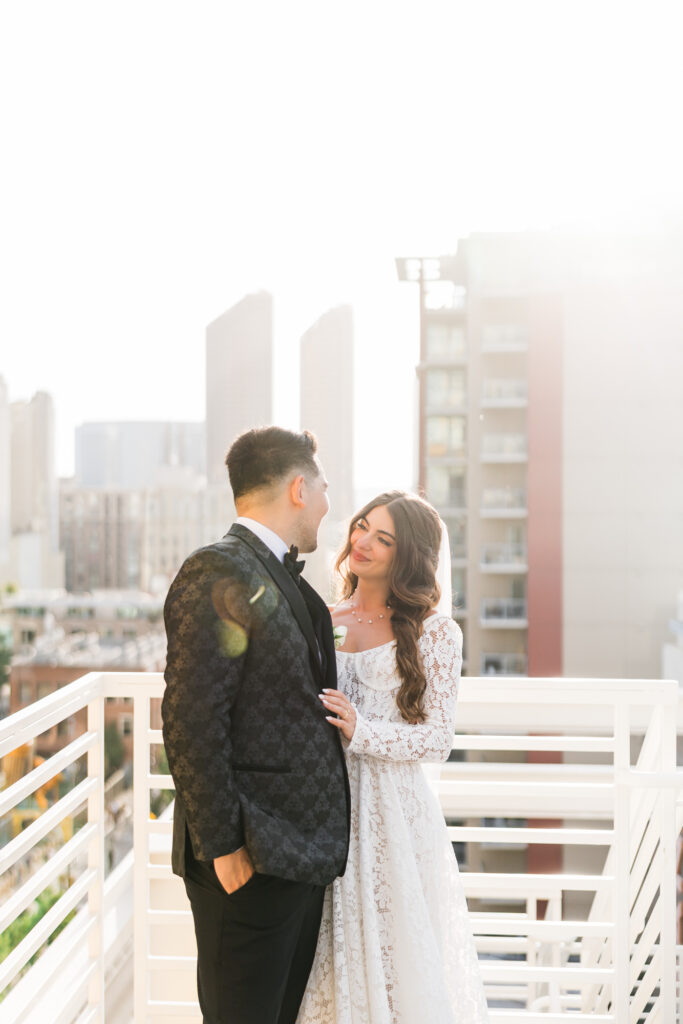
PMC Photography went both ways on San Diego roof decks. The first stops down enough to render a hard starburst off the tower edge, keeps the sky, and uses the veil swept across the foreground to fill the empty bottom third. The second opens up, lets the background haze blow out almost completely, and keeps only enough tone in the buildings to place the couple in a city.
The failure case is the accidental middle, where the sky is half gone and the flare is neither controlled nor committed.
8. Use motion to say “city”
A still frame of an empty street is a picture of an empty street. Movement turns it into a place with a pulse.
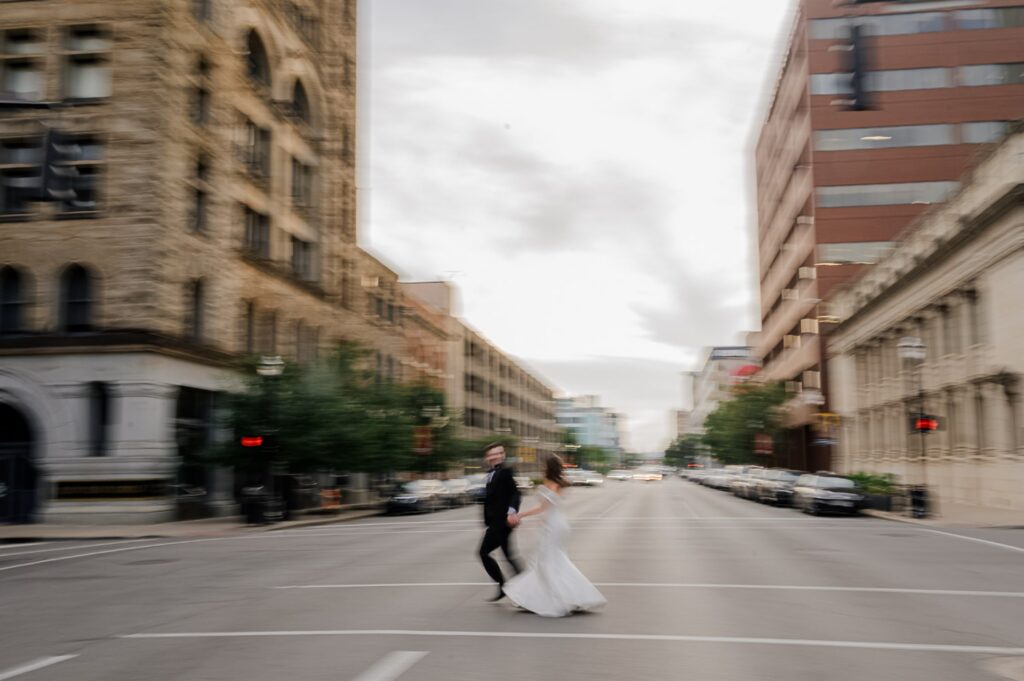
Green Apple Photography walked the couple across an empty downtown intersection and moved the camera through the exposure. The buildings smear radially, the couple stay legible enough to read as two people mid-stride, and the wet road holds the bottom of the frame together.
Start around 1/8 to 1/15, pan or push the zoom during the exposure, and shoot a lot of them. The hit rate is low and it only takes one.
One more thing about city venues
Almost every technique above depends on access: which roof, at what hour, for how long. The photographers who get these frames consistently are the ones who walked the venue first and then asked for twenty minutes at a specific time, rather than hoping for a gap.
See more work from the photographers in this article: Tove Lundquist, Vows and Peaks, Picturist Photography, Stefani Ciotti Photography, NZ Wedding Studio, Green Apple Photography, PMC Photography, Natasha Lamalle Photography, Andy Sidders Photography.