If you are looking to edit videos, there are innumerable options. Unfortunately, most of the good video editors are complicated, expensive, and require a steep learning curve. Then, if you find an easy video editor that is more user-friendly, it’s often just not very good; buggy, clunky, and oversimplified for what you need.
That’s why we’re always happy to review a video editing program that brings together everything we demand from a high-end app, but in an affordable, user-friendly package. And that is why today we’re reviewing the video editor by Movavi!
There’s also a good reason to take a fresh look at Movavi right now. The company has just launched Movavi Video Templates, and they’re a pretty different take on the idea. Most video templates are one fixed piece: you swap in your footage and that’s about it. Movavi’s are built from smaller parts you can rearrange, remove, or add to. The template works around your video instead of the other way around.
The 2027 version also expands Movavi’s set of one-click AI tools. The editor already had AI subtitles, background and noise removal, and motion tracking. Now there’s auto-tracked cropping and AI video denoise too. Like the rest, they’re built around a single click. You pick the tool, and the software takes care of the tedious part.
What does all that add up to? An editor where even a complete beginner can put together a great-looking video quickly, often on the very first try. So whether you’re creating content for YouTube or any social platform, cutting quick vertical clips, or just making a cozy family video, read on…
What Is Movavi Video Editor?
Movavi makes several apps for working with video, images, and other media. Movavi Video Editor is its main desktop editing program for Windows and macOS.
The audience is pretty broad. There are complete beginners, of course, along with YouTubers and social creators, small-business owners, teachers, students, gamers, and people editing family videos. Movavi also targets people who already know their way around a timeline and simply don’t want to spend every project inside a more complicated professional editor.
At its core, the program works the way you’d expect a desktop video editor to work. Bring in your clips, arrange them on a timeline, trim what you don’t need, adjust the picture and sound, add titles or effects, then export the finished video. None of those steps is hard to figure out. More importantly, the tools are set up so your first project can look properly put together, not like a practice run.
Movavi Video Editor 2027 | What Stands Out?
Interface & Ease of Use
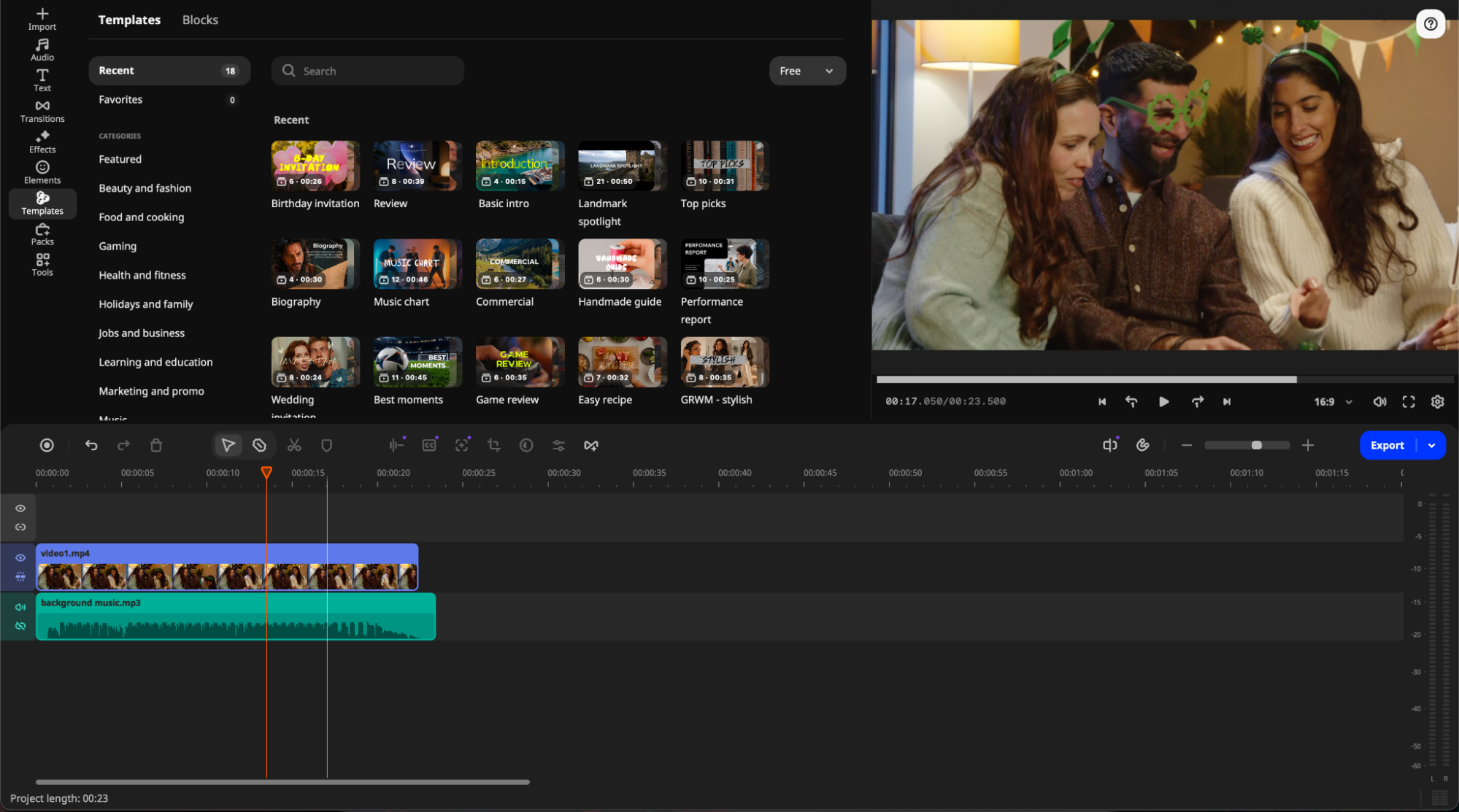
This is one of the first things you notice about Movavi. There’s a timeline, a preview window, your media, and the tools you need to edit it. You don’t have to spend twenty minutes figuring out which workspace you’re supposed to be in. If you’ve edited video anywhere before, most of the interface will make sense pretty quickly. If you haven’t, the basic logic is still easy enough to follow.
If you’re brand new to editing, Movavi gives you little hints along the way too. They pop up inside the editor and help you figure out what to do next, which makes those first few projects a lot less confusing.
Movavi has also kept a lot of everyday actions very direct. You can drag effects and presets onto a clip. Hover over media, transitions, or effects to preview them. Move along the timeline and you can see the frame under the cursor.
There’s a new pre-timeline trimming option too, and we can see this being handy with long source files. Say you recorded a 40-minute interview and only need a two-minute section. You can pull out that section first instead of dropping the whole recording onto your project and cleaning it up there.
It’s a small change compared with the new templates or AI tools. It’s also the kind of change you may end up using constantly.
Editing Tools
The simple interface can make Movavi Video Editor look fairly basic at first glance. There’s more going on once you start opening the different tool panels.
You have frame-level cutting, cropping, speed controls, color correction, titles, transitions, overlays, chroma key, stabilization, animation, audio controls, and the usual collection of filters and presets. Video speed goes up to 100x, so you can turn a long recording into a short time-lapse or speed through parts of a process video.
Color correction is handled in much the same way as the rest of the editor. You can pick a preset if you want a quick result, or go into the manual controls and adjust things yourself.
Is this going to replace the deeper color, audio, or compositing systems in DaVinci Resolve, Premiere Pro, or Final Cut Pro for a professional editor? Probably not. That really isn’t the point of Movavi. For a vlog, product video, tutorial, family movie, social clip, or a typical YouTube project, there’s quite a lot here.
Movavi Video Templates & Blocks
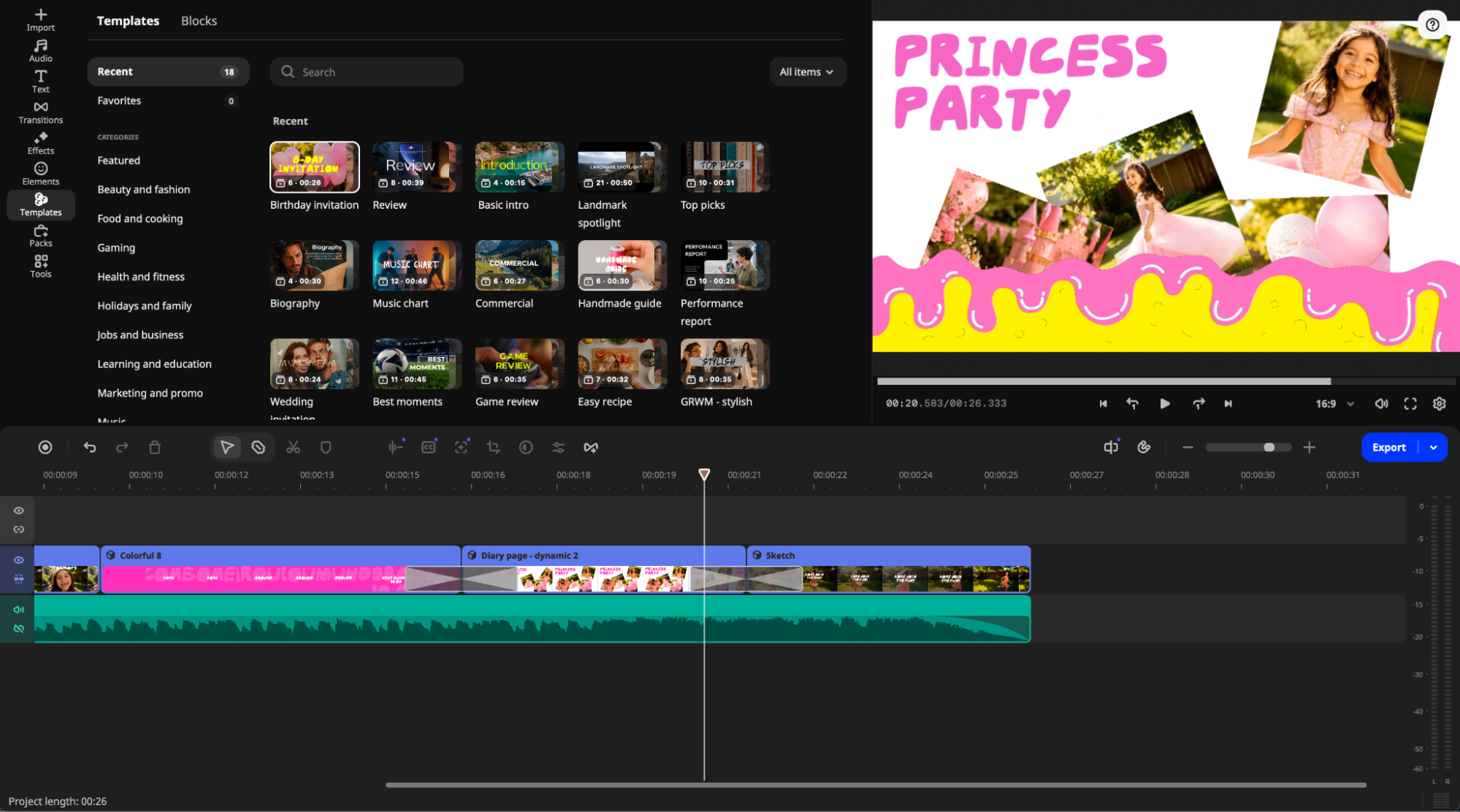
Templates in video software aren’t exactly new. Usually, though, a template is hardly customizable. You get one finished design, drop your clips into the placeholders, and that’s that. Want to shorten the intro, skip a section, or change the order? Most of the time you’re either stuck with what the designer decided, or you end up pulling the whole thing apart on the timeline.
Movavi has rethought how templates work. A Movavi Video Template is a multi-style library of customizable, pro-looking, modular templates for any kind of video. It still comes with the editing, music, transitions, and text already in place, so there’s no setup before you start. The difference is what’s inside. Each template is made of smaller, pre-edited sections called Blocks. A Block might be an intro, a countdown, a short sequence of quick cuts, or an animated collage. You drop in your own clips, photos, and text, and the Block handles the editing for that part of the video.
Because the template is built from separate pieces, you can reshape it however you like. Don’t need one of the Blocks? Delete it. Want the third section to come first? Move it. Need another section? Add one. You can even skip the complete template and put a video together from individual Blocks.
That’s the real difference. A regular template gives you a finished video with your footage in it. A Movavi Video Template gives you a starting structure you can actually shape.
Think about a travel video, for example. You might pick a template that already has an opening sequence, a location card, a few quick-cut sections, a photo collage, and an outro. Replace the sample media with your own footage, move a couple of Blocks around, get rid of the collage if you hate collages, and you already have the bones of the video. You can still go into the timeline afterward and edit things yourself.
That last part matters because a lot of template-driven video tools are appealing right up until you want to change something they didn’t expect you to change. Blocks leave more of the structure open.
For beginners, this is where Movavi really shines. You don’t need to know how to pace an intro or time your cuts to music, because that part is already done. Pick a template, add your footage, and you can have a great-looking video in very little time. As you get more confident, you can start rearranging Blocks and making each video more your own.
The library is sorted by the kind of video you’re making, so finding a starting point is easy. There are categories for vlogs, travel, beauty and fashion, food and cooking, gaming, health and fitness, music, storytelling, and plenty more. Inside, you’ll find templates for the stuff people actually make all the time. Need an intro or a YouTube outro? A slideshow of your vacation photos? A birthday or wedding video? There’s a template for that. The same goes for more practical projects like promo videos, video resumes, portfolios, and infographic-style explainers. There are fun ones too, like breaking-news-style clips and movie-style credits, which are perfect for giving a family video a little extra drama.
Several templates come included with the full version of Movavi Video Editor, and the complete library is available through a Movavi Templates subscription. But more on that below.
AI Tools

AI has been creeping into video editors for a while now. In Movavi Video Editor, it mostly shows up in places where you’d otherwise spend time doing repetitive work by hand, and nearly all of it works in a single click.
There are tools for subtitles, video noise, audio noise, cropping, silence removal, motion tracking, and background removal. Some are new or updated for version 2027, while others have been part of Movavi for years. The nice thing is you don’t need to understand what’s happening under the hood. Even if you’ve never cleaned up audio or reframed a video before, you can get a clean result right away.
Auto Subtitles & Active Word Highlighting
If you make talking-head videos, tutorials, Shorts, or Reels, this is an obvious one.
Movavi Video Editor can listen to the speech in a video and turn it into captions in more than 100 languages, and you can choose among more than 60 caption designs and font styles.
Movavi has also recently added active word highlighting. Words change appearance in time with the speaker, giving you that animated subtitle style you see all over short-form video.
You obviously could create something similar manually, but you probably wouldn’t want to do it word by word for a five-minute video.
AI Video Denoise
This one deals with the picture itself. Shoot in low light and you’ll often end up with grain or other visible noise in the image, particularly with phone footage or older video. Movavi’s AI Video Denoise analyzes the clip and reduces that noise while trying to keep faces, edges, and textures clear.
That gives it a few obvious uses. Night footage, dim indoor clips, old phone videos, and archival footage are all candidates. It’s a one-click tool, which tells you quite a lot about the intended audience. You don’t get buried in technical denoising controls. You apply it and let the software do the processing.
Auto-Tracked Cropping
Ever shoot a horizontal clip and then decide you also want a vertical version?
Cropping the center of the frame is easy enough until the person in the video starts moving around. Then you end up adding adjustments throughout the clip just to keep them on screen.
Auto-tracked cropping handles that movement for you. Movavi Video Editor identifies the main subject and follows it as the video is reframed, including when you turn horizontal footage into a vertical format.
For people who regularly repurpose the same footage for widescreen and vertical platforms, this could save a fair amount of dull editing.
AI Audio Noise Removal
Movavi’s audio noise removal looks for sounds such as traffic, wind, and steady hums, then reduces them while keeping the main voice or other primary audio.
That’s particularly relevant if you’re recording YouTube videos, lessons, interviews, or business content in normal rooms rather than controlled recording spaces. Fans happen. Cars drive past. Someone starts vacuuming in the next room at exactly the wrong moment. Having the cleanup inside the editor means one less reason to move the audio into another app.
Silence Removal
Anyone who has edited a long talking-head video knows how much time can disappear into cutting pauses.
Movavi can find those pauses automatically and remove them. You can also change the pause-length and volume thresholds, so you have some say over what the program treats as silence.
For a tiny video, who cares? You could make those cuts yourself in a minute. For a long tutorial, podcast-style recording, course, or interview, it starts making a lot more sense.
Motion Tracking & Background Removal
The other AI tools are still here too. Motion tracking lets you attach an image, graphic, or another video to something moving in the frame. The software analyzes that movement and keeps the added element attached to it.
AI background removal does pretty much what the name suggests. Give it a video with a person, and it can separate that person from the background so you can replace the scene behind them. No green screen required.
These are more specialized than trimming a clip or adding subtitles, though they open up a lot of options for creator-style videos.
Extras That Make It Even Easier
Movavi Video Editor works perfectly well on its own. Movavi also offers a few extras that make it even easier to create something great. There’s a full library of editable templates, a huge collection of effects and music, and free editing ideas with new ones every week. Here’s how each one fits in.
Movavi Templates Subscription
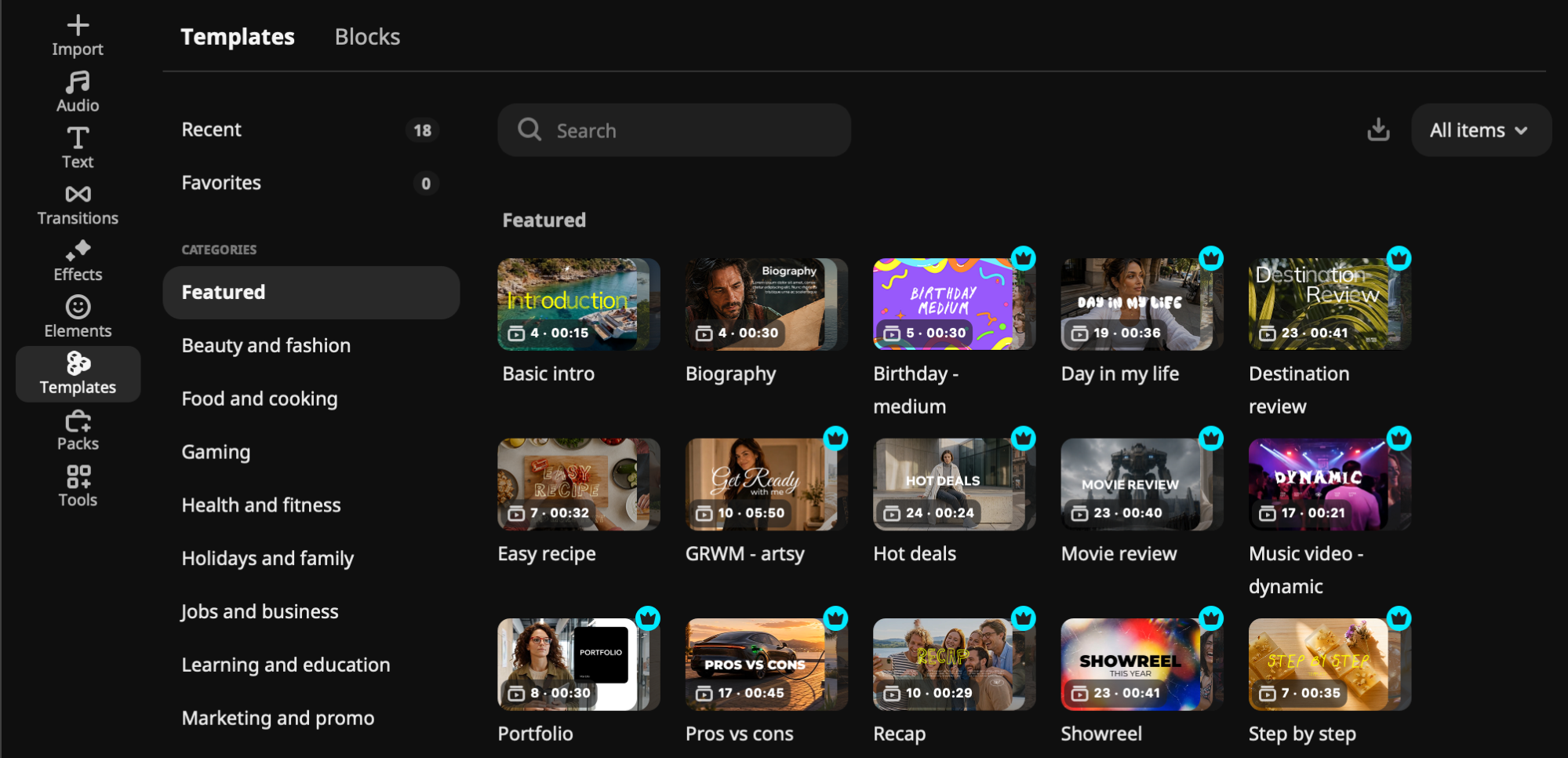
As we’ve mentioned, the full version of Movavi Video Editor includes several templates, which is plenty to get a feel for how they (and Blocks) work. If you find yourself reaching for templates a lot, the Movavi Templates subscription unlocks the entire collection of templates and Blocks.
That gives you themes covering vlogs, business promos, family videos, holidays, and more, all built the same customizable way. Use a template as-is when you’re short on time, or build a video from individual Blocks when you want something that feels more like you.
If you post regularly, this is probably the extra that saves you the most time. You don’t have to figure out how to start each new video from a blank timeline. You pick a structure, drop in your footage, and adjust from there.
Movavi Effects

If you like dressing up your edits, Movavi Video Editor gives you quite a bit to play with. The editor comes with hundreds of titles, transitions, filters, stickers, overlays, and other effects. Many of them have their own settings, so you can adjust them after dropping them onto the timeline. There’s also copyright-free music and sound included, which is handy if you’re posting to YouTube or social media.
Movavi Effects is a separate subscription for when you want more. It has over 10,000 effects and more than 1,500 music tracks, from calm and chill to upbeat and dynamic. The library covers intros, transitions, titles, overlays, stickers, backgrounds, and frames. Themes include blogs, social media, business, family, holidays, education, and plenty of others.
Here’s a detail we really like: you can preview any effect from the collection directly on your own video for free. You can even save a version with a watermark before you buy. So you’re never paying for something only to discover it doesn’t suit your footage.
It’s worth keeping Effects and Templates straight, because they sound similar at first. Movavi Effects gives you individual things to add to a project. Movavi Video Templates can give you the structure of the project itself.
Movavi Ideas
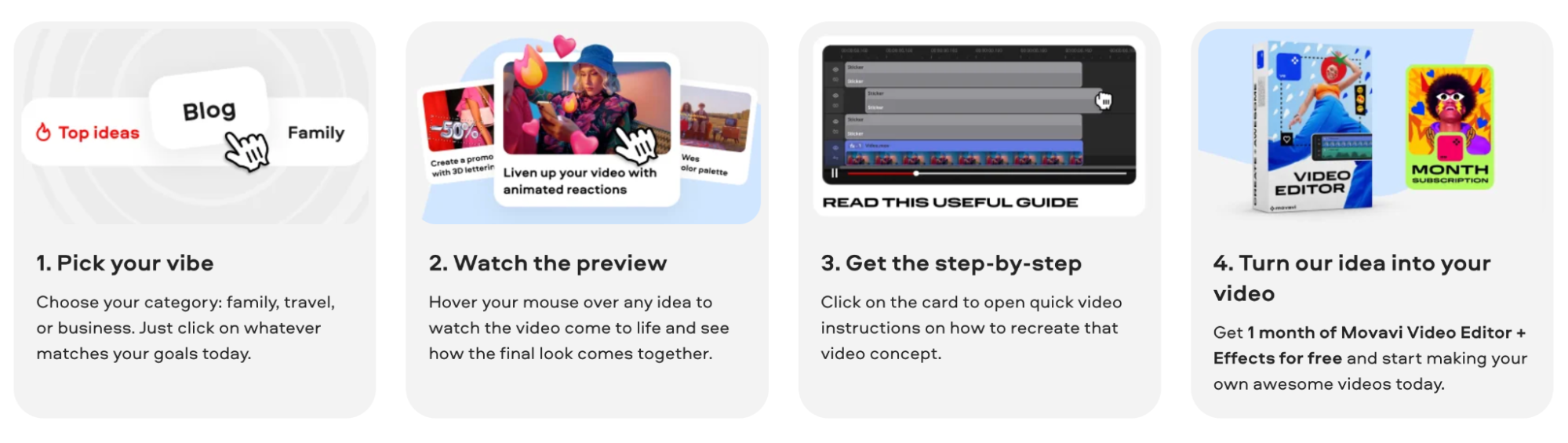
Then there’s Movavi Ideas, and we actually like the concept here. Sometimes you know how to use an editor and still have no clue what you want to do with the video.
Ideas is Movavi’s free collection of short editing tutorials, made specifically for Movavi Video Editor users. Pick an idea, see what the finished effect looks like, then follow the step-by-step instructions to recreate it. Each tutorial takes less than a minute to follow, so it’s the kind of thing you can check right before you start editing.
New ideas are added every week, so there’s always something fresh and on-trend to try, and themes range from vlogs, short vertical clips, and business content to travel, holidays, family videos, and even memes. The current library includes techniques such as jump cuts, countdown timers, split-screen ideas, animated reactions, stylized intros, and various social-video effects.
For beginners especially, this is a great shortcut. You don’t have to guess what makes a video look good. You can follow a proven trick and get an eye-catching result the first time you try it. It feels much closer to browsing for an editing idea than reading a software manual.
Speed & Performance
Besides high-quality results, one of the things that value-oriented software used to be unable to offer was sheer speed and performance. However, we all have an equal interest in saving time, of course! It is important that any application we recommend is powerful, fast, and efficient. Also, we prefer to recommend software that doesn’t require an expensive, high-end computer.
And we can say that Movavi Video Editor is both fast and resource-efficient. Additionally, even when you’re done editing, the export process is also fast, and doesn’t “bog down” your computer very much either.
As for hardware, the current official requirements are fairly modest: 4 GB of RAM as the minimum on Windows and Mac. We’d still want more RAM for regular 4K editing. Minimum requirements tell you whether software can run, but don’t tell you what machine you’d actually enjoy editing on.
System Compatibility & Formats
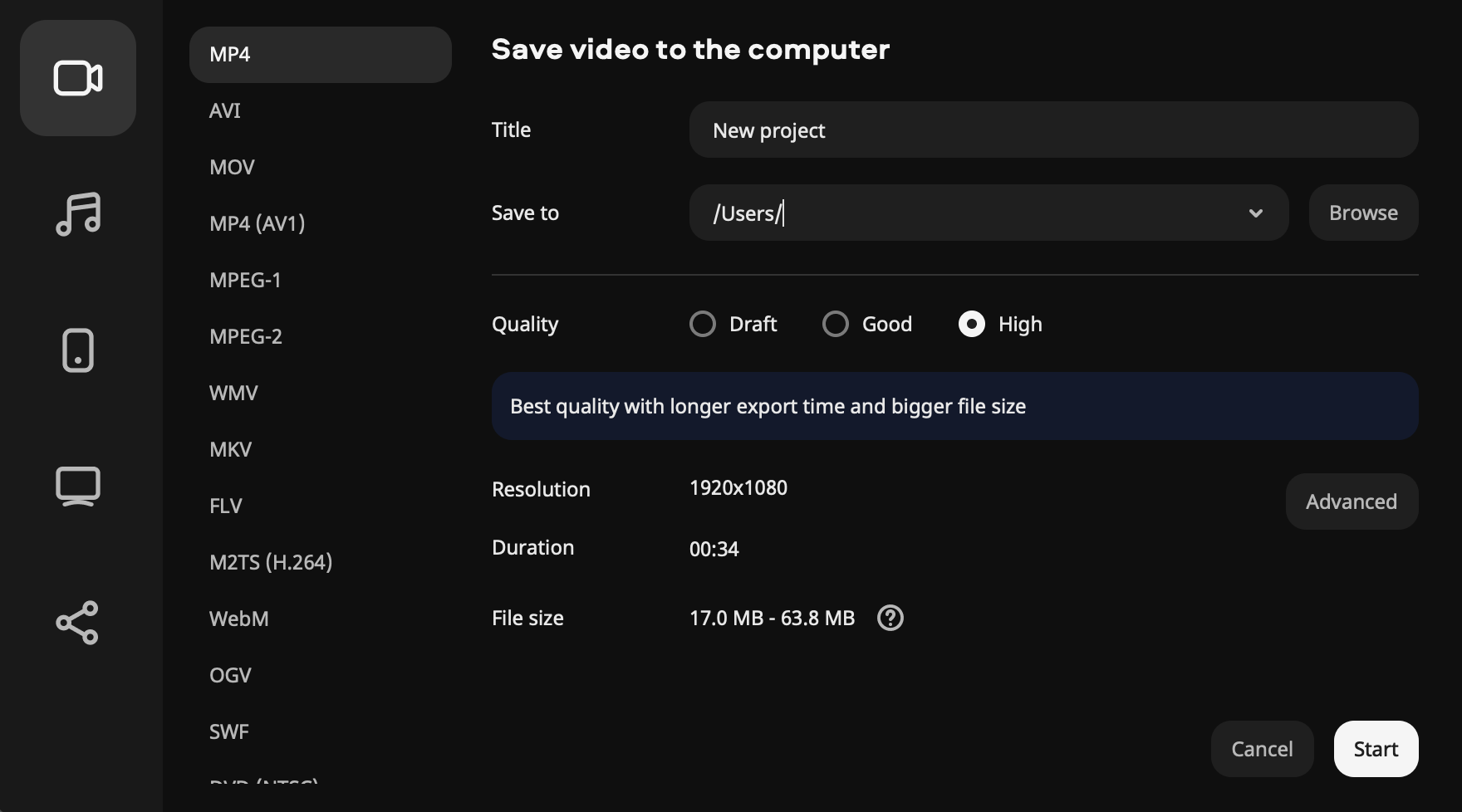
Movavi Video Editor 2027 supports Windows 10 and 11 on 64-bit systems, plus macOS 12.0 and newer. On Mac, there’s also native support for Apple M1 and newer chips.
Common video formats include MP4, MOV, AVI, MKV, and WMV. For audio, there’s MP3, WAV, and FLAC. JPEG, PNG, HEIC, BMP, and static GIF files can be imported as images.
So for the kinds of files most people are likely to bring in from cameras, phones, screen recordings, and downloaded media, you’re covered.
Movavi Packages & Bundles
Movavi Video Editor can be purchased on its own, though Movavi also has larger software bundles for people whose workflow goes beyond editing.
For example, Movavi Video Suite combines video editing with tools for screen recording and media conversion. That makes more sense if you’re regularly recording tutorials, webinars, gaming footage, or your computer screen and then editing those recordings afterward.
What About the Price?
There are several levels to Movavi now, so this takes a little explaining.
The full version of Movavi Video Editor ($19.95/mo or $69.95/yr) gives you the full editor and its AI tools, with regular watermark-free exports and no standard export-length restrictions. Several Movavi Video Templates and effects are included there too.
The complete Movavi Video Templates library is an extra subscription. Movavi Effects is separate as well if you want the much larger effects and music catalog.
There are Free and Lite ($11.95/mo) versions too.
The free version is a great way to see if Movavi is right for you, and it isn’t a trial that runs out after a week. You can use it for as long as you like. It opens the same file formats as the full version, too: MP4, MOV, AVI, MKV, and WMV video, MP3, WAV, and FLAC audio, plus JPEG, PNG, HEIC, BMP, and static GIF images. You get the essential editing tools along with auto subtitles, auto crop, and silence removal, and you can try out every other tool in the app as well.
The catch comes at export. Free exports are capped at 60 seconds, come with a watermark, are saved at lower quality (1080p max), and support fewer codecs. If you use any of the paid features in your project, the export will be restricted. Still, it’s a really easy way to play around, and you can upgrade to the full version whenever you’re ready.
Lite gives you the core editing tools, auto subtitles, auto crop, silence removal, and built-in effects, with a small watermark on exported videos and several advanced tools left out.
One more thing we really appreciate: there are no AI credits to keep track of. A lot of editors now give you a monthly stash of credits and charge you more once you run out. With the full version of Movavi Video Editor, the AI tools are simply yours to use. Auto-subtitle a dozen videos, denoise every clip from last night’s party, crop the same footage five different ways. Go for it. The same goes for the Movavi Templates and Movavi Effects subscriptions. No credits, no counting. As long as your subscription is active, you can use as much of the library as you like.
We actually prefer explaining the product this way rather than throwing one price into the headline. The amount you pay depends quite a bit on which parts of Movavi you want.
If all you need is the editor, you can stick with the editor. If you find yourself constantly using extra effects or templates, those libraries are there to add later.
Who Should Buy Movavi Video Editor?

If you’re choosing a video editor for beginners, Movavi makes a lot of sense as your first one. Much of the hard work of making a video look good is already done for you, so you can end up with a video you’re genuinely happy with pretty quickly, even on your very first project.
You still learn the basics on a normal timeline instead of being pushed into a completely automated workflow. And there’s enough depth there to keep learning once cutting clips and adding transitions starts to feel easy.
It also makes sense for YouTubers and social creators who already understand editing and care more about getting videos finished quickly. Auto subtitles, active word highlighting, silence removal, vertical cropping, background removal, Templates, and Blocks all speak directly to that type of work.
Then you have teachers, students, small businesses, and people editing personal videos. They may never touch motion tracking or chroma key, and that’s fine. The regular trimming, titles, music, color tools, effects, and templates may be everything they use.
Professional editors are a different story. If your projects depend on very detailed color grading, complex compositing, large collaborative workflows, or deep audio work, you’ll probably stay in software such as DaVinci Resolve, Premiere Pro, or Final Cut Pro.
Still, plenty of experienced editors don’t want to open their full professional setup for every 30-second video. Movavi makes sense in that situation.
Movavi Video Editor Pros and Cons
Pros:
- Friendly interface that doesn’t take long to understand
- Proper timeline editing with a broad set of video and audio tools
- Customizable Movavi Video Templates: rearrange, delete, or add Blocks instead of settling for a fixed ready-made edit
- Useful AI tools for subtitles, noise, cropping, background removal, and silence removal to speed up the first part of an edit
- Hundreds of built-in effects
- Windows and macOS support, including Apple Silicon
- Movavi Ideas gives you editing techniques and ideas to try
Cons
- Fewer advanced controls than you get in major professional editors
- No UI customization
- Although hundreds of effects and several templates are available in the full version, additional sets require separate subscriptions
Movavi Video Editor Review | Conclusion
Movavi Video Editor feels very easy to get into, and that’s a big part of its appeal. You can open it, figure out where things are pretty quickly, and start editing. What’s even better is that easy doesn’t mean basic-looking. The new Templates and Blocks give you professionally structured edits you can still reshape however you like, while tools like auto-cropping, denoise, subtitles, and silence removal can take a fair bit of repetitive work off your plate.
If you need deep color grading, complex compositing, or a full professional post-production setup, you’ll probably be happier in Premiere Pro, Final Cut Pro, or DaVinci Resolve. For YouTube videos, social content, tutorials, business videos, and everyday projects, though, Movavi gives you a lot to play with and keeps the whole process pretty painless.
And really, that has always been the appeal of Movavi. You can spend your evening learning your video editor. Or you can edit the video.