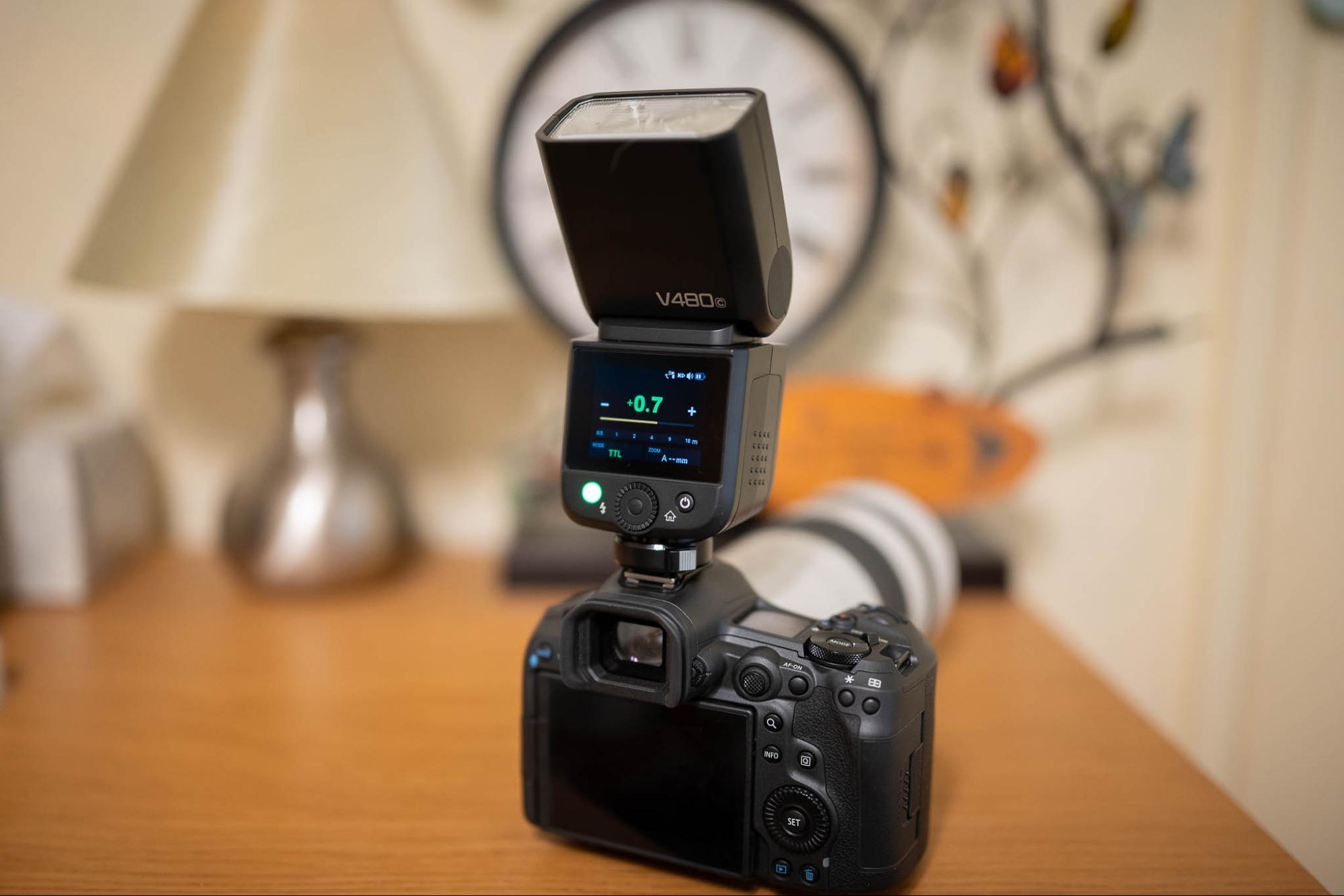
As wedding and portrait photographers, we often face the challenge of finding just the right flash for long, all-day work. Whether you’re documenting a Hindu wedding, or covering any sort of large event, having a reliable on-camera flash makes a huge difference. That is why we are creating this Godox V480 review: This flash is portable, affordable, and it just might be perfect for your line of work!
The Godox V480 is a relatively simple, lightweight on-camera flash, compared to most. It’s portable and affordable, yet it delivers all the core functionality you really need. This includes full TTL, including E-TTL II for Canon’s latest mirrorless cameras. There’s also HSS, and even remote wireless triggering, both as a remote and as an on-camera trigger.
Last but not least, it’s got impressive battery life, solidifying its position as a smart choice for photographers who want a dependable on-camera flash, especially if you’re carrying it all day.
Let’s dive into this review and see where the Godox V480 shines. We’ll compare the advantages against any disadvantages, and we’ll consider a few alternatives that might make sense for other types of professional work.
Godox V480 | Specifications & Features
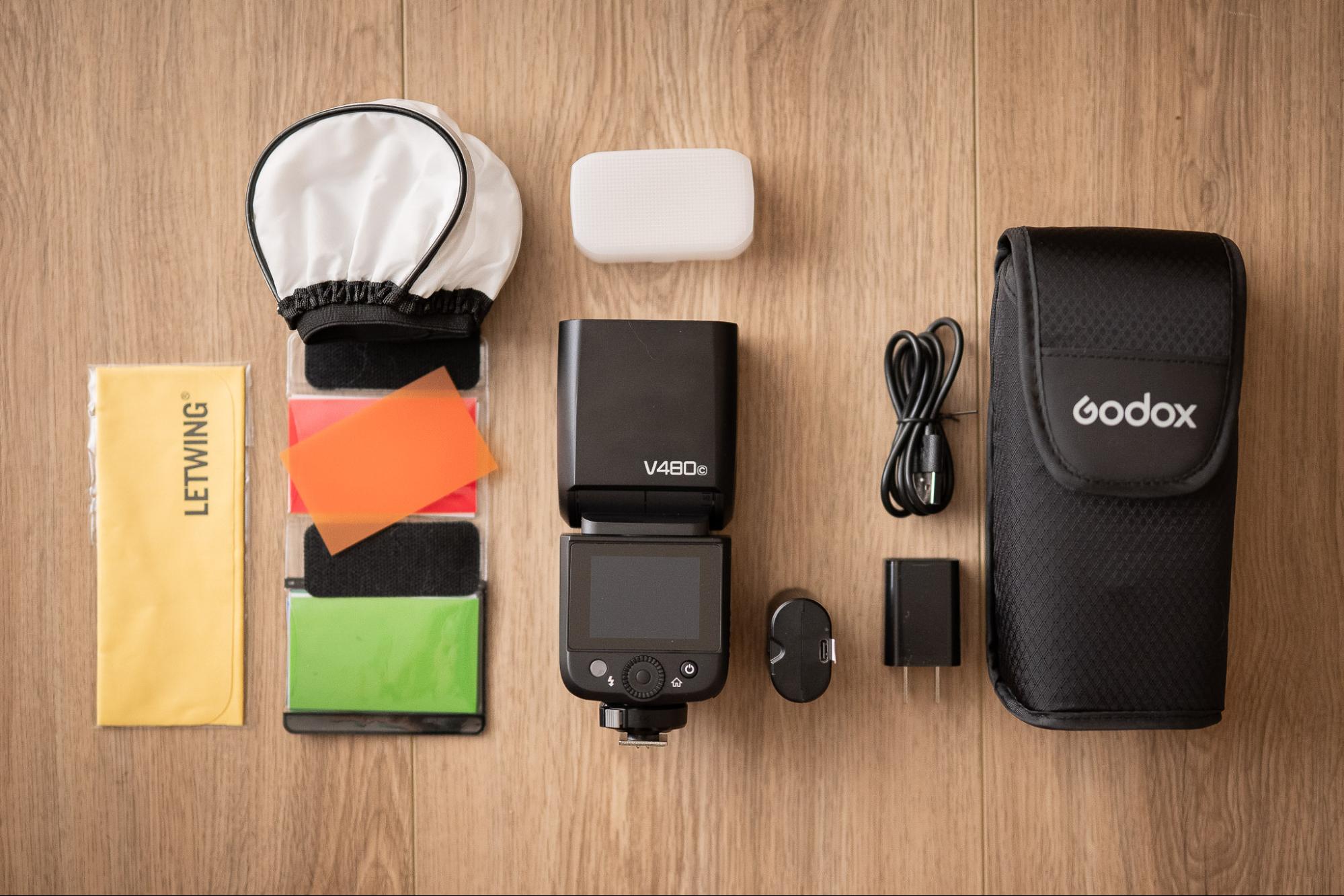
Compatibility: Canon (E-TTL II), Sony, Nikon, Fujifilm, Olympus/Panasonic
Guide Number: 50
Power Levels: 1/1 to 1/256
Power Increments: 0.1 EV
Recycle Time @ Full Power: ~1.7 sec
TTL & HSS: Yes
Modeling Light: 2W LED (adjustable brightness, ~5300K)
Bounce Rotation: -7° to +120° vertical, 330° horizontal
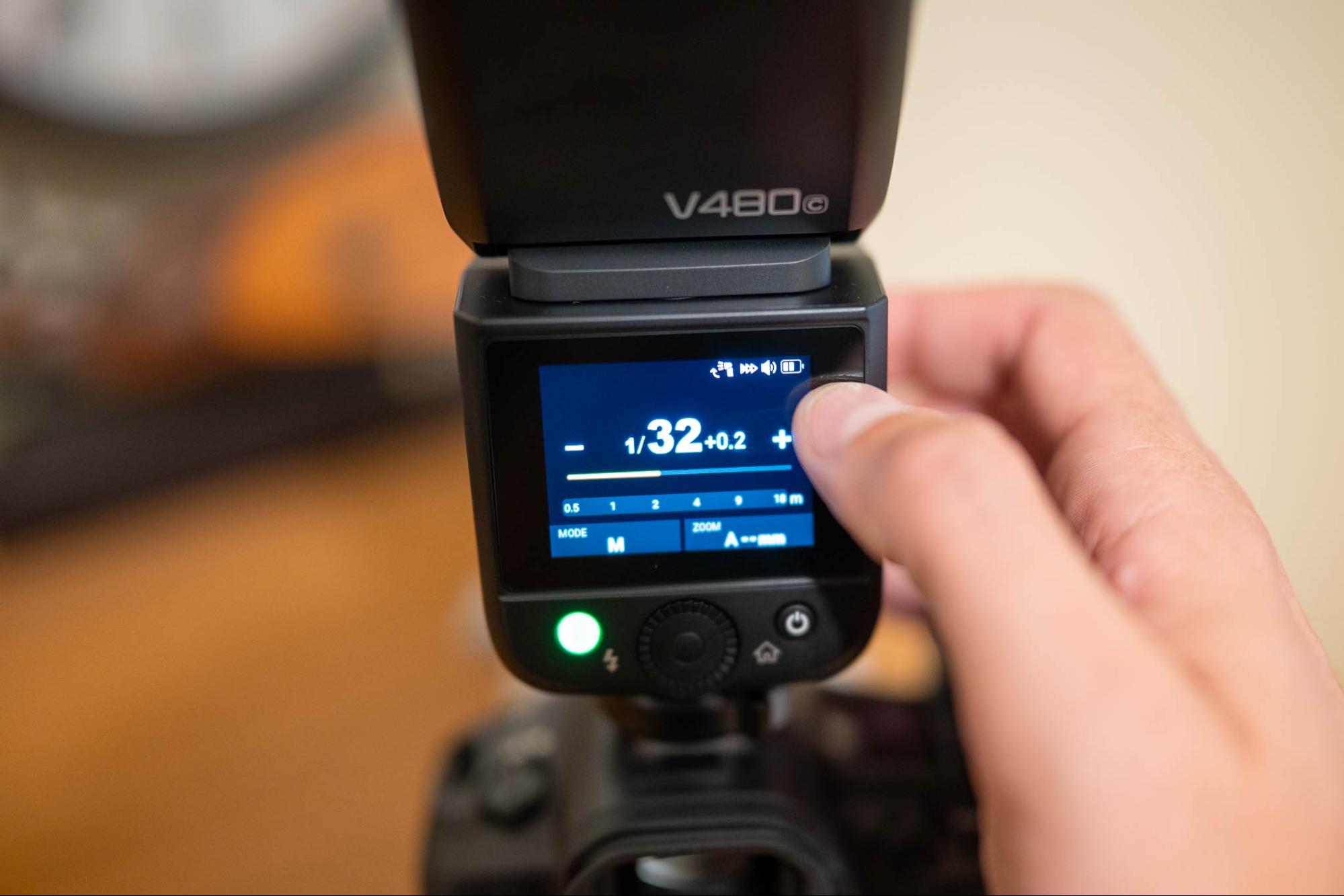
User Interface: 2” touchscreen, 3 buttons & physical dial
Battery Type: 2200 mAh Li-ion, USB-C charging
Battery Life: ~650 full-power flashes
Weight: 12.7 oz / 361g (with battery)
Size: 6.54 x 2.8 x 1.93 in
Wireless Control: 2.4 GHz “X” system
Price – $169.00: Godox V480C | Godox V480S | Godox V480N | Godox V480F | Godox V480O
V480C-Compatible Flash Triggers – $69-$89: Godox XPro-C | Godox XProII-C | Godox X3C
Godox V480 Review | Compact Convenience

What’s most notable about the Godox V480 is just how much it offers in such a small package at such an affordable price. It’s significantly lighter and more compact than “flagship” on-camera flashes such as the Godox V100. While this comes with one drawback, it could make the V480 a dream for photographers who need an all-day on-camera flash.
It gets better, though. Surprisingly, the TTL works very well. That’s not something we say often about third-party flashes, but Godox has clearly refined its TTL performance over the years. The V480 is reliable for both direct and bounced flash usage, making it perfect for fast-paced shooting when you don’t have time to fiddle with manual power settings.
We’ll talk about the overall power & performance next, but suffice it to say that as long as your ceiling isn’t painted a dark color, and/or very high up, you’ll love the V480 every day you use it.
The most surprising thing for me, with such a small flash, was that the V480 offers remote wireless capability. It’s somewhat simplified compared to the most advanced wireless systems, but it certainly gets the job done. If you are used to working with 2-3 total flashes (one on-camera, and one or more off-camera), then you’ll be able to use one V480 on-camera, and the other(s) off-camera. (However, if I am not mistaken, all of the remote flashes will fall under one control group.)
Godox V480 Review | Performance & Limitations
The V480’s performance is dependable across the board. The guide number of 50 is modest, but adequate. The recycle time at full power is right around 1.7 seconds, which is usually fast enough for wedding & portrait scenarios. In real-world working conditions, we found the V480 to be consistent and reliable, even when used heavily.
While it doesn’t boast the staggering 100W output of its big sibling, the Godox V480 delivers more than enough power for most indoor environments, especially when using direct flash for things like wedding receptions. If you’re using basic “bounce” techniques under normal ceiling heights, especially with white or light-toned walls & ceilings, you’ll also be fine.
However, you won’t be totally lighting up a large softbox, or balancing out the midday sun, with just one of these flashes. The V480 is meant to be used for mostly indoor wedding and event work, where it gets the job done just fine. Of course, if you’re doing portraits with a softbox or umbrella and you need more power, you have options: either add another V480 to the same softbox, (there’s lots of adapters for this), or use a dedicated off-camera flash such as a Godox AD100Pro or Godox AD200Pro.
Honestly, this isn’t a limitation of the V480 for me. As a wedding photographer, I’ve always needed 3-4 flashes anyways. I want my on-camera flash to be very lightweight, and I want my off-camera flashes to be powerful. (NOTE: I’m not entirely sure about how cross-compatible all of the wireless flashes are; you might not be able to trigger the AD-series flashes with a V480 on-camera; that might require an X-series trigger. The Godox V480, by the way, is fully compatible with the X-series ecosystem.)
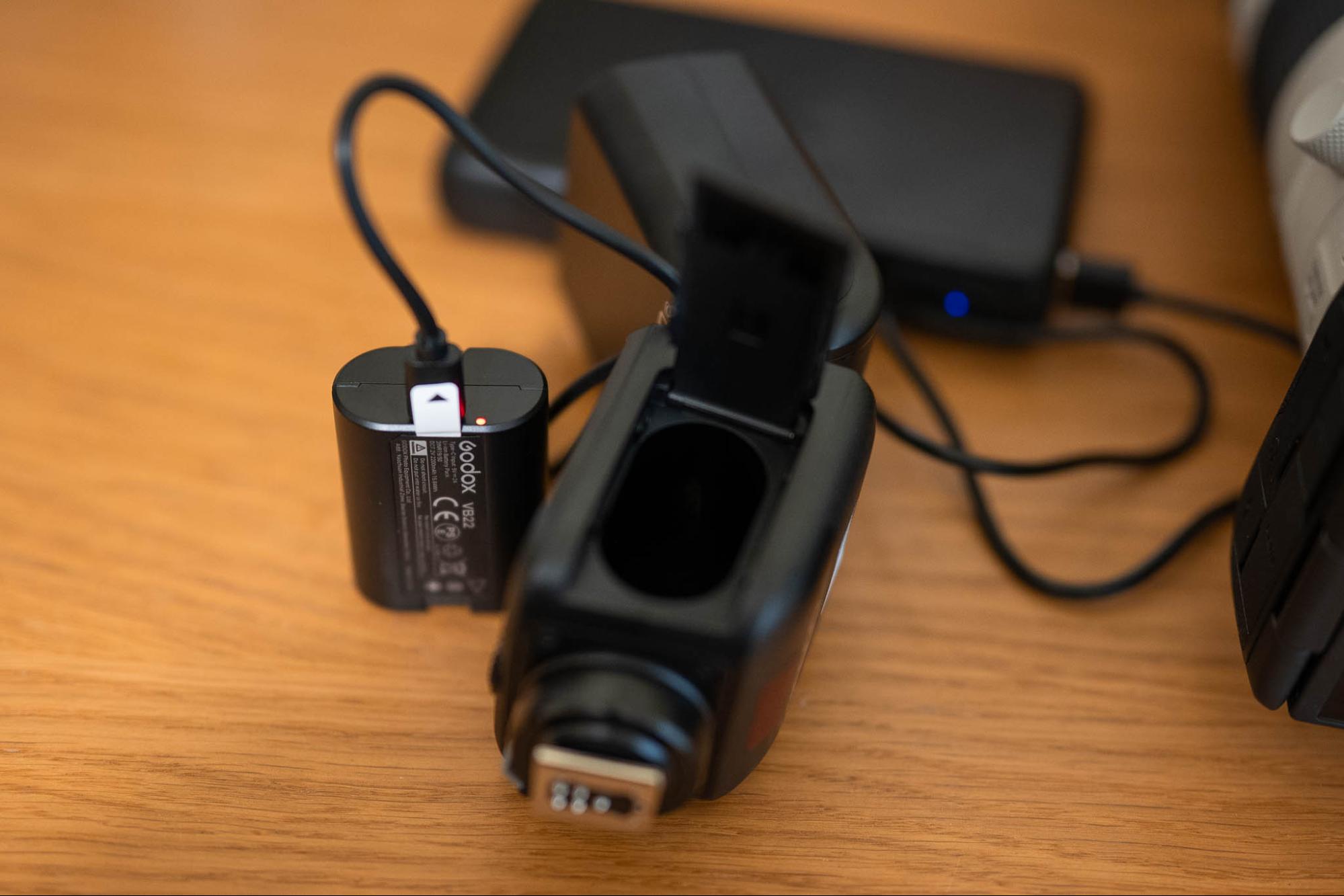
Battery life is another strong point. The capacious 2200 mAh battery gives you around 650 full-power pops on a single charge. Of course, that equates to many more if you’re using a lower output; therefore, just two or three batteries will be more than enough for even your longest days of work. USB-C charging is also a welcome feature; you can carry a 10,000 mAh or 20,000 mAh battery in your camera bag and thus always have a fully-charged flash battery ready to go!
With all of that being said, the V480 does have that high-power output limitation. As I said earlier, if you try to bounce off a very high ceiling, or push light through a modifier like a softbox or umbrella, you’ll quickly find yourself needing to max out the flash at 1/1. This is where it becomes clear that the V480 isn’t meant to replace larger off-camera strobes—it’s meant to complement them as part of a complete lighting setup.
Lastly, while TTL performance on-camera is excellent, the off-camera TTL does seem to slightly underexpose in some scenarios. That’s not a dealbreaker, it’s just something to keep in mind.
Godox V480 Review | Design, Durability, & Features
The build quality of the Godox V480 is just what we expect from recent Godox products: it’s solid, professional, and user-friendly. It doesn’t feel like a budget flash, despite the surprisingly low price.
The bounce head offers one of the most useful features for an indoor event & portrait photographer, which is a rearward bounce capability. This gives you excellent flexibility for bouncing light for perfect portrait & candid lighting; and it’s easy to use, whether you’re shooting in a tight reception hall or a portrait session in a living room.
A built-in LED modeling light is also included. It’s not massively powerful at just 2W, and it’s a fixed forward-facing light. Still, for low-light fill and autofocus assistance, it’s a handy addition.
Physically, the flash is streamlined and intuitive. The buttons feel responsive, the touchscreen display is clear, and navigating settings is straightforward. Personally I’m not the biggest fan of touchscreens in general, but I’m sure that younger photographers are totally used to them.
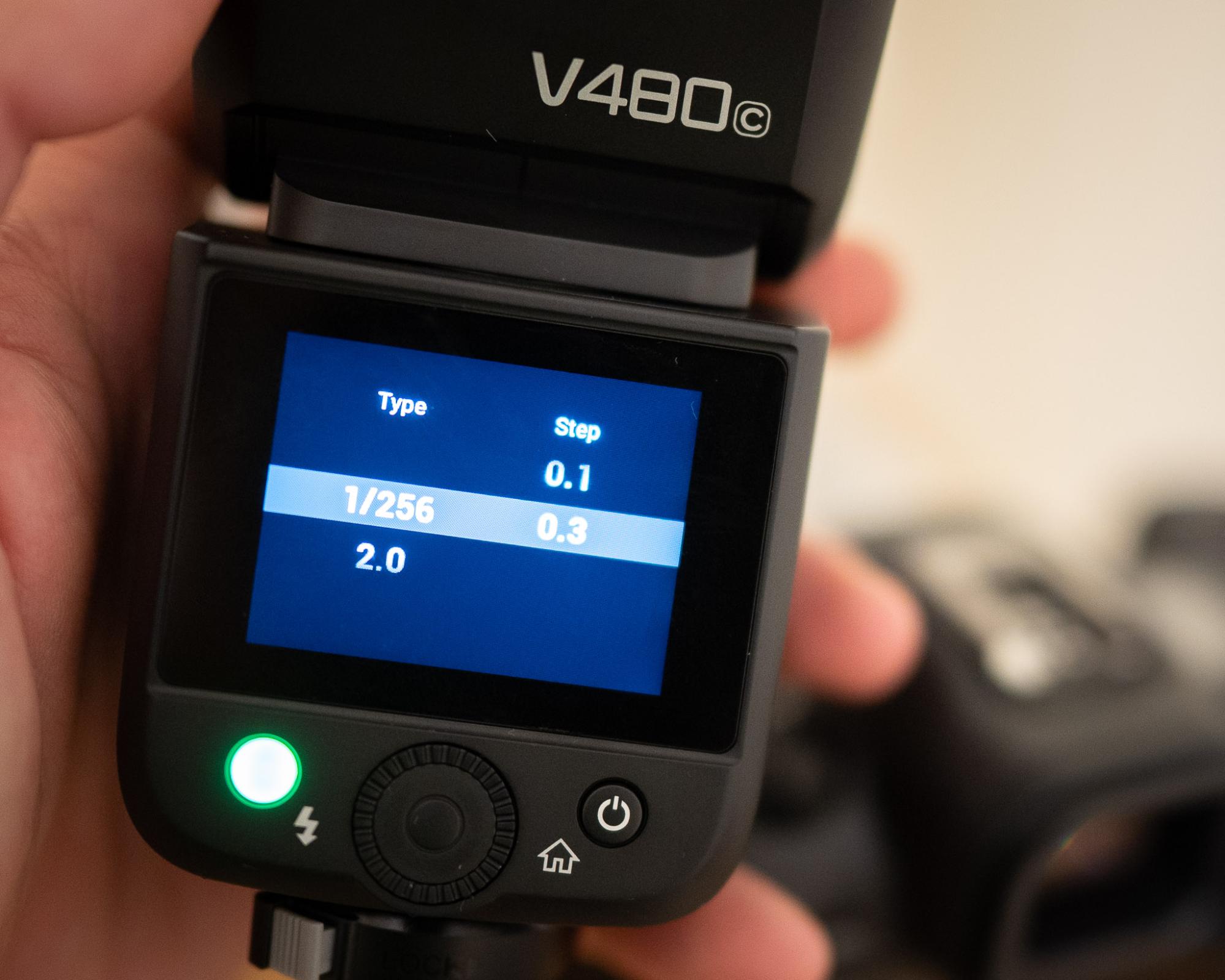
One more feature that I really appreciated is that you can go into the settings and change the increments from 1/10 stops to 1/3 stops; this makes it much easier to dial up/down the flash power when in manual mode. (Of course, if you always use it in TTL mode, the finer increments are optimal!)
Either way, whether you’re a seasoned pro who wants to lighten their hand-holding, or you’re looking for a wise investment in a beginner setup, the V480 won’t throw you any curveballs. It’s simple, reliable, and durable.
Godox V480 Camera Flash Review | Pros & Cons
As with any tool, the V480 comes with its strengths and its trade-offs. Here’s a quick rundown:
Pros
- Incredibly lightweight and compact
- Excellent value at $169
- TTL and HSS that actually work
- Incredible battery life
- USB-C battery charging
- Great bounce articulation
- Wireless 2.4GHz compatibility
Cons
- Not as powerful as high-end flashes (e.g., Godox V100)
- Off-camera TTL can underexpose slightly
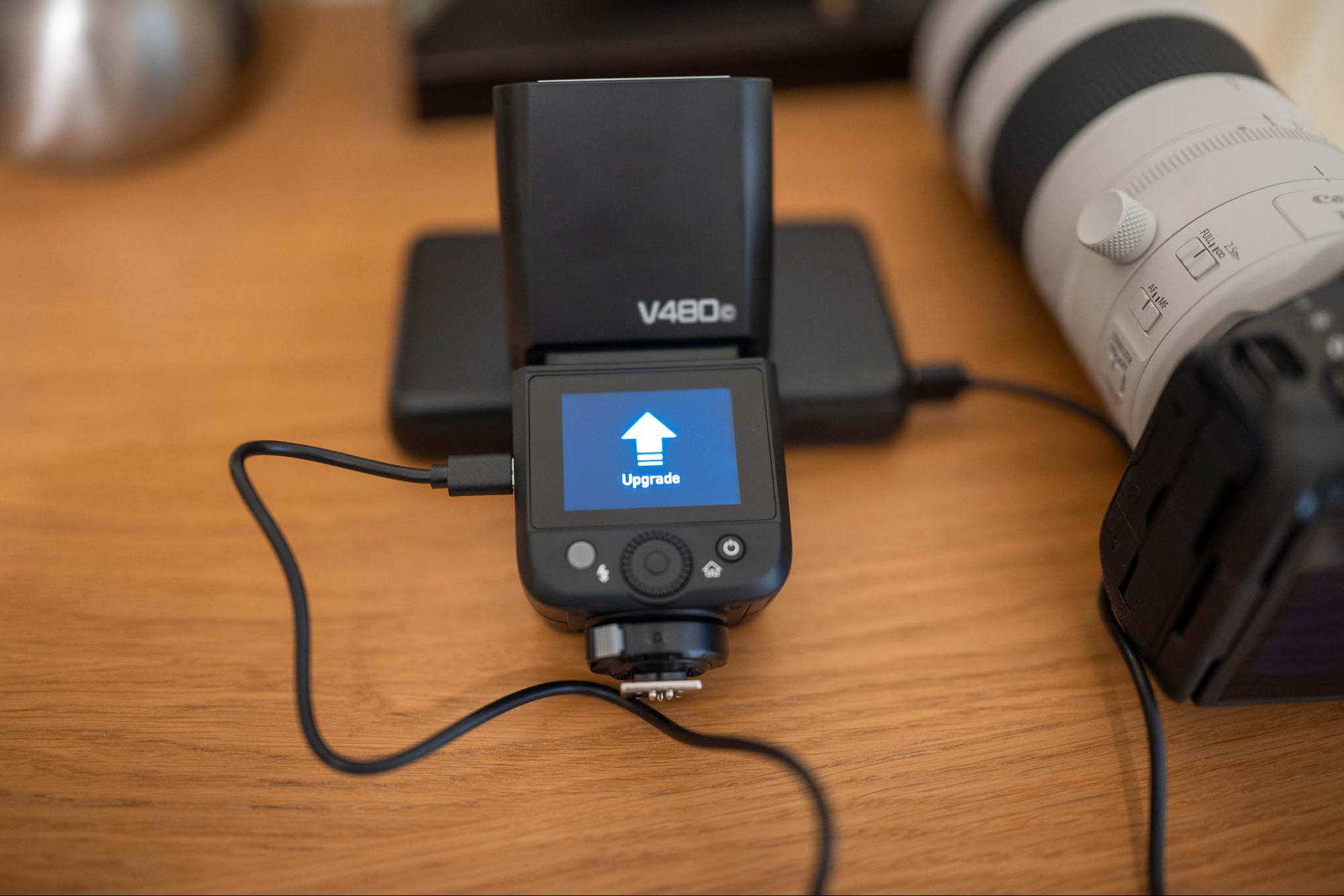
- Battery cannot be charged directly in flash (Without a firmware upgrade?)
Overall, the “pros” are more than enough for me to not think twice about buying a V480, and the “cons” simply aren’t deal-breakers, they’re just natural trade-offs when you demand portability.
Useful Tip: How To Use Bounce Flash
As a wedding & event photographer, one set of features that I demand from all my on-camera flashes is this: Make sure your on-camera flash has both a wide-angle diffuser, and manual flash zoom control (The Godox V480 has both of these features!)
Here’s why: If you’re in extremely close proximity to either your subject and/or the wall/ceiling, you will want to use the wide-angle diffuser when bouncing flash off the nearest wall & ceiling. It spreads out the light much more, and gives you incredibly soft, professional lighting even in constricted areas.
Oppositely, what if the ceiling is rather high up, or the subject is far away? Your flash “bounce” must travel farther, and in this case, I recommend not using the wide-angle diffuser, but instead, setting the flash zoom head to its longest setting, 105mm. This “throws” the light towards the ceiling just a little bit better, thus allowing you to better illuminate across greater distances even with a bounce. At 1/1 power, you’d be surprised at how your compact V480 can light up almost a whole room when you perfect your bouncing technique!
Godox V480 Review | Competitors & Alternatives
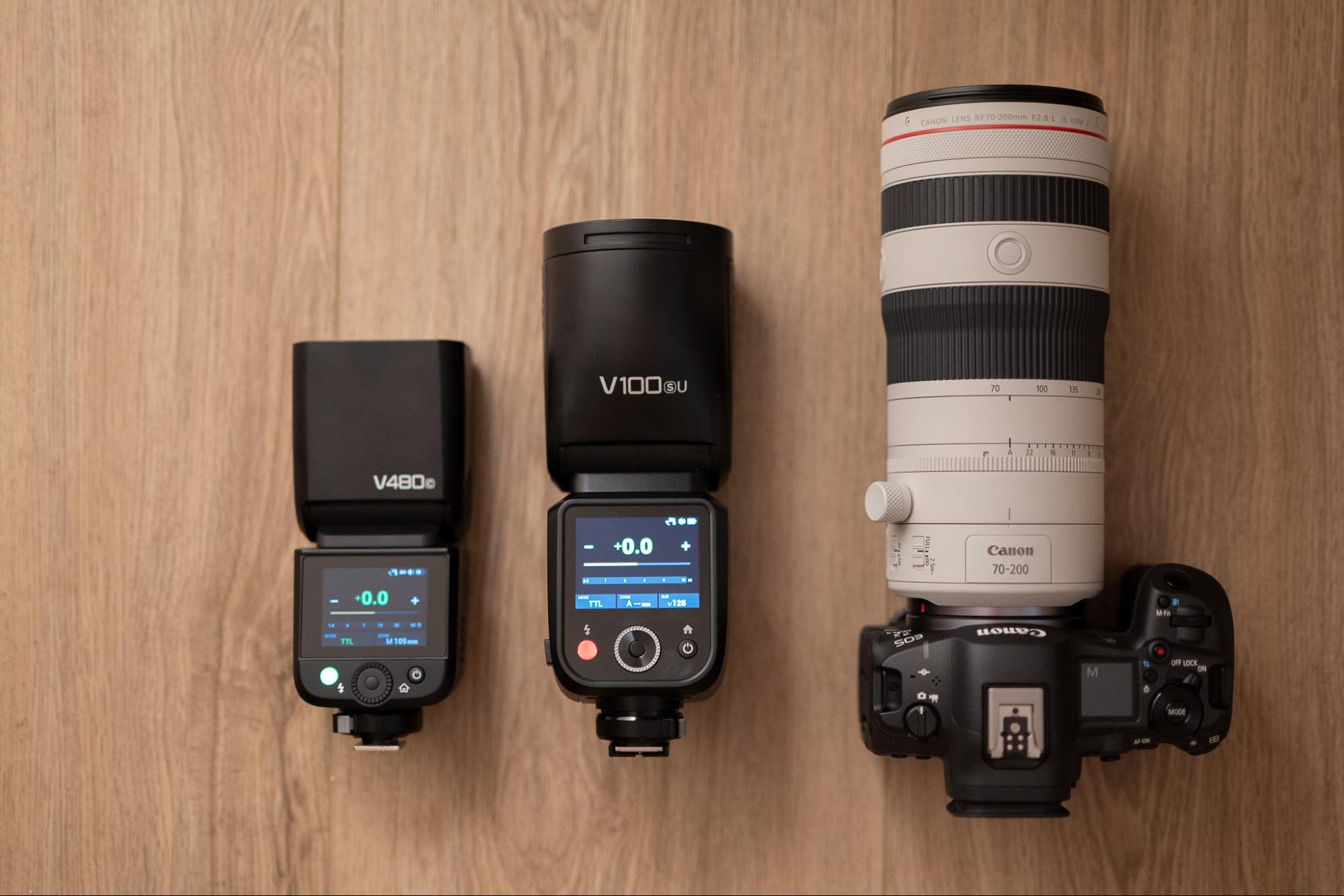
Compared to a Godox V100 or V1Pro, the Godox V480 is clearly designed to be lighter, simpler, and more accessible. It’s clearly not trying to compete with larger studio strobes such as the Godox AD series, either. As I mentioned before, the V480 is a complement to such larger flashes, not a competitor. With that said, it offers a solid foundation for on-camera flash work, with all the essential features and no unnecessary bulk.
Personally, and for any photographer who shoots long-day weddings, candid indoor portraits, or small events—especially indoors—the V480 is just what I’ve always looked for. When my workday is 10+ hours long, I want to be hand-holding a camera, lens, and flash that is as lightweight as possible. This means I’m opting for f/1.8 primes instead of f/1.2, or the more lightweight f/2.8 zooms instead of the flagships. Lastly, of course, it means I’m going to choose the lightweight hotshoe flash too.
If you’re doing advanced off-camera flash setups or working outdoors in bright sunlight, you’ll still want a V100 or an AD200/AD300. Honestly, though, a photographer could also build a kit around two or three V480’s, and get roughly the same total power output.
Godox V480 Hotshoe Flash Review | Final Verdict
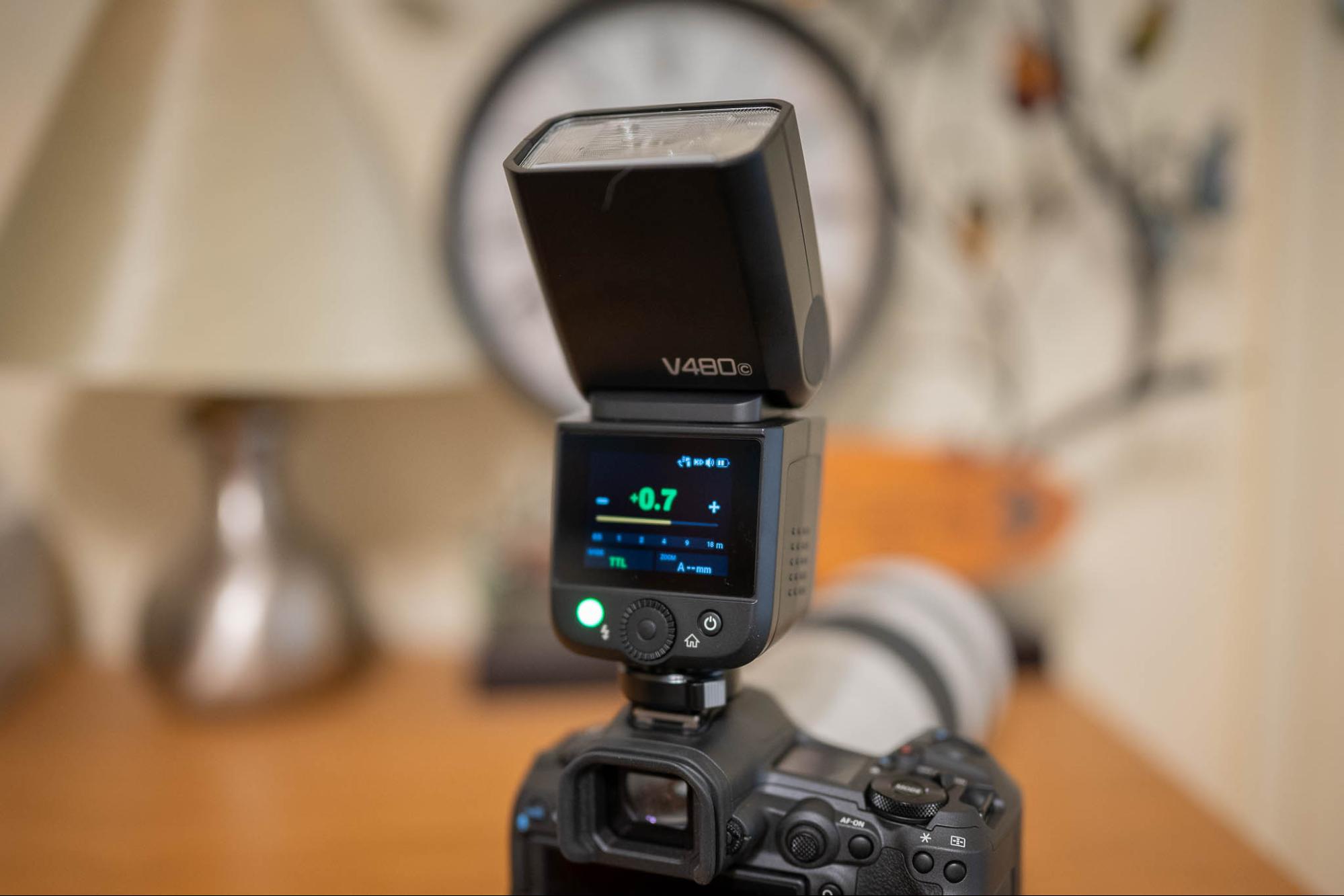
The Godox V480 is one of my favorite “workhorse” flashes that I’ve ever tested. While most on-camera flashes keep going in the direction of bigger, heavier, and more expensive, I’m thrilled with this portable option.
It delivers a rock-solid combination of portability, simplicity, and performance—without breaking the bank.
If you’re a wedding, portrait, or event photographer who needs a simple, reliable on-camera lash that won’t weigh your right wrist down as the hours drag on, this is it! At $169, it’s one of the easiest decisions you’ll make.

So, there you have it. Use the Godox V480 on-camera all day, and maybe add a second one off-camera for some creative lighting. Or, combine it with other flashes to suit your advanced lighting needs! Either way, you’ll be getting a flash that punches well above its size—and one that fits snugly into a pro-level lighting kit.
Available now for Canon, Sony, Nikon, Fujifilm, Olympus & Panasonic.